Search Results
1222 results found with an empty search
- Language…or Logic? | Aletheia Today
< Back Language…or Logic? David Bowles Jul 13, 2026 “Don’t you just hate it when real-physics spoils meta-physics?” 1500 words, 6 minute read Few ideas in Intellectual History remain constant across diverse cultures and through successive eras. One exception? The privileged relationship between Language and Logic. The Old Testament story of the Tower of Babel directly connects our ability to solve physical problems (logic, engineering) with our use of language. In the creation narrative (Genesis 1: 3), “God said , ‘Let there be light’, and there was light.” Across the Bosporus, the father of Western philosophy, Parmenides ( On Nature , 5 th century BCE) also linked speaking with being: “What there is for speaking and knowing, there is for being.” (Fragment 6) . Apparently, physis (being) and logos (language) are two sides of one coin on both sides of the Strait. 500 years later, the Apostle John retold the creation story from the Christian perspective, incorporating material from the Old Testament and from the Pre-Socratics, resulting in an even heavier emphasis on the linguistic component: “In the beginning ( arche ) was the Word ( logos )…through whom all things were made and without whom nothing came to be. In him ( logos ) was life and that life was the Light of the world.” (John 1: 1 – 4) Now fast forward a few millennia and see various schools of North Atlantic Analytic Philosophy, from Logical Positivism through Deconstruction, attempting to ‘reduce’ philosophy to linguistics once and for all. Do names like Ayer, Wittgenstein, Austin, Derrida and Chomsky ring any bells? But it’s all for naught! (Don’t you just hate it when real-physics spoils meta-physics?) A recent study conducted at MIT's McGovern Institute for Brain Research concludes that “language isn't necessary for logical reasoning.” Wow! That’s 2500 years we’ll never get back! Our ability to induce from experience and deduce from assumptions is neurologically unrelated to our ability to use language. Brain imaging shows that language-processing parts of the brain are not involved in logical reasoning. In research published in the journal PNAS , and reported by Medical Xpress (July 9, 2026), researchers led by MIT associate professor of brain and cognitive sciences Evelina Fedorenko showed that people can perform well on tasks that require logical reasoning even if their language abilities are severely impaired. Researchers presented participants with challenges involving geometric shapes, numerical sequences, etc. As participants solved increasingly difficult puzzles, it became clear that people don't need language for this kind of reasoning. Patients with language impairments solved the problems as well as the ‘verbo-typical’ control group. The MRI scans showed the brain's language system was not engaged for either inductive reasoning (when participants identified hidden rules) or deductive reasoning (when they assessed the validity of syllogistic arguments). How come? Why don’t the language and logic functions converge, or at least overlap, neurologically? For one thing, language is naturally, and probably necessarily, fuzzy . Wittgenstein (above) spoke of word meanings as familial relationships . We’ve all experienced frustration when talking with someone whose speech is unwaveringly literal. Logic, on the other hand, is inherently precise. Much blood has been shed, figuratively and literally, because someone applied rigorous logic to an imprecisely defined concept (language). Plus, language is multifunctional. It can ‘compare thee to a summer’s day’, it can talk you through an IKEA assembly maze, and it can inspire soldiers at Agincourt. Logic is, well, more logical. Finally, most languages are linear in structure, progressing one word at a time, whereas evaluating available information to reach logical conclusions often requires thinking along several tracks at once, connecting those tracks via reciprocity and recursion. The closest thing we have to that in English is the work of James Joyce, especially Ulysses and Finnegans Wake . In these ‘novels’ the narrative follows multiple story lines simultaneously: Leopold and Stephen in Dublin, Ulysses and Telemachus in Ithica, King Hamlet’s ghost and the Prince in Denmark, YHWH and his Christ in Roman Catholic Liturgy. As in polyphonic music, each line maintains its integrity but harmonizes with others. These extraordinary works are to the rest of literature as Beethoven is to Gregorian Chant…or as today’s quantum computers are to their analog ancestors. In truth, Ulysses and Finnegans Wake are exceptions that prove the rule. They demonstrate both the limitations and the potential of linear language foe modeling non-linear reality. When we approach the whole with language, we necessarily break the entirety into a sequence of stages (so-called causes and effects); we think horizontally. By contrast, Logic is threadbare; but it is also inherently holistic and recursive. We conceptualize our problem as a whole and then break it down into discrete modules, each modifying and being modified by the whole. We reason vertically. We trust that we can gain information about the whole by understanding its self-similar parts ( aka fractals). Because I know that 1 + 1 = 2, I can calculate x + y for any values of x and y. *** "(This research) really upends a(ny) theory that says that symbolic rule induction is not possible without linguistic capacities." Yes, it does…and it upends more besides. For example, I no longer have any reason to assume that my poor pussy cat, who struggles mightily but unsuccessfully to participate in family conversations, is any less conscious than I am (and perhaps even more so after I’ve had a couple of bone dry martinis). Fedorenko’s team has provided a major boost to advocates of panpsychism and/or animal rights. On the other hand, the implications for AI are less sanguine. Large language models like ChatGPT and Claude are trained entirely on text and use text as their output—yet they convincingly simulate some kinds of human reasoning (Turing, Searle). My LLM bot, for all its apparent genius, relies exclusively on language to reach logical conclusions. Knowing that, it is hard to assign any logical validity to its output. Is this the greatest con job in history? Like many a fast talker I’ve known (and one I’ve caught sight of in a mirror), does Claude use language facility to mask logical inadequacy? Does he have a career in politics in mind? Earlier we smirked that physics was overturning metaphysics; could it also be said that rhetoric (LLM) is overturning logic? Or is it just possible that at the performance extremes achieved by today’s AI, horizonal reasoning (language) genuinely reproduces the results of vertical reasoning (logic). If so, can we treat that confluence as significant or must we consider it mere coincidence? I am reminded of Aristophanes’ Clouds . In this play, the students in Socrates’ Thinkery are trained to apply logic to nonsense…with predictably hilarious results. Are today’s LLMs extensions of Socrates’ academy? Could it be that Kitty is conscious and Claude is not? And what of Turing’s Test ? And Searle’s Room ? These philosophical paradigms draw their power from an assumed relationship between Logic (reasoning) and Language (communication). But what if there is no such relationship? *** “What if there is no such relationship?” What if? There is none! (assuming we trust the research of course) So now what? What can we say we know? And how do we live? Imagine a triangle. Label the apex R for Reality. Label the base points L1 and L2 (L1 is Language, L2 Logic). This figure lies, unrecognized of course, at the foundation of all of our conceptions of the World; no more! R ↙ ↘ L1 ↔ L2 We have concluded (above) that Language and Logic provide irreconcilable accounts of Reality; our triangle is inherently unstable. That leaves us with a choice of three possible models: (1) The world of Lewis Carroll ( Alice and her Lookingglass ): Language but no Logic. (2) The world of Jacques Ellul ( Propaganda ) and George Orwell ( 1984 ): Language and Logic but no Reality. (3) The world of Samuel Beckett and Eugene Ionesco: Logic and Reality but no Language. (Of course, all three employ language masterfully in their works but it has no agentic force, it does not advance the narrative, its function is subservient to Logic and Reality.) Hold up! If there are three models of the World that fit the data with equal fidelity, don’t we have to conclude that ALL of them are true? Yes indeed, we do! No single model of the World that includes Logic, Language and Reality can be stable; but no model can be complete without all three. So, we must accept that we live in a world of wave-particle duality, of quantum complementarity, of Feynman’s Sum over Histories, or Bell’s entanglement. No single model can account for the World as it is but multiple models, applied separately but simultaneously, just might; but you’ll have to stay on your toes to make sure that they never meet. And they say Atlas had a tough job. Previous Share Next Do you like what you just read and want to read more Thoughts? Subscribe today for free! Thoughts While Shaving - the official blog of Aletheia Today Magazine. Click here.
- Do Nebulae Think? | Aletheia Today
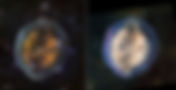
< Back Do Nebulae Think? David Cowles May 17, 2026 “If nebulae do think they, if they are conscious, we may assume that they integrate information…across light years.” 1300 words, 6 minute read In 1974 Thomas Nagel earned himself a permanent position in the Intellectual Pantheon of the Western World. His signature essay, What’s it like to be a Bat , catalyzed the Search for Intelligent Life on Earth (SILE): “There is something that it is like to be a bat…what it is like for a bat to be a bat…because we know what it is like to be us.” (Do we really?) At least in the Judeo-Christian West, folks have long imagined themselves ‘little less than angels’. (Psalms 8: 5, Heb. 2: 7 – 9) Prior to Darwin, any suggestion that we were more Gorilla than Gabriel would have been considered preposterous. And prior to Nagel, extending monikers like ‘conscious, intelligent, sentient’ to non-human life forms was a non-starter. Besides, we were occupied with more serious questions: Should we extend these monikers to women, to children, to members of other races, other ethnic groups, other nationalities, other age cohorts, other political parties, other social castes? Heady stuff! I’m pleased to report that we’ve made uncharacteristically significant progress in these areas over the half-century since Nagel, and there is now something approaching consensus that even certain non-human life forms are intelligent and conscious. Primates and Sea Mammals make almost everyone’s list. Corvids (ravens, parrots, crows), Cephalopoda (octopus), and Pachyderms (elephants) show up frequently as well. They know what they know, and they know that they know it, and they project similar self-awareness onto others in their community (so-called ‘other minds’). There is even serious conversation now about the mental status and intellectual life of forests, plants, fungi, and…wait for it…unicellular organisms. The average adult human body consists of about 30 trillion of these little critters – we call them ‘cells’ - working together to promote the survival (and fecundity) of a single host: You! Researchers at Carnegie Mellon University have recently shown that bacteria (prokaryotes) can learn from past experiences, store memories and access those memories when deciding future behavior. Snooze fest? Ok then, how about this? They can pass these memories on to future generations - something we can only approximate via our elaborate cultural superstructure. And they can use remembered experience when imagining and evaluating novel responses to changes in their environment. Did I mention, they do all this without a nucleus, much less a brain or nervous system? *** Phenotypically, life on Earth could not be more varied - from figs to ferns, bats to bacteria, cabbages to kings. But structurally, behaviorally, even morphologically, all life on Earth is remarkably similar. Birds fly, so do bats, so do bugs, and so do we (thanks to our technology). Different structures support similar functions. For example, many animals have a sense of sight but the organ of sight, the eye, has evolved many times, independently and differently, across multiple species. Apparently being able to see is a useful trait. At the same time, similar structures enable different functions. For example, fish have gills for breathing, but we use ‘their’ gills for hearing. Gills and ears have the same structure but very different functions. Evolution, the wellspring of biodiversity, is also convergent: several organisms from different limbs on the tree of life may evolve similar traits/structures via radically different pathways. The features in question confer survival (reproductive) advantage across phyla and a variety of unrelated structures can serve as ground zero for their development. Plus every member of every species now living on Earth is descended from a single DNA molecule synthesized about 4 billion years ago. How’s that for bio-similarity? So on the one hand, no two cells are identical (mutation, epigenesis) but on the other hand, all cells are clones of a single aboriginal cell. Can we find similarly homologous structures in the inanimate world as well? *** No self-respecting 6 th grade geek has failed to notice similarities in the structure of atoms, a fundamental unit of physics, and that of eukaryotic cells, a fundamental unit of biology. “Nucleus & Electrons, meet Nucleus & Mitochondria” - not bad for the first day of middle school. Our cognitive lenses seem to work better as a microscope than as a telescope. We can detect congruent patterns in regions of the cosmos twenty orders of magnitude smaller than us, and we are not shy about attributing common functions to such congruent structures. For example, recent studies reinforce our conviction that bacteria have functioning memories, learn from experience, and calculate behavioral strategies. But we are less apt to recognize structural congruence on larger scales, and we are much less willing to posit homologous function on that scale. The same structure we noticed in atoms and eucaryotic cells appears in solar systems, galaxies, and galactic sheets. At the highest level of generality, the network of galaxies in the universe forms a pattern eerily similar to the network of neurons in the human brain (nodes and filaments). A recent photo taken by the JWST of Nebula PMR 1 (left image, above), stretching more than 5 light years across and located some 5,000 light-years from Earth, reveals a structure similar to that in an MRI (right image) of an unremarkable human brain. Note especially (1) the inner concentration of structural elements protected by an outer membrane, and (2) a division of those elements into two hemispheres, separated by a longitudinal fissure. Co-incidence? Sure. An example of the self-similar organization of the cosmos? That too! According to the popular holographic model of cosmology, the universe is self-similar across all scales, so we will not be surprised if it turns out that the Cosmos is similar to the Quantum. *** Consciousness is strongly associated with patterning: Consciousness seems to be emergent in entities with certain structural similarities, and it consists of the patterns it discovers. (There is a strong argument that we are only conscious of patterns; true one-offs go unregistered.) Finally, consciousness appears to impose its own patterns when confronted with random sensory input: “Rows and flows of angel hair and ice cream castles in the air…It’s clouds Illusions (patterns) I recall, I really don’t know clouds at all.” (Joni Mitchell) Patterns are often self-similar across scales and across various material substrates. To bastardize Stephen Hawking, et al., “it’s patterns all the way down”. Perhaps a more useful phrasing would be, “it’s patterns discovering patterns,” suggesting that the propensity to form patterns ( logoi ), may be substructural, applying equally to the percipient and to the perceived. There is growing unease among biologists re the shortcomings of the Neo-Darwinian framework. Epigenetic effects are not only real but critical for the evolution of cells and, contrary to long held beliefs, epigenetic modifications can be inherited. The ‘sins’ of the father (and mother) are indeed visited on future generations. Further, it is increasingly clear that the central assumption of Neo-Darwinism, that mutations occur randomly and that natural selection simply operates to conserve the most adaptive variations, is wrong. It is virtually certain that cells control gene expression by the decisions and choices they make . Likely, all cells are sentient and self-aware and capable of decision-making and problem-solving at some level. These cellular faculties rely on information integrated across the entire cell. Consciousness seems unrelated to the volume of information. Instead it is a function of, and a driving force for, information integration and so ‘interconnectedness’ becomes the measure of consciousness. If nebulae do think, if they are conscious, we may assume that they integrate information, not across nanometers but across light years. So are the patterns of celestial objects in Nebula PMR 1 and neurons in our skulls sufficiently similar to allow both to support consciousness ? Has PMR 1 discovered the meaning of life? Share, please! Previous Share Next Do you like what you just read and want to read more Thoughts? Subscribe today for free! Thoughts While Shaving - the official blog of Aletheia Today Magazine. Click here.
- Expunge me, Expunge me Not | Aletheia Today
< Back Expunge me, Expunge me Not David Cowles Jun 26, 2026 “Next time your little one asks, ‘Daddy, are there monsters under my bed?’ Reassure her: ‘Yes there are, thank God!” 2250 words, 10 minute read When I arrived at college to begin my freshman year, I was handed the university’s ‘orientation guide’. It included a code of conduct (yes, they still had such things back in them thar days), a long ladder of increasingly Draconian consequences for increasingly serious infractions; The final rung: Be expunged! As the manual explained (and I paraphrase): “All trace of you ever having attended this university will be permanently expunged from the record. It will be as if you had never been.” Kilroy was not here! Prior to college, I had done a bit ‘upstate’, i.e. 6 years in parochial school. At each grade level, the first full day of classes included a lengthy and graphic description of Hell that awaited us if we ate meat on a Friday. (We learned to love peanut butter and, being from Boston, Marshmallow Fluff rather than jelly.) But even the religious sisters who taught us could not imagine a punishment as severe as expungement. Imagine being so bad that God decides to erase you from the record, retroactively. Adam and Eve were not expunged; nor was Lot’s wife. Even back in the day we were told of God’s love and mercy but apparently that lesson never breached the ivy infested walls of academia. But college got me thinking (it’s supposed to do that, right?): What if the university’s disciplinary code leaked outside its haunted halls and came to infect the entire cosmos? Crossing the street after some unusually mean and thoughtless act, you suddenly disappear; God has tired of your repeated malfeasance: you’ve been expunged! *** The Book of Job , which includes some of the oldest text found anywhere in the Bible, presents a verbatim transcript of a mock legal proceeding modeled on jurisprudence as practiced throughout the Near East in the 2 nd millennium BCE. Welcome to Job v. God . Who does this? Who takes the creator of heaven and earth to court…and why? Job does! He seeks to compel God (1) to disclose the detailed terms and conditions that govern creation ( gnosis ) and (2) to submit to the same ethical imperatives as the rest of us ( dikay ). The Book of Job asks one question: Do ethical standards apply to God or is he exempt? Is God free to determine arbitrarily what is Good? Is he compelled even to acknowledge the normative power of universal Values? The ‘whole world’ is watching, and Job opens (3: 3 – 5): “May the day disappear, the day I was born, and the night that announced, ‘A man has been conceived’…let darkness expunge it.” Job is playing for all the marbles. There will be no settlement, no plea bargain here. Job makes it clear to the ‘cosmic court’ that he is prepared to put at risk not just life but existence per se . ‘Find in my favor…or expunge me! I do not choose to be, or ever to have been, part of a world where God does not exemplify universally acknowledged ethical values.’ A gutsy challenge from one who is dust and ashes . (42: 6) Job sneers at capital punishment; death is nothing to be feared. It leaves existence (having been) intact. Since everything will one day cease to be, there is no existential difference between what is, what was, and what will be. Job puts up not just his miserable present and hopeless future but his glorious, prosperous, and honored past as well. He is all in from the get-go. Good thing too because Job v. God is about to relegate Marbury, Madison, and OJ Simpson to bit roles in moot court. *** What does it mean to be expunged? Not only were you never conceived, the chains of dominoes you set in motion never fell. You made the sound of one hand clapping; you were a tree falling in an empty forest. Your existential footprint is obliterated. Not only does the evil that you’ve done vanish from the world but your good deeds as well. No old ladies helped across the street. No spouse adored; no children born and raised. No taxes paid, no donations to the United Way. For better and for worse, you simply never happened. Everything you touch, everyone you meet, is irrevocably altered by their interaction with you, no matter how trivial or perfunctory. Without you, everything around you is changed ( It’s a Wonderful Life ); and in almost no time ( Six Degrees of Separation ) the effect of your absence has radiated into every nook and cranny of the anthroposphere. Your actions are free, undetermined and unconditioned. But your physical being is the product of forces set in motion 14 billion years ago, and we know that we all share an LCA (last common ancestor) who lived just a few millennia ago. To the extent that your physical being is an effect , prior states of affairs would need to be altered to preclude that effect (i.e. you). You cannot preclude a particular effect (e.g. you) without altering its causal chain…in both directions! But even this is too linear. Causal chains intersect. As your expungement works its way forward and backwards along your causal chain, that chain intersects with other chains, setting off a tsunami of required adjustments in every direction. Every quantum of being is modified if even one quantum is modified. Everything changes everything else! Adjusting for rate limitations on the propagation of influences, the effect of any local modification would be immediate and universal. And if a single quantum of being were to be expunged , the cosmic fabric would unravel and the universe as we know it would cease to exist, now or ever. *** What then of Free Will ? Will operates in the interstices of the fabric. It is epigenetic. It introduces novelty. It is to causality as mitochondria is to DNA. Will is not determined, or even influenced, by causal chains. Will is the one and only source of novelty in the world, but determinations of will cannot be inconsistent with their relevant causal chains. Sartre called this condition Facticity : I am free to do whatever I wish but even so, unaided I cannot jump 10 feet in the air. That would not be consistent with causality. Free will means that whatever can happen may happen; determinism means that whatever may happen must happen. So when I exercise free will I impact the causal chain going forward but my actions have no retroactive impact because whatever I do is by definition compatible with whatever came before. Volition impacts the future without impacting the past. But not every event is determined or free. In fact, most events are neither. In Quantum Mechanics (QM), when the wave function decoheres (collapses), the result is neither determined nor volitional. Each specific result is uncaused (random) but the patterns formed by multiple results will be consistent with a pre-determined probability distribution. I’m at a craps table in the Bellagio . I place a quarter ($25) on the pass line. I’m hoping for a 7 or an 11. I roll the dice and the dealer calls out, “Snake eyes, line away!” I lost but the outcome was neither determined nor intentional; it was a function of probability. Events can occur according to causality, free will, or probability. According to renowned physicist Richard Feynman, when an event occurs at the QM level, the outcome includes all possible outcomes weighted according to their probability of occurrence. It is this broad spectrum ‘outcome’ that enters into the causal chain , regardless of event specifics. It’s exactly the same at Bellagio …except there probability unfolds over time. I bet a quarter and rolled craps: $25 lost. On the next throw, the dice comes up ‘winner winner chicken dinner’: $25 gained. If I roll the dice ‘enough times’, it will turn out that I have lost an average of about 50 cents (2% - the house margin) on each bet. Of course it won’t feel that way after I’ve lost 4 $25 bets in a row. *** At last, it’s time for our serpentine wanderings (above) to bear fruit. Apples : There is no conflict between Classical and Quantum Mechanics. Classical systems behave just like Quantum systems…spread over time. Schoedinger’s wave function, Bellagio’s odds, and Feynman’s Sum over Histories turn out to be different manifestations of the same underlying phenomenon. The universe is one! Oranges : There is no such thing as Cause and Effect . We assumed Causality at the outset of this journey, but that concept turns out to be oxymoronic ( reductio ad absurdum ). Any independent modification of any event in the cosmic field must immediately modify all events (from Big Bang to Heat Death) to maintain the consistency and solidarity of the cosmos. Absent the unconditioned exercise of free will, the entire spatiotemporal field, i.e. the Universe, self-adjusts to each perturbation. In the absence of novelty (free will), the cosmos seeks consistency at all costs. Causality assumes the existence of spatiotemporal locality (here and now) and directionality (vectors): A → B. In fact, there are no vectors and nothing is local! ( Everything Everywhere All at Once ) Nothing causes anything else; rather every event is a holistic response of the entire universe to itself. That response is instantaneous, but it manifests as a wave propagating at 300,000 km per second. The universe is one! We’re not unfamiliar with this phenomenon. Since 1964 (Bell’s Theorem) we have known that ‘entangled’ particles constitute a system that evolves instantaneously without violating the light speed barrier. But without linear causality, how do we explain the appearance of continuity among events? Turns out, conservation and correlation do the work of causation with none of the heart burn. Every event conserves as much of its inherited world as possible, consistent with its own subjective aim. I am reminded of my second job moonlighting as a neurosurgeon. Note to self : “When operating on a brain tumor, remove all infected, but no uninfected, tissue.” Or to repurpose a contemporary advertising slogan, “Only pay for what you need!” Avocadoes : Nothing can ever be expunged. What! We just spent 10 minutes exploring a phenomenon that doesn’t exist? Seriously? Yes! However justified the Dean of Students may be, she cannot expunge me. I exist and I cannot be made not to exist . Death is not inconsistent with existence. It’s part and parcel of it. To be expunged, on the other hand, is inconsistent with ever having been. Avocadoes is a corollary of the Grandfather Paradox . If I expunge you, you have never been; but if you have never been, what am I expunging? ‘Do unto others…the bell tolls for you’, etc. But what of the entirety? Parts cannot be expunged but what of the whole? Bertrand Russell held that the set of all events could not, itself, be an event but merely a collection, an inert receptacle. The only way to expunge the whole is to expunge, individually, each of its parts, but we have already determined that it is not possible to expunge any event. So the whole is safe! Whitehead, on the other hand, held that the set of all events is itself an event. The cosmic event is entangled with each of its component events. Whitehead turns Russell on his head but with the same result: no event, specific or cosmic, can be expunged because every event is inextricably entangled with every other event. The whole is inextricably entangled with each of its parts. It can no more be expunged than any of its members. You are safe, you exist, your existence is atemporal and therefore eternal, even though you are not immortal. You are…period! Now you just have to find a way to live with yourself. Pseudo-Job: “God, treat me justly or expunge me!” Pseudo-God: “To do so, I’d have to uncreate the entire Universe, and frankly, you’re not worth it!” God’s reasoning here is stunning. God does not cite Job’s virtues or his many good works. Instead, he crows about Leviathan, a monster ! “Of all that’s under heaven, he is mine. I cannot keep silent about him, his incomparable valor…Even the gods live in fear of his majesty. They’re in terror of the ruin he wrecks…Over beasts of all kinds he is king.” (41: 4 – 26) Leviathan is God’s pride and joy, not homo sapiens and certainly not pesky Job! So next time your little one asks, “Daddy, are there monsters under my bed?” Reassure her: “Yes there are, thank God!” Job is expendable, de trop ; Leviathan is not…and therefore we are forever safe from expungement. Our existence is eternal…guaranteed. Is that fruit enough for you? Previous Share Next Do you like what you just read and want to read more Thoughts? Subscribe today for free! Thoughts While Shaving - the official blog of Aletheia Today Magazine. Click here.
- Thoughts While Shaving
Written by David Cowles, Thoughts While Shaving is the official blog of Aletheia Today magazine and explores short, profound thoughts and discoveries about theology, science, philosophy, literature, the arts, society, and prayer. Subscribe today for FREE! Enter your email address here: Subscribe now! Thanks for submitting! Jul 13, 2026 Language…or Logic? “Don’t you just hate it when real-physics spoils meta-physics?” Read More Jul 9, 2026 Proving Parmenides “Advances in science and philosophy allow us to say now with confidence: Parmenides QED.” Read More Jul 1, 2026 Kids and Curiosity “No parent or grandparent fails to notice that their kids’ insatiable curiosity wanes with the onset of puberty.” Read More Jun 26, 2026 Origin of Cannibalism? “This discovery pushes back the evolutionary timeline for certain functional behaviors by 400%.” Read More Jun 26, 2026 Thai Food and a Salad “It was a light shrimp dish that lit up my mouth like a bonfire…a good bonfire.” Read More Jun 26, 2026 Expunge me, Expunge me Not “Next time your little one asks, ‘Daddy, are there monsters under my bed?’ Reassure her: ‘Yes there are, thank God!” Read More Jun 22, 2026 R U Happy? “Being something is always a matter of make-believe…There is no difference between being and pretending to be.” Read More Jun 22, 2026 The End of All War “ It is a pleasure to announce that we are the generation that ended warfare once and for all on Planet Earth.” Read More Jun 15, 2026 Dignity or Death “There is nothing dignified about death… In fact, death is the antithesis of dignity.” Read More Jun 9, 2026 Logos (not Legos) “If Being is an organism, logos is its skeleton; if it’s an edifice, logos is the foundation and the frame.” Read More Jun 9, 2026 The Wisdom of Wisdom “Who would have guessed that the struggle of Good vs. Evil would boil down to a debate pitting King Solomon against Bertrand Russell?” Read More Jun 8, 2026 Dark Forces Reconsidered “Dark Forces are thought to account for 95% of the universe’s gravitational behavior…96% on October 31.” Read More Thoughts While Shaving 42 Page 1
- Kids and Curiosity | Aletheia Today
< Back Kids and Curiosity David Cowles Jul 1, 2026 “No parent or grandparent fails to notice that their kids’ insatiable curiosity wanes with the onset of puberty.” 1500 words, 6 minute read In a short reflection in Scientific American (August 29, 2025) Andrea Tamayo accurately observed that children, as they age, seem ever less interested in exploring the world around them. She reasons that this might be due to linguistic cues coming from adults. For example, when talking to children, we might say “Let’s be scientists today” or “You’re such a good scientist!” This language focuses on science as an identity, a role, something you play at or perform, rather than something that is an integral part of daily living. Andrea is right, of course! No parent or grandparent fails to notice that their kids’ insatiable curiosity wanes with the onset of puberty. And yes, adults’ language can be spirit robbing and demotivating. But at most, the two phenomena are loosely connected and identifying one with the other denatures both. First, face facts: adults have a deeply felt need to infantilize the children in their orbit. In Andrea’s example, we make it abundantly clear to our charges that they are not doing real science (whatever that is), that they are not being real scientists…they are just playing . Adults are bigger and stronger and know more than most kids, so why do we feel a need to marginalize them and trivialize their contributions; why do we damn them with faint praise? My hypothesis : Consciously or not, adults realize that their rugrats are orders of magnitude smarter than they are and that makes us insecure and defensive. Wait, smarter than we are? My kid is smarter than me? You bet! Here’s how it works: A 10 year old’s brain processes information 4x more efficiently than a 40 year old’s. Raw mental acuity declines in what approximates a straight line (i.e. arithmetically) from birth to death. However, learning is predicated on what we already know (we stand on the shoulders of giants) and the average 40 year old knows 4² (16x) more than the average 10 year old. Knowledge increases geometrically: the magic of compound information . In one year, a 40 year old will learn 4x as much as a 10 year old, even though the 10 year old is learning 4x faster than we are: 1/4 x 16 = 4. That’s how it is that superannuated ‘know-it-alls’ can’t keep up with their size 10s. Memorize the periodic table? You have an edge. Find an imaginative solution to a unique problem? Don’t even bother! Let’s break this down. Studies show that the central nervous system ‘reorganizes’ according to a timeline that doesn’t map neatly onto the milestones we typically celebrate (6, 16, 21, etc.). For one study, scientists compared MRI diffusion scans of more than 3,800 people, ranging from newborns to 90-year-olds; they found that our brains ‘molt’ 4 times, once at around age 9, and then again around 32, 66, and 83. I am reminded of how caterpillars totally reassemble in the chrysalis as they become butterflies . Our brain’s connections wire themselves in a certain way from birth to nine years of age. Our neural architecture reorganizes as we prepare to enter adolescence and that pattern persists into our early 30’s, marking our transition to full onset adulthood . This is the point at which intelligence plateaus and personality crystalizes. Since Plato, Westerners have thought in terms of classes and their members. There is a class of objects known as ‘chairs’; they all serve a common function though no two of them are identical. Organizing experience into classes and members is a form of data compression; it is our way of adjusting to declining metal acuity. It works…but at a price: we are now one step removed from the material world as it actually happens. Children know no classes. They only learn how to ‘classify’ from adults. Initially, every object is its own class, a class of one. When I was a child, our house was filled with all sorts of interesting furniture. Each piece had its own unique name. I had no idea that what was called the Winged Chair was simply a chair that had wings . Children routinely nominalize adjectives. Ab initio , every noun is a proper noun. To the extent that we internalize Plato’s categorial scheme, tangible things become the intersections of abstract qualities; we lose contact with the concrete . Children have no role in society. They serve no function (unless ‘being cute’ qualifies). When children age from day care through kindergarten into first grade, they begin to understand their day to day experiences in the context of a ‘role’. How many parents have said, “Our job is to go to work and earn; your job is to go to school and learn?” And so learning becomes a scheduled task, not a spontaneous response to one’s environment. As we age further, we become immersed in our roles. We are players on a Little League team, members of a Cub Scout den, voices in a church choir. Later, we are in the cast of a high school musical, we play right guard on a football team, and we write for our school newspaper. We not only break down the external world into classes and their members, we define ourselves in the same way. Our roles abstract us from naked experience. We gain competence…but at the expense of the concrete contact that promotes curiosity. It doesn’t have to be this way! There’s nothing wrong with competence per se ; in fact, it’s a good thing and it is a prerequisite for survival in this world. The problem comes when we identify with the roles associated with those skills. We do not just ‘play’ football, we are football players; we do not just ‘write’, we are authors. And yes, Andrea, we do not just ‘do’ science, we are scientists. In fact of course, we are none of those things. We’re not anything in this world. We are, potentially at least, much, much more! We are the world transcending itself. We are not just conscious, we are consciousness . We are stereoscopically aware of our environment and of ourselves being aware of that environment. We are not just recursive, we are recursion . We are how the Universe looks at itself, judges itself…and adjusts itself. We are right to be terrified. The power is awesome…and we are totally alone with it. Unbearable! And so, like tweens on their first day of middle school, we sand-down our rough edges and cover-over our identifying marks. We yearn to be ‘just like everybody else’, someone who belongs, a member, one who plays role, an adult . As we get older, we ask, “Who am I?” and we expect an answer! Of course, Odysseus ( via Homer) gave us that answer 3000 years ago: we are Nemo , we are no one! More recently, we were reminded by Jean-Paul Sartre that we are Neant . We are the subjects of our lives, not artifacts of a civilization. We are like sleeper agents of a foreign power - not the USSR this time but God ( Kosmos or Gaia if you prefer). Our MO is to blend in, to attract no notice, to be as much like everyone else as possible. And just like sleeper agents during the Cold War, we are almost certain to go native . We forget all about our existential mission and we focus on lowering our handicap (golf talk). As we age, we become ever more identified with our roles. We become spouses, parents, employees, managers, entrepreneurs. Gradually, these are no longer things we do or even roles we assume; they become who (or what) we are. The pressure of living in our aspirational society is all consuming. We are 100% invested in making a living, raising a family, saving for retirement. Work/Life Balance is a meme without meaning. Or, if it means anything, it refers to balancing different roles , e.g. cutting back on the job so that we have time to coach our kids’ sports teams. There’s no question of making any room for us . So we gradually become what we are here to observe and correct; we become the problem we were meant to solve. And, of course, we eagerly perpetuate this cycle of doom with our own offspring; our fondest hope is for a mini-me. Once we’ve bought in, most of us will not have a realistic opportunity to pull back until we reach seniority (or senility, whichever comes first). Then we’ll yearn to reinvent ourselves, but by then we have no idea where to begin. Perhaps Social Security benefits should include a free class: Reawakening the Kid in you . Previous Share Next Do you like what you just read and want to read more Thoughts? Subscribe today for free! Thoughts While Shaving - the official blog of Aletheia Today Magazine. Click here.
- Proving Parmenides | Aletheia Today
< Back Proving Parmenides David Cowles Jul 9, 2026 “Advances in science and philosophy allow us to say now with confidence: Parmenides QED.” 2000 words, 8 minute read “…What-is is ungenerated and imperishable…whole, single-limbed, steadfast, and complete; nor was it once, nor will it be, since it is now, all together, one, continuous…Thus coming-to-be is extinguished and perishing not to be heard of…it is not right for what-is to be incomplete; for it is not lacking, but if it were, it would lack everything…Therefore, it must either be completely, or not at all.” Parmenides’ epic poem, On Nature , is the oldest substantially extant text in all of Western philosophy; it dates from the middle of the 5 th century BCE. Before Parmenides, only bits and pieces survive. In the fragment (#8) quoted above, the father of Western philosophy describes Being in the realm of Aletheia (truth, uncovered, revealed, Sanskrit = Brahman ). But Parmenides goes on to describe what it is to exist in the alternate realm of Doxa (appearance, seeming, Sanskrit = Maya ): “To come to be and to perish, to be and not to be, to shift place and to exchange bright color…” Earlier, in an often underappreciated fragment (#1), Parmenides described the relationship between the two realms: “It is right that you should learn all things, both the steadfast heart of persuasive truth ( Aletheia ) and the beliefs of mortals ( Doxa )…how things that seem had to have genuine existence, permeating all things completely .” Our stated preference for so-called ‘truth’ over ‘mere’ appearance has led almost all commentators to imagine that Parmenides was advocating Aletheia at the expense of Doxa . Clearly (#1 above), this was not Parmenides’ intent. That said, Parmenides’ fundamental all or nothing proposition has proven controversial…highly controversial…until now. Advances in science and philosophy allow us to say now with confidence: Parmenides QED . *** At about that time, but 1500 kilometers to the south, the Book of Job , including some of the oldest texts (2 nd millennium BCE) anywhere in the Bible, was getting its final makeover. Aletheia Today has written extensively about Job ; mercifully, we will not repeat that here. Suffice to say, the epic ends with God and Job locked in furious debate over the process of creation and the nature of justice. Heady stuff! Their debate introduces two astonishingly 20 th century ideas. First, Job contends that God must be subject to the same ethical imperatives as humans. God does not transcend the Law, God is the Law ( Torah ). He must exemplify the law (Whitehead) and cannot contravene the law. Amazing! But God’s response is even more surprising. In his best imitation of a 1970s American hippie, God shouts, ‘Ecology! Ecology!’ at his accuser. One can only imagine him waving a ‘little green book’ like the Maoist Cultural Revolutionaries of the 1960s. Essentially, God argues that his ecological responsibilities take precedence over his duty to act justly. God’s argument is somewhat persuasive…at first; but later, under Job’s deft ‘no-cross cross’, God admits that his concern for the environment is at least in part a function of his subjective preferences. God reveals his vulnerable underbelly in a way that is not replicated anywhere in Judeo-Christian scripture, setting the stage for Job’s historic legal triumph . Let’s listen in on God’s testimony: “Who cleaves…a path for the thunderstorm to rain down on land without people…spreading grassy growth? “Who endowed the ibis with wisdom and gave understanding to the cock? “Who provides rations to ravens when their children cry out to El (an ancient name for God) as they wander without food? “Who sends forth free the wild ass...who scorns the city’s clamor, hears not the cries of a driver?” God cannot be overly concerned with the complaints of one individual when there is an entire Universe needing to be managed. Ingeniously, God turns the tables on Job: If you think it’s possible to do better, go ahead and try…but don’t hold me to a standard that you yourself are unable or unwilling to meet. “If you have an arm as strong as El’s…look for the proud and lay him low and crush the wicked where they stand.” But then God goes off the rails. He defends his ‘creative choices’, but he also confesses a personal attachment that undermines the objectivity of his argument. The balance of God’s testimony concerns two of his creatures, Behemoth (Hippopotamus) and Leviathan (Sea Monster). “Behold Behemoth whom like you I created….Behold the strength of his loins, the power in his belly’s muscles…his bones like an iron rod.” And Leviathan? " Of all that's under heaven, he is mine . I cannot keep silent about him, the fact of his incomparable valor…Even 'gods' live in fear of his majesty; they're in terror of the ruin he wreaks…He has no match on earth, who is made as fearless as he? …Over beasts of all kinds he is king." (41:43-26) God’s ecologically motivated care for the Cosmos is laudable; his Nietzschean amorality, less so. God reveals a touch of Narcissism here. He is ‘crushing’ on his creatures. Still, God has made an important point: the Cosmos is not a collection of creatures; it is creation itself, whole, entire, and of a piece. In order to sustain human life, it may be necessary to foster ‘grassy growth’ in uninhabited regions of the planet. *** In his opening speech (3: 3 - 5), Job offers to remove himself from the equation: “May the day disappear, the day I was born, and the night that announced, ‘a man has been conceived’…let darkness expunge it.” Job makes it clear to the ‘cosmic court’ that he is prepared to put at risk not just his present life and future prospects but his existence per se - past, present, and future, the whole enchilada, never to have been, never to become, never to be. From Job’s perspective, we can divide the biosphere into organisms that live, lived or will live. But from the cosmic perspective this is a distinction without a difference. Presumably, everything comes to be, is, and then is not, so what’s the difference? From the cosmic perspective, entities can be divided into two classes, those that ‘be’ (past, present or future) and those that ‘be not’ (past, present and future). The class of entities that do not experience being is a boundless, undifferentiated void: Bobby Kennedy’s ‘things that never were’…and never will be, Whitehead’s set of all unrealized propositions. In a cosmic game of Texas Hold ‘em, Job has just gone all in on God. He has called God’s bluff. The whole universe is waiting for God to wipe out this annoying pipsqueak, but God double clutches, he cannot call. He doesn’t have the cards. In a stunning reversal of fortune, the creator of heaven and earth folds, and Job walks off with the entire pot (quite literally in this case). *** Parmenides and the Job-poet faced the same problem, how to juxtapose becoming (and un-becoming) with being, and they came to the same conclusion: it can’t be done! Being and becoming are not opposites. Being is Being, period, regardless of whether it is mortal, immortal, or eternal. Becoming and perishing are ‘accidents’ of Being; they describe the contingent experience of being but not its necessary essence. This is where ordinary language trips us up. Properly speaking, the verb to be should only appear in the present tense, indicative mood. I mean, that makes sense, doesn’t it? What can you say about being ? It is, or it is not, (0 or 1); anything else is a corruption. Was and will be , might and should be , are forms of to be highjacked to express not being . (Of course, these pseudo-forms are extremely useful in everyday life, even if, like geometric forms, they don’t correspond to anything material.) If something is, it cannot not be. It is, or it is not, period. You cannot meaningfully say, “It is and it is not.” If it is, it is, and if it’s not, it’s not. Of course, from a subjective perspective within fluid spacetime, things are coming to be and ceasing to be all the time. But from an objective perspective beyond spacetime, they are…or they are not. *** “…Nor was it once, nor will it be, since it is now…Thus coming-to-be is extinguished and perishing not to be heard of.” “…It is not lacking, but if it were, it would lack everything…It must either be completely, or not at all.” What would it mean to expunge a quantum of being, any quantum of being, from the cosmos? To flip a bit from 1 to 0, from being to not being? To be expunged is never to have been. An ‘expunged event’ never occurred; it never set in motion any of the falling chains of dominoes that intersect it. Every interaction of one quantum of being with another triggers waterfalls of dominoes in all different directions. It’s like a particle collision at CERN. Come to think of it, it is a particle collision (just not at CERN). Every time one quantum of being (call it ‘A’) interacts with another quantum (‘B’), both are irrevocably altered by the event (entangled). If the interaction of A and B expunges B (so that it never existed), everything around A changes too ( It’s a Wonderful Life ); and in almost no time ( Six Degrees of Separation ) the effects of that change have radiated out into every nook and cranny of the anthroposphere. And not just prospectively. Presumably B was a node in many intersecting causal chains (e.g. X, Y, Z). If X → B, Y → B and Z → B and if we allow A to preclude even the possibility of B, then our three causal chains (X, Y, Z) would need to disappear (also expunged) or be irrevocably altered. In the first instance, it is easy to see that the annihilation would cascade through the universe at the speed of ‘the propagation of influences in the medium’ (e.g. the speed of light in a vacuum, c). In the second instance, where causal chains survive but in altered form, those alterations would cascade, inevitably annihilating certain entities in their path. Eventually, the process would run out of phase space, causal chains per se would vanish, and total annihilation would ensue. Annihilation in the second instance would likely be orders of magnitude slower than in the first. But would we even notice the difference? But total annihilation is impossible! The Universe exists, it is not a node on any causal chain, it cannot be annihilated, and since the Universe consists of its elements, those elements would be safe from annihilation as well. Are you getting the picture? It’s an all or nothing proposition! To the extent that your physical being is an effect , prior states of affairs would need to be altered to eliminate that effect (i.e. you). If a particular chain of causes terminates organically (e.g. in natural death), that termination will have been part of the causal sequence itself. On the other hand, if the termination were ad hoc , then the causal chain itself would have to be rebuilt, retroactively, to eliminate you from the catalogue of its effects . Effects are not optional. Causes are not capricious. It is a major fallacy to imagine that you can preclude a certain effect without thereby altering its causal chain…in both directions! Therefore, every quantum of being is modified if just one quantum is modified. Every quantum is annihilated if just one… Adjusting for rate limitations on the propagation of influences, the effect of any local modification would be immediate and universal. And if a single quantum of being were to be expunged? The Cosmic fabric would unravel and the universe as we know it would exist only as a pile of thread, now and forever: “ Formless and empty with darkness over the abyss.” (Gen 1: 2) “Therefore, it must either be completely or not at all.” QED Previous Share Next Do you like what you just read and want to read more Thoughts? Subscribe today for free! Thoughts While Shaving - the official blog of Aletheia Today Magazine. Click here.
- What is an Event? | Aletheia Today
< Back What is an Event? David Cowles May 10, 2026 “Events are the building blocks of Being; understanding them correctly is the key to unlocking the secrets of the Universe.” 1500 words, 6 minute read “Everything has a cause,” you can’t make it through an evening of network TV without hearing some ‘corner cop’ wax philosophical. Even the great Thomas Aquinas was taken it by the scam: the assumption of ‘causality’ forms the basis of at least one of his 5 proofs for the existence of God. Everything has a cause, but only if we fool ourselves into separating an act from its result. Vivisect an event (don’t tell PETA) and you end up with three pseudo-events which we label motivation , action , and result , respectively. But there are no such things! One hand clapping does not produce a sound. Such things only exist as stages in the unfolding of organic, indivisible, events. When you speak of cause and effect separately from action , you’re breaking a naturally occurring quantum of being into pseudo - event stages . In fact, an action is not ‘an event’ until you include its impetus and its legacy. Intention, action, and resolution are essential stages of every event. Applying Gregory Bateson’s all-purpose criterion to this problem, we can define an ‘event’ as ‘a difference that makes a difference’. An event unfolds in three phases: (1) it begins as a reverse image of an actual world, marked up to indicate areas targeted for change, along with a curated selection of values motivating that change; (2) it consists of the process of defining, modeling, prototyping, testing, and refining specific proposed changes; (3) It completes only when some version of those proposed changes is ‘superjected’ back into the world. Sidebar : Jesus final words at the moment of his death on the cross were simply, “ It is finished.” What is finished? The redemption of the Universe which began with the expulsion of Adam and Eve from Eden. The Resurrection, Ascension, Pentecost, and Eschaton are consequences of Christ’s redemptive act: i.e. the incarnation (birth and death) of God. Every event represents a change from its Actual World which in turn is reflected in the Actual Worlds of every event that follows it. That’s academic talk. On the mean streets of Hell’s Kitchen, we used to put it like this: “Nothing happens until a circumferentially challenged chanteuse expresses her existential angst in song.” We were tough kids back in the day! *** Alfred North Whitehead, probably the 20 th century’s greatest systematic philosopher, termed the immediate result of an event its ‘satisfaction, objective immortality, or superject’, depending on the point of view of the speaker. It’s what the event is, to itself and for the world. But perhaps you’re not talking about an immediate result; perhaps you’re thinking about so-called long term consequences . What’s the difference? A result is simply the climax of the event itself; a consequence is the reaction of the World to that event. Results are embedded in the figure , the event itself; consequences are embedded in the ground , the external world. An event controls, at least so far as possible, its result and therefore is solely responsible for its outcome. But an event has no control, or even influence, over how the external world reacts to it. Needless to say, no event is responsible for its consequences…just its result. I am reminded here of the Serenity Prayer , made popular by AA and other 12 step programs: “Lord grant me the serenity to accept the things I cannot change (consequences), the courage to change the things I can (results), and the wisdom to know the difference.” *** When I say, ‘result’, I don’t mean the Chicago thunderstorm that was supposedly triggered by a butterfly in Borneo; I just mean the displacement of air occasioned by a single flap of that butterfly’s wings. The Chicago thunderstorm is the alleged consequence of that flap, and in one sense it is, but it is a consequence that has been mediated by every other event in its rearview light cone. The flap factors into that dynamic but there is no way it ‘causes’ Chicago’s infamous weather patterns. On the other hand, the motion of a butterfly’s wing is not a ‘flap’ (an event) until air is displaced (a result). In the lingo of this essay, the result is a displacement of air, the consequence is a thunderstorm. *** Our modern Indo-European languages do extreme violence to the organic integrity of the event . We break Heraclitus’ famous flow into ‘atoms’ of matter/energy which we call ‘words’ and we link those words together according to a rigid template: Subjects → Verbs → Objects (SVO), “rite words in rote order.” (Joyce) An event is a quantum of Being, a part reflecting the whole - fun house , fractal, or monad-like ( Leibniz ). The Universe consists entirely of events, events reflecting and reflected. And what of Universe per se ? Is it just an inert, accidental accumulation of events? Of course not! If Universe exists as something other than a mental construct, it must itself be an event, albeit the event of all events. (Sorry, Bertrand Russell ) To paraphrase Stephen Hawking, “It’s events, all the way up…and down.” An event disrupts the status quo . In fact, the definition of ‘event’ requires the injection of novelty ( aka creativity) into the Heraclitean flow. On the other hand, the Universe is economical; each event inherits its unique environment intact and only modifies it (above) as necessary to support its Subjective Aim (below). There is no such thing as change for change’s sake. Universe guards its achievements jealously. Solidarity is a value (virtue) that enters into the calculus of every event and continuity is its primary manifestation. Consequently, events appear to be linked in logical sequences…which they are not! On the contrary, Being per se has two indispensable aspects: novelty, without which it would be inert, and solidarity, without which it would be chaotic. *** All events do have certain structural features in common. To qualify as an ‘event’, four things need to be present (again, I am indebted to Alfred North Whitehead for the terminology): (1) Actual World, i.e. the status quo ante apprehended as a nexus. (2) Subjective Aim (above), i.e. a potential realization of Good (e.g. Beauty, Truth, Justice ) in the context of that specific Actual World. (3) Act, i.e. the process by which the Aim pursues that realization. (4) Objective Immortality ( aka Satisfaction, Superject), i.e. the event as it is to itself and for others. Unfortunately, in our fetish to reduce things to a lowest common denominator and to deconstruct everything with molecular precision, we treat Stage 3, the naked Act, as the event entire…which it is not ! This categorial error is responsible for much of the confusion that is contemporary philosophy. *** Every event is a quantum of process, recursive process. Every event spans spacetime. Every event is coterminous with Universe. That said, most events are focused locally in time and space. There is a steep, non-linear gradient that works like a dissipative membrane, apparently distancing an event from its environment without sealing it off from the World. Every event begins with the Universe passing judgment on itself. That judgment is guided by the Transcendental Values (Whitehead called them ‘eternal objects’) that constitute ‘God’s Essence ’ (Sartre). God’s essence is simple: it is ‘ Good ’ per se . But as white light refracts to reveal its familiar rainbow of colors, so ‘Good’ refracts to reveal specific values we can recognize and relate to. These are sometimes known as the ‘Divine Values’. There’s no ‘official list’ but at a minimum, Beauty, Truth, and Justice make the cut. Events are quanta of actuality . They are recursive knots in the Norns ’ thread of Fate. Spacetime is virtual scaffolding on which events can be hung, ornament like, creating locus . An event may be focused in a region of spacetime but within an event itself there is no space or time. Properly understanding ‘events’ is a crucial first step in our effort to ‘do’ cosmology . Once we understand that every event is essentially introspective and superjective, certain persistent riddles ‘obviously’ evaporate: Freedom vs. Determinism Causality vs. Correlation Spacetime vs. Eternity Ends vs. Means Ok, don’t leave us hanging! How so? (1) Every event is 100% free and 0% determined; every event is causa sui and sui generis . Free! (2) There is no such thing as causality; there is creativity (novelty), continuity (conservation), and correlation (solidarity). Together they support the illusion of causality. (3) Spacetime is real but epiphenomenal; it is a powerful but arbitrary tool that allows us to order events relative to one another. (4) There are neither ends nor means; there are simply events. Events are the building blocks of Being; understanding them correctly is the key to unlocking the secrets of the Universe. Previous Share Next Do you like what you just read and want to read more Thoughts? Subscribe today for free! Thoughts While Shaving - the official blog of Aletheia Today Magazine. Click here.
- Thai Food and a Salad | Aletheia Today
< Back Thai Food and a Salad David Cowles Jun 26, 2026 “It was a light shrimp dish that lit up my mouth like a bonfire…a good bonfire.” 1600 words, 8 minute read When Thai food first came to Boston, yup way back then, I couldn’t wait to give it a try. Asian, spicy, fresh, what’s not to like? Even so, I was absolutely blown away by my first experience. All I can remember now is that it was a light shrimp dish that lit up my mouth like a bonfire…a good bonfire. I never tasted shrimp (or anything) quite like this before…or since. I was in heaven (literally, as it turns out). So I called my dad with whom I had a ‘complicated’ relationship, “You’ve got to try this!” And so we did, and it was good, very good, and I was crestfallen. And so began a 50 (yes, 50) year quest to duplicate ‘my first time’. A lot of meals, mostly mediocre, a few awful, with a couple of great surprises mixed in…but nothing with anything in common with my original. I won’t (further) bore you with details of my life’s other quests; suffice to say, they are legion…and they’ve all come up snake eyes, which has led me to draw some conclusions about life itself: Mysticism aside, there is no such thing as ‘present experience’. As much as I seem to ‘be here now’ (Ram Dass), I am in fact almost anywhere else. Whenever I ‘should’ (who says so) be lost in a luscious swill or sumptuous bite, I am instead comparing it to other tastes I’ve had at other times and other places. “Good, but not as good as Prague.” If my experience is net positive, I immediately begin to redecorate the room, revise the menu (or at least our orders), train new wait staff, soften the lighting, and sorry my friend, make some changes to the guest list. I seem to be enjoying myself here and now, but actually I am savoring the experience I imagine I will have at the same venue on some future date. Of course no such experience will ever occur. Most likely, I’ll never set foot in this restaurant again but, if I do, I can be certain of one thing: it will disappoint. On the other hand, if my experience is even a titch below par, ‘I dream a dream in time gone by’ ( Les Mis ): the last time I had veal parm, the first time I had this wine, and oh, remember the 1963 Margaux we paired with foie gras on that rainy afternoon in Lyon? I’m not a curmudgeon, copious testimony to the contrary; in fact, I have been criticized for conferring ‘exaggerated praise’. But I know good and I recognize it in many places: Giotto and Gaugin, Wagyu and Big Mac, Neiman’s and Walmart…you get the picture. I know good, but I also know best, and this dish, sir, is NOT the best! (Lloyd Bentsen) A few disappointing culinary experiences will not rob life of all value and purpose. But applying this ethic beyond the protective gaze of the maître d’ just might. Suppose Georgie and Mandy’s first marriage is just ‘prep’ for their second; suppose Henry decided after all that he loved his first wife best; suppose you work 80,000 hours at a job that is not the job you wanted to be doing. Recently, however, I experienced something that forces me to revise my outlook: a salad! Not metaphorically, literally ‘a salad’, and not my first salad, not by a long shot. In fact, I would describe myself as something of an aficionado : Lobster Cobb in NYC, Antipasto in Boston’s North End, Greek Salad in Tarpon Springs, Pizza Topping in London. I’ve even fantasized opening a super high end restaurant called Salads, Salads, Salads where every item on the menu would be… But the salad that changed my life was made at home, thanks to my amazing spouse. Granted, it featured ‘local farm fresh’ veg and ‘up market’ versions of everything else…but nothing out of the ordinary. (No, I won’t be sharing the recipe: that’s not the point!) On a particular day, a particular combination of thoughtfully curated ingredients, mixed and dressed in a particular way, changed my view, not just of salads but of life itself. Unlike most everything else I’ve enjoyed in my life, the experience of ‘this salad’ was incomparable . No point asking my spouse to make it again. It wouldn’t be the same. No question of tweaking the ingredients; there’s nothing to tweak. It’s perfect and, drum roll please, it can’t be made more perfect ! Everything else , from salads to sunsets, is something else . Not better, not worse, but incomparable. My recent experience with this perfect salad will never be repeated or surpassed, but perhaps I may have other experiences of perfection. Some of those experiences may even include ‘local farm fresh veg’, but none of them will be the same as, or comparable to, what I now call my Salad Zero (S/0)…although some may be ‘incomparably perfect’ on their own. Now, you wouldn’t be reading this on Aletheia Today unless my experience resonated beyond the dining room. What if we can apply my culinary epiphany to, well, everything? *** Good comes in comparative forms (better, best); perfect does not. Something cannot be ‘more perfect’ than something else unless that something else is imperfect . ‘Perfect’ cannot be compared with ‘perfect’. There is only one Perfect and whatever is ‘perfect’ reflects (or shares in) that Perfect. So who do we know who’s perfect? Oh yah, God! God is perfect, a trait shared with S/0, but God is also Perfection per se - something a salad, even a perfect salad, cannot be. God is perfect. God is Perfection. As such God is singular, unique, and incomparable. Other entities (e.g. salads) can be perfect; they are also singular, unique, and incomparable. But they are not Perfection per se . That’s uniquely God. Whenever I have an experience, my immediate tendency is to evaluate that experience by comparing it with others. The moment I do, I am no longer ‘here now’ - I am no longer living my ‘present’ life. But very occasionally, one encounters something that ‘pushes back’, that refuses ‘comparative valuation’, i.e. something like S/0. I cannot compare Salad Zero to ‘other salads’; it only bears a superficial relationship to any of them. What then can I say about S/0? “I had it once and I will never have that experience again.” I cannot compare S/0 to other salads or dining fare because it defines its own category, a category of one. Other experiences may be perfect; if so, each of them in its perfection will have defined its own ‘category of perfection’ of which it will be the sole non-null member. Nerd Corner : There is a set of ‘things that are perfect’ (Whitehead’s Kingdom of Heaven). God is the paradigmatic member of that set, so is S/0, so is everything else that is perfect. But these things are not mere elements, they are also sets, but unlike the Set of All Things Bright and Beautiful , they are sets that contain, and can contain, only one non-null member. What defines a salad as ‘perfect’? It is any salad for which no addition or subtraction of ingredients or modification of technique would produce a ‘better’ product. Different, certainly; good, possibly; but better? Impossible or, ‘better’ still, meaningless . I hope to have many more salads in my lifetime and some of them will probably be good, perhaps very good. A few may even be ‘perfect’ in their own right. But none will be the ‘same as or better than’ Salad Zero . Improving on a bad experience should be easy; improving on a good experience is harder. But improving on a perfect experience is impossible. In fact, the concept itself is meaningless. Obviously, you can’t improve what is already perfect. *** But I beg your pardon, I promised you a rose garden, and I have not delivered…yet: Ray Stevens was right after all, “Everything is beautiful…in its own way.” (The beautiful manifests the Good but Beauty per se is a manifestation of Perfection, God.) For most experiences, we lack a unique conceptual category: “There are no words for this.” We are left to assign each new experience to a familiar if ill-fitting category. Every time we do so, we fall prey to Whitehead’s Fallacy of Misplaced Concreteness , the original sin of the human condition. In that ‘misplaced’ context we find something comparatively good…or not. But perhaps there exists a category, undefined and for now at least ineffable, that has ‘this experience’ as its only non-null member. Leap : The Universe consists not of naked events but of sets of events. Each event is a member of a unique set of which it is the only non-null member. Each event is ‘perfect’ in relation to that set. Every event is its own paradigm. Therefore, the Universe consists of sets of events, each of which is perfect in the context of that set. Postscript : Have I become a Platonist? Not really. My perfect sets are not Plato’s pre-existent Forms. In my model, events create their own categories, their own sets, their own Forms. In the full flower of my grandiosity, I might even say, “I stood Plato on his head (apologies to Marx and Hegel). Forgive me, everyone! Previous Share Next Do you like what you just read and want to read more Thoughts? Subscribe today for free! Thoughts While Shaving - the official blog of Aletheia Today Magazine. Click here.
- Origin of Cannibalism? | Aletheia Today
< Back Origin of Cannibalism? David Cowles Jun 26, 2026 “This discovery pushes back the evolutionary timeline for certain functional behaviors by 400%.” 1100 Words, 5 minute read Scientists at Rensselaer Polytechnic Institute (RPI) recently discovered a microscopic organism, Euplotes Gigatrox (EG), that can change size, shape, and behavior to hunt and consume their genetically identical relatives. In other words…cannibals! Under specific conditions, a small number of cells in clonal EG colonies ‘spontaneously’ develop into super-giants more than twice the length of normal cells, with a broader body shape and a larger mouth. These altered cells become predators, capturing the now smaller clonal relatives and swallowing them whole, at a rate of roughly one prey every ten minutes. Beyond the obvious horror involved in this practice, this phenomenon demonstrates that single-celled organisms are capable of complex behavior previously studied only in multicellular animals. EG has discovered a feedback loop that allows it to continuously optimize a colony’s population density in response to ever changing environmental conditions. Imagine no more famines and no more one child policies! (Of course, these gains come at an horrific price!) EG ’s discovery raises more questions than it answers. How does the colony control the behavior of its individual members so that the aggregate result is optimized for the survival and procreation of the colony? How is it decided which organisms will transform (predators) and which will remain in their natural state (prey)? How does the colony know when the concentration of super-giants is optimal and how is that determination communicated among the individual organisms so that no additional cells convert to super-giant status? Likewise, how does the colony know when the crisis has passed and the concentration of super-giants must be reduced, ultimately to zero. How are individual super-giants instructed to revert to their normal state? The RPI team sequenced single-cell transcriptomes from (1) normal cells, (2) super-giants, and (3) cells that had recently reverted back to ‘home base’ from a super-giant state. The results showed that super-giants are a distinct developmental stage, with widespread differences in gene expression including cell cycle regulation, protein production, and membrane organization. I am reminded of the Caterpillar whose genetic material completely reorganizes during its metamorphosis into a Butterfly . Cells that revert from the super-giant state also carry a distinct molecular signature that appears to temporarily suppress the pathways driving transformation. Populations started from recently reverted cells produced new super-giants more slowly and at lower overall rate than populations started from normal cells, regardless of external conditions . This makes perfect sense! If the initial population adjustment overshoots the mark, it makes sense that the colony would be more restrained in the future. Somehow, this colony of single celled organisms ‘learns’ from experience and adjusts its future behavior accordingly, a feat not always duplicated in humans. Super-giant formation tends to occur following periods of rapid population growth, especially when alternative small prey are less than abundant. Formation continues only while alternative prey remains scarce. Importantly, super-giants never exceed about 5% of the population. 5% appears to be a universal tipping point for all EG populations. A concentration of super-giants in excess of 5% almost always results in depletion of the population below safe levels. Unlike most gluttons (present company included, non-cannibalistically of course), EG knows its limits. This itself is a puzzle. How can a species learn not to ‘extinct itself’? After all, we’ve been told that ‘extinction is forever’: you don’t come back from an extinction event so how can you learn from it. Arguably at least, Homo Sapiens (HS) is struggling with a similar paradox right now. The existential question: Will we be as successful as our unicellular cousins? There are two fascinating aspects to this discovery. First, it offers a clear model of population (vs. organism) centric evolution. Second, it bridges a long supposed gap between unicellular and multicellular organisms. The evolution of life on Earth traces an interesting, and I think somewhat unexpected, timeline. Give or take a few hundred million years, but who’s counting, the sequence of events looks something like this: 4.5 billion (years ago) Earth takes solid form 4.0 billion First self-replicating molecules (RNA) 3.5 billion First cell (DNA powered) 2.0 billion First eukaryote (nucleated cell); e.g. EG 1.0 billion First multicellular organism 0.5 billion First animals; e.g. sponges .05 billion First primates; e.g. HS This discovery ( Euplotes Gigatrox) pushes back the evolutionary timeline for certain functional behaviors by 400%. It’s as if we just found out that George Washington was not born 400 years ago but 1600 years ago, before the Fall of Rome. Or that Bill Gates invented the Windows operating system during the War Between the States. Unsettling. Yet somehow these unicellular organisms are able to carry out all the functions of both a cell and an entire organism within a single membrane. According to Ben Larson, a member of the RPI research team, “Most of what we know about development comes from animals. We now have a system where we can study those same fundamental questions, as analogous developmental processes play out in a single-celled organism on a completely different branch of the tree of life’.” Fascinating…but so what? Well first, perhaps we can learn something from our unicellular ancestors: how to prioritize population survival over individual success. But second, this is another example of the incredible collapse of the Tree of Life that is taking place in our own time. Just a few generations ago, HS was the star atop the Tree of Life. It was the purpose of the tree, its raison d’etre . It was the entirety of the tree compressed, i.e. the business end of an ontological telescope. The rest of tree, from baboon to bacterium, had no intrinsic importance and only functional value. In my lifetime alone, the Tree of Life has transformed from a formidable redwood to a cute bonsai. The only question now is, “When will this process end?” The discovery of Euplotes Gigatrox suggests that we still have some way to go. What a time to be alive! What a time to be alive? Photo Source : Ben Larson and Samuel Lord: Euplotes Gigatrox cell, imaged by scanning electron microscopy (SEM), published on the cover of the Proceedings of the National Academy of Sciences (PNAS) . Previous Share Next Do you like what you just read and want to read more Thoughts? Subscribe today for free! Thoughts While Shaving - the official blog of Aletheia Today Magazine. Click here.
- The End of All War | Aletheia Today
< Back The End of All War David Cowles Jun 22, 2026 “ It is a pleasure to announce that we are the generation that ended warfare once and for all on Planet Earth.” 1000 words, 5 minute read It’s official. Our 5 millennia love affair with ‘intertribal’ warfare is finally over. The first recorded war was about 5,000 years ago in Mesopotamia, but it is likely that there were wars before then, probably going back all the way to the time when Homo Sapiens (HS) crowded out the more dovish Neandertals and Denisovans . In any event, since the first recorded arrow was shot into the air, it is barely an exaggeration to say that we have been continuously at war. So much so that we classify conflicts by their duration: the 100 Years War, the 30 Years War, etc. The US apparently has a preference for 20 Year Wars: Vietnam, the Gulf Wars, Afghanistan. Peace has come to mean those rare periods of rest, reconstruction, and rearmament that inevitably punctuate martial history. War by whom, against whom, for what? Hardly matters! By everyone against everyone for only temporary advantage. We have met the enemy and he is us . - Pogo So it is a pleasure to announce that we are the generation that ended warfare once and for all on Planet Earth. All those peace signs, sit-ins, and protest marches from the ‘60s and ‘70s apparently paid off. To quote the infamous Neville Chamberlain: We have “peace in our time!” This doesn’t mean that all shooting will stop tomorrow, or that new skirmishes won’t break out. It does mean that war is no longer a viable, long term foreign policy option. It would be nice to think that humanity has at last acquired wisdom and virtue, that we have heeded the call of the prophet Isaiah to turn our swords into ploughshares; it would be nice… but it would be wrong. Sadly, our appetite for battle has not subsided, not even a little bit. (Does the discovery of recoverable Neandertal genes in our DNA offer hope?) And no, the international football pitch has not taken the place of the local battlefield. Sport, even American football, has not sublimated, much less satisfied, our thirst for blood. The ‘problem’ is much more practical. The wave of warfare empowering technology has finally crested. Social scientists debate whether war is the mother of technological progress or whether technological progress whets our appetite for conflict. Most probably, warfare and technology constitute a self-perpetuating and self-reinforcing feedback loop, a vicious cycle . Putting on our best imitation of Karl Marx, we can say that material conditions conducive to war no longer exist. Much as we might like to obliterate our neighbors, we lack the technology to do so effectively . Hmm, that sounds strange, doesn’t it? Certainly, if I want you gone, I have more ways to accomplish that today than ever before! But if CSI is to be believed (and why wouldn’t you believe something that’s on TV?), I would almost certainly be caught, tried, incarcerated or executed. So I can kill you…but it’s no longer an effective way for me to deal with the nuisance you’ve become. Similarly, our technical ability to wipe out another nation has never been greater but our practical ability to do so has been permanently compromised. (Those who decry the advance of technology, take note!) Consider the evidence. Since World War II, major wars have rarely had unambiguous outcomes. Korea, for example, ended with armistice and partition, Vietnam with a temporary peace, Iraq I with Al Quada, Iraq II with ISIS, Afghanistan with the Taliban. As always, “It’s the economy, stupid!” Our ultimate weapons of mass destruction are too expensive to build, maintain, upgrade, and replenish; and their consequences make them too expensive to deploy. Our technology has made itself obsolete. At the other end of the spectrum, for the price of a used car I can buy technology that will take out an entire neighborhood. Unexpectedly, war has democratized. Marx’ means of destruction are finally in the hands of the proletariat. The Carnegies and Vanderbilts of warfare (US, Russia) have become ineffectual figureheads, worthy of a deferential nod but little else. Consider Russia’s war with Ukraine, two sides killing each other, soldiers and civilians alike, in the most horrible ways possible. But Chernobyl is off limits and fighting must stop from time to time for grain ships to leave Odessa (or the world would starve), for oil and gas to pass through pipelines (or Europe would freeze), and, most of all, to keep Europe’s largest nuclear power plant safe and operational (or the entire region would risk annihilation). Consider the US war with Iran, massive damage to infrastructure, assassinations of political and military leaders, retaliatory strikes on civilian neighborhoods, but the main focus is on getting oil through the Strait of Hormuz. The local human and material losses take a distant back seat to the global economic cost. And that cost is borne by people who have no interest in the war whatsoever, as well as the combatants. We still have the illusion that the physical impact of wars can be contained in small corners of the planet; we conceptualize war as if it were a movie and we the passive but blood lusting audience. We have no such illusions about the economic costs. They affect Norwegian fishermen and Argentinian ranchers alike; and the costs are not minimal…or sustainable…or even supportable. Ergo , it is no longer economically feasible to engage in warfare. War has become, not impossible, but impractical! Animals kill members of other species for food. They may fight with members of their own species over conjugal rights, etc. but those conflicts are rarely group affairs, and they rarely result in death. Plants and fungi have a symbiotic relationship. They can’t live without one another. Plus, animals and plants are engaged in a planet wide symbiotic pageant as they recycle each other’s carbon and oxygen. Homo has been the odd genus out… until now! Previous Share Next Do you like what you just read and want to read more Thoughts? Subscribe today for free! Thoughts While Shaving - the official blog of Aletheia Today Magazine. Click here.
- R U Happy? | Aletheia Today
< Back R U Happy? David Cowles Jun 22, 2026 “Being something is always a matter of make-believe…There is no difference between being and pretending to be.” 1200 words, 5 minute read “So, Mr. Smith, are you happy in your Job?” Happy enough, yes. “Are you happy in your marriage?” Absolutely! “Are you happy at home?” Hey, what is this? “I’m just trying to determine whether or not you’re happy.” Then why not just ask me? Of course I’m not happy! As Shakespeare knew only too well, life is a series of transparent roles laid one atop another. These roles are… roles . They are what we are, not who we are. They are what we are pretending to be since being something (or someone) is always a matter of make-believe. You met my grandson . He was wearing a Captain America costume. Innocently, I asked, “You’re going as Captain America this Halloween?” He was justly insulted, “I am Captain America!” Bingo! He had reminded me that there is no difference between being and pretending . How do genius children tolerate such dull caregivers? You are neither something nor (same thing) someone. You are who you are after all your roles are stripped away. You are who you are when you are no longer anyone . You are ‘the you’ that is not some thing, that is not some one, ‘the you’ that is no thing and no one. You may or may not be happy in your roles. You are slightly more likely to be happy than not since you made choices that pointed you in the direction of these roles…but then again, things change, don’t they? You married for love. That launched your marriage in a positive direction. But not every ship reaches Troy! A doctoral dissertation could be written on who’s happy in what roles…and who’s not…and why. This does not concern us here. If we accept that someone may or may not be more or less happy in some particular role, then from there it’s just a matter of doing the math. How come? Because a role is not an organism; it’s en soi , not pour soi (Sartre). A role can be reduced to an algorithm; it can be measured, quantified, and represented (via code or map). Therefore questions of happiness are decidable . You are not a role, you are not an algorithm. You cannot be reduced to a sum of elements. You are always undecidable! Being happy in a role is a matter of fit, of being comfortable. But ‘being happy’ without reference to any role is another matter altogether. Are you happy just being ? Not being X, just being ? My gut reaction is, “You can’t be!” But we’ll explore that hypothesis, and some possible exceptions, below. You can’t be, because your existence is in every important respect, and to every measurable degree, an accident. The world could easily close up around you and still be a world…as it was before you were born and as it will be after you die. But where does that leave you? You are infinitesimal, you are de trop ! (w – є) = w and (w + є) = w but (w – є) ≠ (w + є). You never fit! You are the ‘one too many’ at the end of a rough night. You can never be comfortable in life the way you may be in a relationship (e.g. marriage) or an undertaking (e.g. job). In fact ‘not fitting’ is who you are. All the same, we prefer to fit. It’s just more comfortable ! You are poised on the very razor’s edge of Being. You exist. But your being adds nothing to Being. Being is, whether you are or not. What could be worse? Too big for oblivion but not big enough to make a difference. In Gregory Bateson’s terminology, you are a difference that makes no difference. You are the point at which all differences vanish in pure subjectivity, absolute freedom (Sartre). You are the event horizon of your own personal black hole. You are, but you add nothing to what is. Is this not the worst of all possible worlds, “ Neti, Neti ”, to be neither something nor nothing. Every day you frantically engage in activities that seem to have important consequences, and they do…inside a bubble. Outside that bubble, however, they are of no consequence at all. You are like a child blowing the most intricate and beautiful bubbles, only to have them evaporate in thin air leaving no trace of identity, quality, or pattern…just a soapy film. What had been soap was always soap and still is soap today. Shapes and patterns are de trop . To be happy, a person needs to be content with who she is (or was or is becoming), i.e. comfortable in her own skin. It is my contention that no one who is aware of their true existential situation (above) can possibly be happy or comfortable. Those who say they are fall into one of the following categories: (1) They do not understand the question. (2) They are deceived. (3) They are merely trying to meet the expectations of their interlocutors. (4) They are lying. (5) They mistake the roles they play for who they are. But I did admit (above) that there might be some exceptions to this generalization. If so, those exceptions will not be found in the realm of roles or in an index of identities. Someone could only be happy if something/one relates to them as they relate to their roles. I am a salesman; I sell things. Or I am a barber, a pipe fitter, a lover, an acrobat, a friend, etc. These are my roles, historical, current, or potential. We have established that I can be happy in terms of one or more of my roles but not be happy per se . But what if an entity exists that can be happy in terms of me as I am happy in terms of my roles. Just as I transcend my roles even as I am immanent in them, such an entity would transcend me while being intimate with me. What sort of entity might that be? Am I talking about God? Well, yes, God would certainly qualify. But so would any ‘higher power’ or anyone for that matter, even you dear reader, as long as they transcend me. What our poets call ‘love’ is really a relationship of mutual transcendence between two sentient beings. I transcend you as you transcend me. We are each other’s higher power. In the context of love, my roles vanish and my self expands. I no longer live for me but for us. I am not happy unless we are happy but if we are, I am. I would like to take credit for this idea, but that honor goes to the grandfather of Western philosophy, Anaximander of Miletus, 6 th century BCE. As far as we know, he was the first to suggest that ontogenesis is a function of mutual recognition and respect, i.e. ‘granting reck’. To paraphrase the Apostle John, ‘at the beginning, there is love’. I am because you are. I am happy loving and being loved or not at all. Previous Share Next Do you like what you just read and want to read more Thoughts? Subscribe today for free! Thoughts While Shaving - the official blog of Aletheia Today Magazine. Click here.
- God and Consciousness | Aletheia Today
< Back God and Consciousness David Cowles May 28, 2026 “Ironically, the solution to both problems turns out to be the same…and that is the solution!” 1150 words, 6 minute read These days, we have all accepted David Chalmbers’ characterization of consciousness, its origin and its nature, as the ‘hard problem’. Prior to society’s collective lobotomy ( aka the Enlightenment), we struggled with a different ‘hard problem’, the existence and nature of God. Ironically, the solution to both problems turns out to be the same…and that is the solution! Yes, you read right, but just to be clear, the solution to both problems is that the solution to each problem is also the solution to the other. Wow! The concept of consciousness informs our concept of God, and our concept of God (whatever it may be) informs our concept of consciousness. In fact, an analysis of the Trinitarian (Christian) model of God and a parallel analysis of the phenomenon of consciousness reveal a common underlying structure. Consciousness occurs whenever an entity (A) is aware of a world (W) external to itself and is also aware of itself (A’) being aware of that world. I diagram it here: A ↙ ↘ W ← A’ A experiences W stereoscopically, first directly, second by perceiving itself perceiving W. The infinitesimal differance between the two experiences is what we call consciousness , aka fuzziness, dissonance, angst, deja vu , the vague sense that things aren’t quite as they seem, that the door is ajar. We can take for granted that every living organism is ‘aware’ at some level of its environment; even single celled prokaryotes respond to environmental stimuli. So the determining factor is whether the organism in question is aware of itself being aware of its environment. It ‘knows’ but does it know that it knows? *** According to Friedrich Nietzsche, God’s harshest critic, if the World is whole, flat and ontologically democratic, then there is no room for a transcendent entity such as ‘God’: “… One belongs to the whole, one is in the whole – there exists nothing which could judge, measure, compare, condemn our being, for that would be to judge, measure, compare, condemn the whole… But nothing exists apart from the whole!” But the phenomenon of consciousness, at least as modeled above, proves Nietzsche wrong. The subject of conscious experience transcends herself and the world. God or no god, transcendence is not only possible but actual. The conscious subject perceives her surroundings, and she experiences herself perceiving those surroundings. Theoretically at least, she could perhaps perceive herself perceiving herself perceiving… ad infinitum . Bottom line : The phenomenon of consciousness does not prove the existence of God per se , but it does demonstrate its feasibility. Sorry, Nietzsch’. *** The model we are proposing for the phenomenon of consciousness is far from original. It turns out to be the same model the Council of Nicaea (325 CE) used to define Christianity’s unique experience of God (one God/three persons). Of course, these bishops had no idea they were incidentally modeling consciousness at the same time. Nicaea labeled three persons, ‘Father (F), Son (S), and Holy Spirit (H)’ respectively, but a different terminology could be adopted by the theologically squeamish: F ↙ ↘ H ← S What is essential is the structure, the process, the pattern: the Father ‘begets’ the Son and the Holy Spirit ‘proceeds’ from the Father and the Son, exactly as modeled above. So Trinity and consciousness share a common structure; therefore, according to the tenets of 20 th century Structuralism (Levi-Strauss), they enjoy congruent identities. “At the foundation/beginning ( arche ) was the logos (pattern)”, wrote the Apostle John to open his Gospel. At its deepest level, the World consists of patterns; they define everything (e.g. objects and actions). And whenever two distinct entities share sufficiently similar patterns, their identities are entangled . So, our consciousness is entangled with God. That is not to say that our consciousness is God, but it is to say that there is a ‘statistically significant’ affinity, i.e. congruence, between consciousness and Triune God. According to one metaphor, infinite and eternal God ‘sees’ the World through the conscious experience of mortal ‘beings’ like us. We are to God as ‘organelles’ are to a cell or organs to a body; i.e. we are independent but functionally aligned. This is not so surprising. Christian theology refers to us as ‘members’ (cells) of Christ’s Mystical Body , and conversely, Christ becomes part of our bodies in Eucharist . To be clear, I am not God…as if there were ever any doubt on that score. Rather I am the image and likeness of God: we share a common structure , we are inexorably template, like it or not we are entangled. This realization makes both hard problems disappear. We know that God exists because we are conscious and we experience consciousness because God exists. Here, we are reminded of the simple profundity of Medieval Irish poet, St. Dallan : “Naught be all else to me save that thou (God) art!” Quite literally true…according to our analysis. There could be no meaningful (i.e. conscious) ‘you’ without God! Therefore, absent God, you are naught . Dallan is not talking here about God the Creator; his God is much more immediate and immanent. Life itself, and every drop of experience it contains, is both the experience and the manifestation of divinity. “A shout in the street, that’s God.” ( St. Joyce , 1250 years later) Dallan writes (in part): Be thou my vision , O Lord of my heart; Naught be all else to me save that thou art! Thou my best thought by day and by night; Waking or sleeping, thy presence my light . Be thou my wisdom , and thou my true Word ; I ever with thee and thou with me, Lord… Be thou my breastplate, my sword for the fight; Be thou my dignity , thou my delight … Heart of my heart, whatever befall, Still be my vision , O Ruler of all. God is in every nook and cranny of my being. Or to put it another way, “I (Christ) am in the Father and you are in me and I am in you.” (John 14: 20) My relationship to God is not in the least bit remote. God and I share a common structure. God is my foundation, my scaffolding, my logos . God is in every nook and cranny of my being; God permeates me. Enriched (hopefully) by this insight, we can read the words of Saint John (Apostle,1st century CE) and the ‘other John’ (Lennon, 20th century) with renewed awe: “I am in the Father and you in me and I in you.” (John 14: 20) “I am he as you are he as you are me and we are all together…” (I am the Walrus ) Previous Share Next Do you like what you just read and want to read more Thoughts? Subscribe today for free! Thoughts While Shaving - the official blog of Aletheia Today Magazine. Click here.