David Cowles
May 17, 2026
“If nebulae do think they, if they are conscious, we may assume that they integrate information…across light years.”
1300 words, 6 minute read
In 1974 Thomas Nagel earned himself a permanent position in the Intellectual Pantheon of the Western World. His signature essay, What’s it like to be a Bat, catalyzed the Search for Intelligent Life on Earth (SILE):
“There is something that it is like to be a bat…what it is like for a bat to be a bat…because we know what it is like to be us.” (Do we really?)
At least in the Judeo-Christian West, folks have long imagined themselves ‘little less than angels’. (Psalms 8: 5, Heb. 2: 7 – 9) Prior to Darwin, any suggestion that we were more Gorilla than Gabriel would have been considered preposterous.
And prior to Nagel, extending monikers like ‘conscious, intelligent, sentient’ to non-human life forms was a non-starter. Besides, we were occupied with more serious questions: Should we extend these monikers to women, to children, to members of other races, other ethnic groups, other nationalities, other age cohorts, other political parties, other social castes? Heady stuff!
I’m pleased to report that we’ve made uncharacteristically significant progress in these areas over the half-century since Nagel, and there is now something approaching consensus that even certain non-human life forms are intelligent and conscious.
Primates and Sea Mammals make almost everyone’s list. Corvids (ravens, parrots, crows), Cephalopoda (octopus), and Pachyderms (elephants) show up frequently as well. They know what they know, and they know that they know it, and they project similar self-awareness onto others in their community (so-called ‘other minds’).
There is even serious conversation now about the mental status and intellectual life of forests, plants, fungi, and…wait for it…unicellular organisms. The average adult human body consists of about 30 trillion of these little critters – we call them ‘cells’ - working together to promote the survival (and fecundity) of a single host: You!
Researchers at Carnegie Mellon University have recently shown that bacteria (prokaryotes) can learn from past experiences, store memories and access those memories when deciding future behavior. Snooze fest?
Ok then, how about this? They can pass these memories on to future generations - something we can only approximate via our elaborate cultural superstructure. And they can use remembered experience when imagining and evaluating novel responses to changes in their environment. Did I mention, they do all this without a nucleus, much less a brain or nervous system?
***
Phenotypically, life on Earth could not be more varied - from figs to ferns, bats to bacteria, cabbages to kings. But structurally, behaviorally, even morphologically, all life on Earth is remarkably similar. Birds fly, so do bats, so do bugs, and so do we (thanks to our technology).
Different structures support similar functions. For example, many animals have a sense of sight but the organ of sight, the eye, has evolved many times, independently and differently, across multiple species. Apparently being able to see is a useful trait.
At the same time, similar structures enable different functions. For example, fish have gills for breathing, but we use ‘their’ gills for hearing. Gills and ears have the same structure but very different functions.
Evolution, the wellspring of biodiversity, is also convergent: several organisms from different limbs on the tree of life may evolve similar traits/structures via radically different pathways. The features in question confer survival (reproductive) advantage across phyla and a variety of unrelated structures can serve as ground zero for their development.
Plus every member of every species now living on Earth is descended from a single DNA molecule synthesized about 4 billion years ago. How’s that for bio-similarity? So on the one hand, no two cells are identical (mutation, epigenesis) but on the other hand, all cells are clones of a single aboriginal cell. Can we find similarly homologous structures in the inanimate world as well?
***
No self-respecting 6th grade geek has failed to notice similarities in the structure of atoms, a fundamental unit of physics, and that of eukaryotic cells, a fundamental unit of biology. “Nucleus & Electrons, meet Nucleus & Mitochondria” - not bad for the first day of middle school.
Our cognitive lenses seem to work better as a microscope than as a telescope. We can detect congruent patterns in regions of the cosmos twenty orders of magnitude smaller than us, and we are not shy about attributing common functions to such congruent structures.
For example, recent studies reinforce our conviction that bacteria have functioning memories, learn from experience, and calculate behavioral strategies. But we are less apt to recognize structural congruence on larger scales, and we are much less willing to posit homologous function on that scale.
The same structure we noticed in atoms and eucaryotic cells appears in solar systems, galaxies, and galactic sheets. At the highest level of generality, the network of galaxies in the universe forms a pattern eerily similar to the network of neurons in the human brain (nodes and filaments).
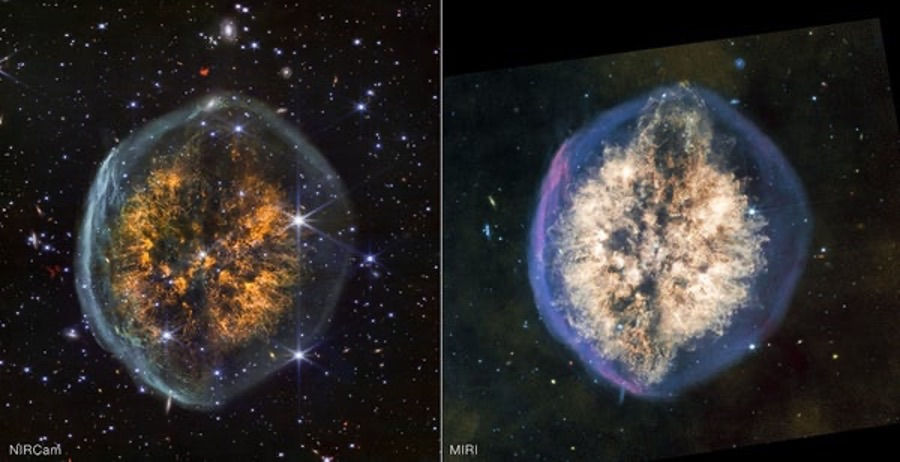
A recent photo taken by the JWST of Nebula PMR 1 (left image, above), stretching more than 5 light years across and located some 5,000 light-years from Earth, reveals a structure similar to that in an MRI (right image) of an unremarkable human brain.
Note especially (1) the inner concentration of structural elements protected by an outer membrane, and (2) a division of those elements into two hemispheres, separated by a longitudinal fissure. Co-incidence? Sure. An example of the self-similar organization of the cosmos? That too!
According to the popular holographic model of cosmology, the universe is self-similar across all scales, so we will not be surprised if it turns out that the Cosmos is similar to the Quantum.
***
Consciousness is strongly associated with patterning: Consciousness seems to be emergent in entities with certain structural similarities, and it consists of the patterns it discovers. (There is a strong argument that we are only conscious of patterns; true one-offs go unregistered.)
Finally, consciousness appears to impose its own patterns when confronted with random sensory input: “Rows and flows of angel hair and ice cream castles in the air…It’s clouds Illusions (patterns) I recall, I really don’t know clouds at all.” (Joni Mitchell)
Patterns are often self-similar across scales and across various material substrates. To bastardize Stephen Hawking, et al., “it’s patterns all the way down”. Perhaps a more useful phrasing would be, “it’s patterns discovering patterns,” suggesting that the propensity to form patterns (logoi), may be substructural, applying equally to the percipient and to the perceived.
There is growing unease among biologists re the shortcomings of the Neo-Darwinian framework. Epigenetic effects are not only real but critical for the evolution of cells and, contrary to long held beliefs, epigenetic modifications can be inherited. The ‘sins’ of the father (and mother) are indeed visited on future generations.
Further, it is increasingly clear that the central assumption of Neo-Darwinism, that mutations occur randomly and that natural selection simply operates to conserve the most adaptive variations, is wrong. It is virtually certain that cells control gene expression by the decisions and choices they make.
Likely, all cells are sentient and self-aware and capable of decision-making and problem-solving at some level. These cellular faculties rely on information integrated across the entire cell.
Consciousness seems unrelated to the volume of information. Instead it is a function of, and a driving force for, information integration and so ‘interconnectedness’ becomes the measure of consciousness. If nebulae do think, if they are conscious, we may assume that they integrate information, not across nanometers but across light years.
So are the patterns of celestial objects in Nebula PMR 1 and neurons in our skulls sufficiently similar to allow both to support consciousness? Has PMR 1 discovered the meaning of life? Share, please!
Do you like what you just read and want to read more Thoughts? Subscribe today for free!
- the official blog of Aletheia Today Magazine.