David Cowles
Mar 23, 2026
“Job Sues God! - the headline screams across the region’s tabloids.”
1900 words, 8 minute read
Americans are currently engaged in a great debate: To what extent is POTUS subject to the same laws as every other resident of the US and to what extent, if any, does (s)he enjoy immunity. It’s an old topic.
It was a subtext in the debate that ultimately led to the US Constitution and its Bill of Rights. George III’s lack of accountability helped spark the War of Independence (1776). While Louis XIV famously asserted, “I am the State,” Louis XVI found himself tied-up in knots by the Parlement of Paris and the Estates General. And of course, it was top of mind for the nobles who confronted King John at Runnymede (Magna Carta 1215 CE). I could go on…but I won’t put you through it. (You’re welcome!)
I will, however, ask you to accompany me back to the first and best known work on the subject, the Old Testament Book of Job, given its present form c. 500 BCE but including primary source material dating at least as far back as the mid-second millennium.
The text of Job is divided into 42 chapters. The first two are a prose prologue describing the circumstances leading up to the matter at hand. They are intended to give the poem context.
The 40 remaining chapters consist of an epic that must be ranked alongside the works of Homer, Virgil, Ovid, Dante, Milton and Pound (Cantos) for sheer poetic prowess.
35 chapters present a verbatim transcript of a debate between Job and several prominent legal scholars concerning the rights of God and Man (sic). The final 5 chapters record the legendary confrontation between YHWH, Maker of Heaven & Earth…and Job, that’s right, ‘dust and ashes’ Job. Whatever you do with the rest of your life, don’t miss this!
That said, the poetic text, beautiful even in translation, can be frustrating. Job and his interlocutors stand toe-to-toe throwing haymakers at each other for 35 chapters. Each speech is logically constructed and brilliantly delivered, but the pugilists never lay a glove on one another.
The problem? The two sides have completely different understandings of ‘God’…and they don’t realize it. They use the same vocabulary (YHWH, Elohim, El Shaddai, et al.) but they mean totally different things by these terms.
The scholars argue that whatever God has done to Job must be just; but tellingly, they argue this conclusion employing three incompatible chains of reasoning:
Whatever God has done vis-a-vis Job must be just because God is just, so whatever he does must be just no matter how it appears to us. It is up to us to conform our concept of ‘justice’ to God’s, not vice-versa. Like the novices that we are, we learn to play chess by studying the moves of the Grand Master.
Because God is the Creator of Heaven and Earth, he defines Justice per se, and accordingly, his will constitutes what is just. Whatever God does is justice!
Because God is Pantocrator, the Supreme Ruler, the question of ‘justice’ doesn’t enter into it. God does what God does, period. He’s God for heaven’s sake! There is no right to question, dispute, or appeal. God is a 1950’s style parent: what God says goes, end of! God’s actions require no justification. And as far as Job’s troubles are concerned…well, “yakety yak, Job talked back!”
But Job demurs: I know justice when I see it and this ain’t it! To be fair, we know that Job is right only because we know the back story (Job 1-2). Otherwise, we might find ourselves on the same side as the overly legalistic scholars.
Here’s the ‘set-up’: Job, a virtuous man by all accounts, righteous in his personal conduct, just and generous in his dealings with others, suddenly loses his wealth, his children, his reputation, his social standing, and eventually, his health. He appears to be the victim of a capricious ‘Act of God’ and, as we know but his audience doesn’t, he is.
That God acted unjustly in this matter is not in dispute. He admits it and shows no remorse. The legal issue here is whether God, being God, the Almighty, Creator of Heaven and Earth, is entitled to act capriciously. I mean, he is God after all! That’s got to count for something, right?
But Job is unwilling to accept this conclusion. He is channeling Sartre, millennia before his time:
God does not choose Justice as an attribute (as we do on our best days). ‘Just’ does not merely characterize God; God is Justice! For him to behave unjustly is incompatible with his nature, his identity, i.e. with his being God. Furthermore, Justice is not some esoteric concept; literally everyone knows what Justice is…even though we may sometimes disagree on how to apply it.
Job’s faith is unshakable! Despite every indication to the contrary, God will make things right. He cannot do otherwise. He is God. The absurdity and audacity of Job’s position is summed up in what is perhaps his most famous fragment: “I know that my redeemer lives and that on the last day he will stand upon the earth and when my skin has fallen off my bones, yet I will still see God, not through the eyes of another, but with my own eyes I will see him.” (19: 25-27)
The idea that we have rights vis-à-vis our creator is one of Judaism’s greatest contributions to Intellectual History. And so Job refuses to defer to the sterile arguments of the scholars. To the amusement of his taunting neighbors, Job initiates formal legal proceedings against YHWH: Job Sues God! - the headline screams across the region’s tabloids.
Job is suing God for performance; he is asking the court to require God to be God and to act accordingly. Job exploits an arcane provision in the legal code of the Levant to summon God to court. Furious but obedient, God appears…though he insists on addressing the court ‘out of the whirlwind’.
The final 5 chapters of Job are nothing less than a middle school cafeteria food fight. God and Job throw ballons de merde at each other non-stop. God sets the tone in his opening statement to the court, dripping with sarcasm:
“Who is this who obscures good counsel, using words without knowledge? Bind up your loins like a man! I will ask you – and you will help me know!” (38: 2-3)
Imagine, God asking Job to instruct him? I don’t think so! And God maintains this demeaning, dismissive tone toward Job throughout the proceedings.
Job says little. According to the intricacies of local law, Job is presumed to be the aggrieved party; it is God who must convince the court that he is innocent…which he is not. Job is no fool…as God is fast finding out. Like Ali in the Jungle, Job is content to let YHWH punch himself out.
Job knows not to talk past the close; but what he does say speaks volumes: “Lacking respect, how can I answer you? My hand I place over my mouth. I have spoken once and I will not repeat; twice, and I will no more.” (40: 4-5)
Unable to imagine a mere mortal responding to God as an equal, commentators have ignored Job’s obvious sarcasm, a reflection of God’s own tone, and concluded that Job is sincerely capitulating. Really? On what planet?
“Lacking respect?” Is Job complaining that God does not respect him, or worse, is he saying that he has lost respect for God, or both? Any way you parse it, these are not the words of a vanquished and contrite vassal.
Plus, if Job were really conceding the case, why doesn’t the trial, and the text, end here? Why does God feel the need to offer a second defense, adding three apparently superfluous chapters to an already ‘overlong’ document? Was God taking a victory lap? I doubt it!
God’s first argument is sharp but ineffectual. It is based on a hierarchical concept of Being and a despotic notion of Divinity. His second argument is softer and rooted in ecology. It runs something like, “Hey, there are a lot of variables here and I have a lot on my plate. You’re not the only fish…or monster…in the sea; in fact, you’re not even my favorite (that’s Behemoth) or the top of the food chain (that’s Leviathan). Frankly, you’re a pain in my butt.”
Bottom line, “I’m doing the best I can under the circumstances.”
Just as we heard Sartre in Job, we now find hints of Leibniz (best of all possible worlds) in God’s argument. But it’s too little too late…and God knows it. The poet gives Job the last word and he makes the most of it:
“Who is this (God) hiding counsel without knowledge? Truly I’ve spoken without comprehending – wonders beyond me that I do not know. Hear now and I will speak! I will ask you and you will help me know. As a hearing by the ear, I have heard you, and now my eye has seen you. That is why I am fed up (with you) and I take pity on ‘dust and ashes’ (humanity).” (42: 3-6)
So often, finales disappoint; not this one! What a brilliant exit speech. Job begins by sarcastically echoing God’s opening statement and ends by demeaning and trivializing the God he so fiercely defended over his entire lifetime. What a crushing blow!
But God is God after all; in the end he proved himself ‘the bigger man (sic)’. He did not smite Job on the spot nor did he set the planet ablaze. Rather, he praised Job for his persistence and for the correctness of his theology; and he castigated the scholars, his self-appointed defense team, for misrepresenting the ways of God to man (sic); but he also urged Job to forgive them (which he did). Meanwhile, God does what Job always believed he would do: he restored all that Job had lost… and he voluntarily paid treble damages!
Job’s victory is a theological game changer; unfortunately, it’s a change that most everyone has missed. It was not until the 20th century that a philosopher (Alfred North Whitehead) clearly reasserted Job’s core contention: God is not an exception to Natural Law nor is he exempt from its mandates; rather God is Natural Law or at least he is the paradigmatic expression of that law.
Natural Law (aka Oral Torah) is the Prime Directive of the Universe. Nothing and no one is exempt from its provisions. But that should not be seen as a limitation on God’s existential freedom. God is free when and only when God is being God and Natural Law is God being God.
Natural Law is God’s essence as it is felt in every corner of the spatiotemporal world. Just as the EM Field is the universal manifestation of an electron so Natural Law is the universal manifestation of God. Natural Law is the Prime Directive of Being itself; as such, it can tolerate no exceptions and not even the Maker of Heaven and Earth is exempt.
***
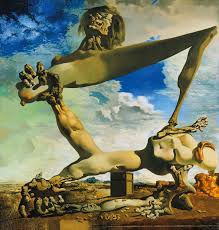
Salvador Dalí’s 1936 masterpiece depicts a grotesque, dismembered figure tearing itself apart against a stark Spanish landscape, serving as a visceral metaphor for the self-destruction of a nation during the Spanish Civil War. The composition features a central, agonizing face and straining limbs that create a claustrophobic, triangular tension, illustrating the physical and psychological horror of internal conflict. By including a small pile of boiled beans at the bottom, Dalí adds a surreal, mundane contrast to the monumental violence, suggesting the meager nourishment available to a society consuming itself.
Do you like what you just read and want to read more Thoughts? Subscribe today for free!
- the official blog of Aletheia Today Magazine.