David Cowles
Mar 6, 2026
“Utopians of all stripes…have long argued that human beings are capable of self-government with little or no interference from a coercive state. Perhaps they’re right!”
1600 words, 7 minute read
In 1762 Jean-Jacques Rousseau wrote the Social Contract, one of the most influential works of political philosophy in the Western World. Rousseau hypothesized a collection of human individuals and families, living in proximity to one another but lacking any defined social institutions. He called this The State of Nature.
Rousseau purports to trace the process of socialization, beginning with this blank slate and leading to complex social structures, albeit different from the typical 18th century European State. He reasoned, somewhat tortuously, that people would have freely and voluntarily ceded personal property and political sovereignty in exchange for legal title and collective security.
Needless to say, Rousseau’s work was, and still is, controversial. One key question: Did he believe he was describing an actual historical process, or did he intend his proposal to be read more as a thought experiment?
Sidebar: In the 1960’s Harvard professor, John Rawls retraced Rousseau’s intellectual journey. However, Rawls was clear from the outset that his process was purely hypothetical and had no basis in history or anthropology. The result was A Theory of Justice, a classic of political theory even today.
Did I mention it was the ‘60s? Rawls was concerned with the question of whether any form of government could ever be legitimate. Unlike many of his colleagues (and students) at the time, he came to a positive conclusion…but only by requiring any such state to satisfy some very stringent economic and political conditions. (We’re not there yet!)
Regardless of original intent, most scholars now agree with Rawls that Rousseau’s State of Nature needs to be understood as a mental construct. Obviously! Except… some recent archeological evidence suggests that something resembling Rousseau’s proto-culture might actually have existed…in Central Europe. And I’m not talking about the Shire!
We’ll need to go back in time…but not that far back! Archaeologists have recently uncovered evidence of a Neolithic culture (the Vinca, see map above) spanning much of what is today modern Hungary, Serbia, Bulgaria and Romania). Remarkably, the Vinca dominated that busy cultural intersection for a millennium c. 5000 BCE.
There are signs that Vinca society made the transition from something resembling Rousseau’s State of Nature to his Proto-State. If so, it would have great significance for contemporary social philosophy.
Let’s start with a brief survey:
Vinca settlements exhibit sophisticated Urban Planning. Residential areas are set apart from areas designated for community, commerce, and manufacture. Is this the Western world’s first attempt at zoning?
Within the residential quarter, buildings are arranged in symmetrical patterns, reflecting both pre-planning and a high level of cooperation.
There seems to have been a robust division of labor with specific individuals performing certain roles essential to the Vinca economy: e.g. hunting, agriculture, manufacturing and trade, but with no hint of any class or caste disparities.
Yet there is no evidence that Vinca society had any sort of central government. The political process appears to have been decentralized with de facto power distributed among members of society in a more or less egalitarian manner and on an ad hoc basis. One is reminded of the period of the Judges (c. 1250 – 1050 BCE) in Israel.
There is no evidence of any designated political or religious castes, no evidence of bureaucracy, and only slight evidence of disparities in status, wealth or power.
Finally, there is no evidence of any standing army and Vinca settlements lack any signs of the fortifications characteristic of that era.
Apparently, the Vinca lived long and prospered due to their critical role in trans-European trade and their cultural and technological contributions to Greater Neolithic Europe. One can imagine a Vinca PR slogan: “We threaten no one, we benefit everyone!”
Because we are comparing Vinca society with Rousseau’s State of Nature, we are focused on its political and economic institutions (above), but the Vinca also made important contributions to the evolution of European culture:
The Vinca produced a great many objects d’art, some quite remarkable in their own right (see Appendix below).
Many of those pieces were adorned with graphic symbols (as below). Whether these markings were merely decorative or emblematic of mythological or philosophical ideas is a matter of debate.
Separately, a system of markings (cross, X’s, hatch marks, etc.) was used and may constitute an early form of writing. If so, it would have preceded Sumerian Cuneiform and Egyptian Hieroglyphics.
Finally, the Vinca may have been millennia ahead on the matter of gender identity. Men and women did have distinct social and economic roles in Vinca society. However, there is no evidence that this was a source of any discontent or discrimination.
On the contrary, a burial site recently uncovered in Hungary and dating back to the Vinca era shows signs of gender plasticity. Traditionally, men and women were buried in different positions with different artifacts.
However, out of the 125 Neolithic graves recently opened, 7 contained skeletons of folks (both genders) who had been buried opposite to their birth physiology. It seems reasonable to speculate that these ritual anomalies reflect those individuals’ non-traditional identities, roles and lifestyle choices.
If Vinca culture is so fundamentally divergent from the European norm, we should expect to find evidence of a different Weltanschauung embedded in its language. But hard cheese: we know virtually nothing about their language except that it was probably pre-Indo-European (pre-IE).
Today, only one pre-IE is still spoken in Europe: Basque thrives in a geographically and culturally isolated region around the Pyrenees Mountains in what is now Southwestern France/Northeastern Spain. Let’s be clear: there is no evidence that modern Basque resembles ancient ‘Vinca’ in any way! But what if it did?
As you might expect, Basque has a grammatical structure very different from today’s Indo-European (IE) tongues. Intriguingly, these differences appear to be consonant with the unusual features of Vinca culture and social structure. For example…
Basque lacks the grammatical gender (masculine, feminine) characteristic of IE languages. This may reflect Vinca’s kinder, gentler take on gender stereotyping.
Basque uses ergative-absolutive rather than the nominative-accusative cases universal in IE languages. In IE languages, the subject of both transitive and intransitive verbs takes the same case (nominative): "She runs" and "She sees him".
Basque works according to a completely different logos: The subject of an intransitive verb and the object of a transitive verb both take the absolutive case. The subject of a transitive verb takes a different case entirely — the ergative, marked with the suffix -k. (Nordic languages, ancient and modern, use a similar suffix for processes that are reciprocal or recursive in nature.)
The ergative frame implicitly asks: are you the originating cause of this event, or are you the field in which it occurs? Are you the figure or the ground? The wave or the particle? Schrödinger’s equation or its collapse? IE grammar trains us to look for a naked doer, someone to take the blame, and when there isn't, we invent one.
Basque uses a SOV (Subject-Object-Verb) word order, placing the verb at the end of the clause. Accordingly, the verb brings subject and object together rather than dividing them as it does in SVO languages (e.g. IE). SOV conveys a ‘we’re all in this together’ ethos rather than the ‘dog eat dog’ we’re used to.
Mind Blow: Basque has no direct equivalent for the verb "to have." In IE languages, to have is right behind to be on any list of frequently used verbs. Yet the concept does not naturally occur in Basque. Imagine building a language without the verb ‘to be’! Try it. (Neolithic Europeans did so without the verb ‘to have’.)
Possession is expressed through a construction meaning roughly "something is to/at me" — using the verb izan (to be) with the dative. This places Basque (and potentially Vinca) philosophy half way between Classical Liberalism (the absolute right to private property) and Marxism (the abolition of private property).
Intriguingly, this is also approximately the position of Islam, Hasidic Judaism and the Roman Catholic Church: there is a right to private property but it is not absolute. Ultimately, everything belongs to God, but it is parceled out to individuals and families for them to nurture…and protect from incursions by ‘diabolical powers’, e.g. the errant mega-state.
Inspired by Homer and HBO, we imagine early European societies as authoritarian, aristocratic, and bellicose; and in some cases that may be apt. But not in every case! A deeper dive into the Vinca civilization may broaden our concept of what’s possible for pre-historical societies…and for us today.
Radical democrats, libertarians, anarchists, and utopians of all stripes (from St. Benedict to John Eliot to Karl Marx) have long argued that human beings are capable of self-government with little or no interference from a coercive state. Perhaps they’re right!
Appendix
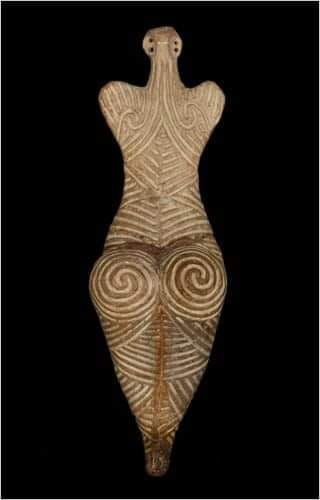
This Vinca figurine is remarkable. Note the proto-spirals associated with the breasts and the more developed spirals associated with genitalia. Cross-culturally, the spiral is one of several symbols (Cross, Star of David, et al.) that seem to symbolize the connection between the immanent, phenomenal world and its transcendent, noumenal doppelganger.
After all, God appeared to Job ‘out of the (spiral) whirlwind’ and Dorothy traveled to Oz on the wings of a (spiral) cyclone. In the language of contemporary cosmology, the spiral may be telling us something: it may be pointing at the phenomenon of scale-independent fractals.
Do you like what you just read and want to read more Thoughts? Subscribe today for free!
- the official blog of Aletheia Today Magazine.