Search Results
Search this site
1240 results found with an empty search
- Mary Magdalene, The Witness | Aletheia Today
< Back Mary Magdalene, The Witness Rachel Held Evans "That Christ ushered in this new era of life and liberation in the presence of women, and that he sent them out as the first witnesses of the complete gospel story, is perhaps the boldest, most overt affirmation of their equality in his kingdom that Jesus ever delivered." Mary Magdalene went to the disciples with the news:“I have seen the Lord!”—John 20:18 The story of how Mary Magdalene became known as a prostitute is a complicated one. One of six Marys that followed Jesus as a disciple, she was distinguished from the others through identification with her hometown of Magdala, a fishing village off the coast of the sea of Galilee. According to the gospels of Mark and Luke, Jesus cleansed Mary of seven demons, (a backstory infinitely more complicated and mysterious than prostitution, if you ask me), after which Mary became a devoted disciple, mentioned by Luke in the same context as the twelve, who traveled with Jesus and helped finance his ministry. In 597 pope Gregory the Great delivered a homily on Luke’s gospel in which he combined Mary Magdalene with Mary of Bethany (Martha’s sister), suggesting that this Mary was the same woman who wept at Jesus’ feet in Luke 7, and that one of the seven demons Jesus excised from her was sexual immorality. The idea caught on and was perpetuated in medieval art and literature, which often portrayed Mary as a weeping, penitent prostitute. In fact, the English word maudlin, meaning “weak and sentimental,” finds its derivation in this distorted image of Mary Magdalene. In 1969, the Vatican formally restated the Gospels’ distinction between Mary Magdalene, Mary of Bethany, and the sinful woman of Luke 7, although it seems Martin Scorsese, Andrew Lloyd Webber, and Mel Gibson have yet to get the message. A cynic might suggest that this mistake and its subsequent popularity represent a deliberate attempt to typecast and discredit a woman whose role in the gospel story is so critical and so revolutionary that the eastern orthodox Church refers to Mary Magdalene as equal to the apostles. Although she appears to have been a critical part of Jesus’ early ministry, Mary Magdalene’s extraordinary faithfulness shines most brightly in the story of the passion. After Jesus’ arrest in the Garden of Gethsemane, his male disciples abandoned him. Judas delivered him over to the authorities for a bribe. Peter denied him three times. And only John, described as “the apostle whom Jesus loved,” was present at the crucifixion. But Mary Magdalene and the band of women who followed Jesus and supported his ministry are described by all four gospel writers as being present during the savior’s darkest hours. Even after Jesus took his last breath, and all hope of redemption seemed lost, the women stayed by their teacher and their friend and prepared his body for burial. It is precisely because they were present, loyal even through failure, that the women who followed Jesus were the first to witness the event that would define Christianity: the resurrection. Gospel accounts vary, but all four identify Mary Magdalene as among the first witnesses of the empty tomb. According to the synoptic Gospels, she and a group of women rose early that fateful morning, three days after Jesus had died, to anoint the body with spices and per- fumes. When they arrived at the tomb, they were met by divine messengers guarding the entrance, who declared that Jesus had risen from the dead, just as he said he would. The women immediately left the tomb behind and, “with fear and great joy” (Matthew 28:8), ran to tell the other disciples. Luke notes that on their way, they remembered what Jesus had taught them about resurrection, confirmation of the fact that these women had been present for some of Christ’s most important and intimate revelations and that they took these teachings to heart. But when the breathless women arrived at the home where the disciples had gathered, the men did not believe them. Women were considered unreliable witnesses at the time (a fact that perhaps explains why the apostle Paul omitted the women from the resurrection account entirely in his letter to the Corinthian church), so their proclamation of the good news was dismissed by the men as an “idle tale,” the type of silly gossip typical of uneducated women. Perhaps the men invoked the widely held belief that, just like their sister Eve, women were easily duped. A few, however, were curious enough to take a look at the tomb, and so, according to John’s account, Mary returned with peter and another disciple to the place she had encountered the messengers. The men saw for them-selves an empty grave and a pile of linen wrappings folded neatly within it, and conceded to the women that the tomb was indeed empty. However, John 20:9 notes, “they still did not understand from scripture that Jesus had to rise from the dead.” The men returned to report what they had seen to the rest of the disciples, leaving Mary behind. Perhaps disciples posited the theory that Jesus’ body had been stolen, for John wrote that Mary, once so full of breathless excitement and impassioned belief, now stood outside the tomb, crying. Angels appeared and asked her what was wrong. “They have taken my Lord away,” she told them, fully accepting the disciple’s dismissal of her “idle tale." The angels were then joined by a mysterious man, whom Mary assumed to be the gardener. He, too, asked why she was crying. “Sir, if you have carried him away, tell me where you have put him, and I will get him,” she pleaded. Only when he called her by her name, did she recognize the man as Jesus. “Mary,” he said. “Rabboni!” she cried. “Do not hold on to me,” Jesus urged as she fell before his feet, “for I have not yet ascended to the Father. Go instead to my brothers and tell them, ‘I am ascending to my Father and your Father, to my God and your God.’” And so again, Mary Magdalene ran to the house where the disciples were staying and told them she had seen the risen savior face-to-face. “I have seen the Lord!” she declared. But it was not until Jesus appeared to the men in person, allowing them to touch the wounds in his hands and side, that they finally believed. Far from being easily deceived, women were the first to make the connection between Christ’s teachings from scripture and his resurrection, and the first to believe these teachings when they mattered the most. For her valor in twice sharing the good news to the skeptical male disciples, the early church honored Mary Magdalene with the title of Apostle to the Apostles. That Christ ushered in this new era of life and liberation in the presence of women, and that he sent them out as the first witnesses of the complete gospel story, is perhaps the boldest, most overt affirmation of their equality in his kingdom that Jesus ever delivered. And yet too many Easter services begin with a man standing before a congregation of Christians and shouting, “he is risen!” to a chorused response of “he is risen indeed!” Were we to honor the symbolic details of the text, that distinction would always belong to a woman. *** This was an excerpt from A Year of Biblical Womanhood. This piece was republished with permission from rachelheldevans.com . *** Image: "Christ and St. Mary Magdalen at the Tomb." Rembrandt Van Rijn (1606-1669). Royal Collection Trust. Rachel Held Evans was a New York Times best-selling author whose books include Faith Unraveled (2010), A Year of Biblical Womanhood (2012), Searching for Sunday (2015), Inspired (2018). Hailing from Dayton, Tennessee—home of the famous Scopes Monkey Trial of 1925— she wrote about faith, doubt and life in the Bible Belt. She was featured in The Washington Post , The Guardian , Christianity Today, Slate, The Huffington Post, The CNN Belief Blog, and on NPR, The BBC, The Today Show, and The View. She served on President Obama’s Advisory Council on Faith-Based and Neighborhood Partnerships, and kept a busy schedule speaking at churches, conferences, and colleges and universities around the country. Rachel and Dan welcomed their second child in 2018. Rachel passed away in 2019. Return to our Holy Days 2023 Table of Contents, Previous Next
- Do Nebulae Think? | Aletheia Today
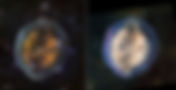
< Back Do Nebulae Think? David Cowles May 17, 2026 “If nebulae do think they, if they are conscious, we may assume that they integrate information…across light years.” 1300 words, 6 minute read In 1974 Thomas Nagel earned himself a permanent position in the Intellectual Pantheon of the Western World. His signature essay, What’s it like to be a Bat , catalyzed the Search for Intelligent Life on Earth (SILE): “There is something that it is like to be a bat…what it is like for a bat to be a bat…because we know what it is like to be us.” (Do we really?) At least in the Judeo-Christian West, folks have long imagined themselves ‘little less than angels’. (Psalms 8: 5, Heb. 2: 7 – 9) Prior to Darwin, any suggestion that we were more Gorilla than Gabriel would have been considered preposterous. And prior to Nagel, extending monikers like ‘conscious, intelligent, sentient’ to non-human life forms was a non-starter. Besides, we were occupied with more serious questions: Should we extend these monikers to women, to children, to members of other races, other ethnic groups, other nationalities, other age cohorts, other political parties, other social castes? Heady stuff! I’m pleased to report that we’ve made uncharacteristically significant progress in these areas over the half-century since Nagel, and there is now something approaching consensus that even certain non-human life forms are intelligent and conscious. Primates and Sea Mammals make almost everyone’s list. Corvids (ravens, parrots, crows), Cephalopoda (octopus), and Pachyderms (elephants) show up frequently as well. They know what they know, and they know that they know it, and they project similar self-awareness onto others in their community (so-called ‘other minds’). There is even serious conversation now about the mental status and intellectual life of forests, plants, fungi, and…wait for it…unicellular organisms. The average adult human body consists of about 30 trillion of these little critters – we call them ‘cells’ - working together to promote the survival (and fecundity) of a single host: You! Researchers at Carnegie Mellon University have recently shown that bacteria (prokaryotes) can learn from past experiences, store memories and access those memories when deciding future behavior. Snooze fest? Ok then, how about this? They can pass these memories on to future generations - something we can only approximate via our elaborate cultural superstructure. And they can use remembered experience when imagining and evaluating novel responses to changes in their environment. Did I mention, they do all this without a nucleus, much less a brain or nervous system? *** Phenotypically, life on Earth could not be more varied - from figs to ferns, bats to bacteria, cabbages to kings. But structurally, behaviorally, even morphologically, all life on Earth is remarkably similar. Birds fly, so do bats, so do bugs, and so do we (thanks to our technology). Different structures support similar functions. For example, many animals have a sense of sight but the organ of sight, the eye, has evolved many times, independently and differently, across multiple species. Apparently being able to see is a useful trait. At the same time, similar structures enable different functions. For example, fish have gills for breathing, but we use ‘their’ gills for hearing. Gills and ears have the same structure but very different functions. Evolution, the wellspring of biodiversity, is also convergent: several organisms from different limbs on the tree of life may evolve similar traits/structures via radically different pathways. The features in question confer survival (reproductive) advantage across phyla and a variety of unrelated structures can serve as ground zero for their development. Plus every member of every species now living on Earth is descended from a single DNA molecule synthesized about 4 billion years ago. How’s that for bio-similarity? So on the one hand, no two cells are identical (mutation, epigenesis) but on the other hand, all cells are clones of a single aboriginal cell. Can we find similarly homologous structures in the inanimate world as well? *** No self-respecting 6 th grade geek has failed to notice similarities in the structure of atoms, a fundamental unit of physics, and that of eukaryotic cells, a fundamental unit of biology. “Nucleus & Electrons, meet Nucleus & Mitochondria” - not bad for the first day of middle school. Our cognitive lenses seem to work better as a microscope than as a telescope. We can detect congruent patterns in regions of the cosmos twenty orders of magnitude smaller than us, and we are not shy about attributing common functions to such congruent structures. For example, recent studies reinforce our conviction that bacteria have functioning memories, learn from experience, and calculate behavioral strategies. But we are less apt to recognize structural congruence on larger scales, and we are much less willing to posit homologous function on that scale. The same structure we noticed in atoms and eucaryotic cells appears in solar systems, galaxies, and galactic sheets. At the highest level of generality, the network of galaxies in the universe forms a pattern eerily similar to the network of neurons in the human brain (nodes and filaments). A recent photo taken by the JWST of Nebula PMR 1 (left image, above), stretching more than 5 light years across and located some 5,000 light-years from Earth, reveals a structure similar to that in an MRI (right image) of an unremarkable human brain. Note especially (1) the inner concentration of structural elements protected by an outer membrane, and (2) a division of those elements into two hemispheres, separated by a longitudinal fissure. Co-incidence? Sure. An example of the self-similar organization of the cosmos? That too! According to the popular holographic model of cosmology, the universe is self-similar across all scales, so we will not be surprised if it turns out that the Cosmos is similar to the Quantum. *** Consciousness is strongly associated with patterning: Consciousness seems to be emergent in entities with certain structural similarities, and it consists of the patterns it discovers. (There is a strong argument that we are only conscious of patterns; true one-offs go unregistered.) Finally, consciousness appears to impose its own patterns when confronted with random sensory input: “Rows and flows of angel hair and ice cream castles in the air…It’s clouds Illusions (patterns) I recall, I really don’t know clouds at all.” (Joni Mitchell) Patterns are often self-similar across scales and across various material substrates. To bastardize Stephen Hawking, et al., “it’s patterns all the way down”. Perhaps a more useful phrasing would be, “it’s patterns discovering patterns,” suggesting that the propensity to form patterns ( logoi ), may be substructural, applying equally to the percipient and to the perceived. There is growing unease among biologists re the shortcomings of the Neo-Darwinian framework. Epigenetic effects are not only real but critical for the evolution of cells and, contrary to long held beliefs, epigenetic modifications can be inherited. The ‘sins’ of the father (and mother) are indeed visited on future generations. Further, it is increasingly clear that the central assumption of Neo-Darwinism, that mutations occur randomly and that natural selection simply operates to conserve the most adaptive variations, is wrong. It is virtually certain that cells control gene expression by the decisions and choices they make . Likely, all cells are sentient and self-aware and capable of decision-making and problem-solving at some level. These cellular faculties rely on information integrated across the entire cell. Consciousness seems unrelated to the volume of information. Instead it is a function of, and a driving force for, information integration and so ‘interconnectedness’ becomes the measure of consciousness. If nebulae do think, if they are conscious, we may assume that they integrate information, not across nanometers but across light years. So are the patterns of celestial objects in Nebula PMR 1 and neurons in our skulls sufficiently similar to allow both to support consciousness ? Has PMR 1 discovered the meaning of life? Share, please! Previous Share Next Do you like what you just read and want to read more Thoughts? Subscribe today for free! Thoughts While Shaving - the official blog of Aletheia Today Magazine. Click here.
- Dr. Who | Aletheia Today
< Back Dr. Who David Cowles May 15, 2025 “A TARDIS is an old fashioned phone booth (or ‘box’) with one very unusual feature: its interior is much, much larger than its exterior.” Who doesn’t know Doctor Who , the 60 year old BBC sci-fi franchise? But the Doctors’ universe seems very different from ours. For one thing, it supports something called a TARDIS. For the uninitiated, a TARDIS is an old fashioned phone booth (or ‘box’) with one very unusual feature: the volume of its interior is much, much larger than the volume of its exterior. According to Heidegger, a work of art shows us something new about our world. On the basis of that definition, Doctor Who is museum grade. When we were in school, we complained about having to learn arithmetic. Now, later in life, we’re glad we learned at least the basics. Whether we know it or not, we use arithmetic every day in a million different ways. Whenever we take a trip, bake a cake, budget our income, save for retirement, we rely on arithmetic. Thank God we live in a universe where it works. But does it? And do we? 2500 years ago, the paradoxical Zeno proved that it doesn’t and/or that we don’t. He used a hypothetical foot race between the fastest man in the world, (no, not Adrian Bolt, but Achilles) and one of nature’s slowest creatures, a lowly tortoise. Of course, we all know that in our world, Achilles would have beaten the reptile with ease. However, Zeno uses the rules of arithmetic to prove that Achilles can’t win (as long as the tortoise has a head start). Zeno’s proof does not invalidate Achilles’ still unbroken track and field records, nor does it fit the tortoise with supernatural jets. Instead, Zeno ‘simply’ proves that the laws of arithmetic do not adequately model our actual world. Zeno’s paradoxes have had a rocky history. Turns out, human beings don’t like to be told they’re wrong. We’ll do just about anything to escape that obvious conclusion. Newton and Leibniz went so far as to invent the Calculus, the scourge of high school seniors and college freshmen everywhere, just to prove Zeno wrong. Bertrand Russell resolved the dilemma: calculus notwithstanding, Zeno’s paradox holds. Why? Because spacetime is discrete, not continuous as arithmetic assumes. Of course, our world for the most part acts as though it were continuous, even though it isn’t, and so arithmetic works, even though it doesn’t…for the most part. Zeno notwithstanding, calculus took us the Moon and back; but that doesn’t change the fact that arithmetic is a hack! That’s 6 years of primary school education down the drain! Somewhere between arithmetic and calculus most of us were introduced to Geometry. We learned a system that was developed 2400 years ago by a Greek mathematician named Euclid. Just as real number arithmetic only works in a continuous universe, Euclidean geometry only works in a flat universe. Trouble is, the world we live in is neither continuous nor flat. Of course, we can always just pretend. We’re very good at that you know. We can pretend that the universe is flat just as we pretend that it is continuous. In reality, the universe is fundamentally discrete…and curved. Continuity and flatness are approximations that work in a wide range of circumstances; but they don’t accurately represent the real world. It was not until 1800 CE that scholars realized that we need a geometry that describes curved surfaces and spaces; if you don’t believe me, try steering your starship in the neighborhood of a black hole and see how far you get with just a Triple A Trip-tick. And so ‘non-Euclidean’ geometry was born. But even non-Euclidean geometries make certain questionable assumptions about the nature of the real world. As in the case of arithmetic, the issue has to do with continuity and order. Turns out, even non-Euclidean geometries may not go far enough to capture the enigmatic nature of reality. We need a geometry that takes us even further from Euclid’s world. Both arithmetic and Euclidean geometry rely on the set of real numbers, augmented by imaginary and complex numbers. But the set of real numbers may not be enough. Between any two real numbers, there are an infinite number of hyperreal infinitesimals. Adding hyperreals to the domain results in a new species of ‘continuity and order’ that is very different from what is suggested by real numbers alone. Mathematicians call geometries that incorporate this expanded definition of ‘number’, non-Archimedean . In standard geometries, Euclidean or non, certain quantitative and spatial relations hold and are conserved. In non-Archimedean geometries, not so much! In fact, these geometries have three highly counter-intuitive features in common: (1) all triangles are either isosceles or equilateral; (2) any point in a sphere can be treated as its center; and (3) any two spheres are either disjoint or they contain one another entirely. There is no such thing as tangency or overlap. These principles of non-Archimedean geometry work together to produce an astonishing result: If a Sphere A contains a Sphere B, the volume of B may be greater than the volume of A. That is the principle behind TARDIS whose interior volume exceeds its exterior volume…by a lot. And we have the creators of Doctor Who to thank for introducing us Muggles to this revelation. The contingency (vs. necessity) of Archimedean Space was brought home to me recently when I watched an episode of Doctor Who with a particularly precocious pre-tween. I hazarded a comment, “Isn’t it odd the way the inside of the box is bigger than the outside?” My question was unexpectedly met with a blank stare, followed by: “Why is that odd?” Bingo! So Euclidean geometry is something we learn, not something we intuit. Here I was, thinking I was about to teach my young friend something about geometry, only to have him school me . (What else is new!) At my age, I have apparently lost the ability to navigate through several different configurations of space simultaneously. Fortunately, my much younger companion has not. Bravo…and thanks! *** Marcel Duchamp. The Bride Stripped Bare by Her Bachelors, Even (The Large Glass), 1915–1923. Oil, varnish, lead foil, lead wire, and dust on two glass panels. 109.25 inches by 69.25 inches. Philadelphia Museum of Art, Philadelphia. Previous Share Next Do you like what you just read and want to read more Thoughts? Subscribe today for free! Thoughts While Shaving - the official blog of Aletheia Today Magazine. Click here.
- Educating Christians
“We must teach our children a totally counter-cultural model of nature. We must teach the doctrines of our Faith, not as exceptions to natural law, but as the highest expressions of natural law.” < Back Educating Christians David Cowles Jan 15, 2023 “We must teach our children a totally counter-cultural model of nature. We must teach the doctrines of our Faith, not as exceptions to natural law, but as the highest expressions of natural law.” We are good parents. From infancy, we teach our children ‘the facts of life’ –how the world works and how it came to be the way it is. We certainly mean well. But do we do well? Let’s see. We teach them that we live in a world of space and time. Space behaves according to the postulates and theorems of Euclid. Time consists of the past, the future, and an ill-defined border region we call “the present”. We teach that space and time contain mass and energy, manifested as matter and force, resulting in what we call ‘events.’ We teach that events consist of things and acts (nouns and verbs). Things may be either subjects of an action or objects of an action; actions may be either active in nature (acting on the object) or passive in nature (acting on the subject). We teach that current events are caused by past events, not by future ones. We teach the concept of scale: a ‘smaller’ entity or event may be included in a ‘larger’ entity or event, but not the other way around. If a is an element of b and b is an element of c, then a is an element of c; but then c cannot be an element of b, nor can b be an element of a. Collectively, we can say that the world we teach to our children is flat and one-directional. Time moves forward, not backwards; the past conditions the future, but not the other way around; wholes consist of smaller parts and are themselves parts of even larger wholes. These are the basic tenets of the world view known as ‘naïve realism’: what you see is what you get! So, what can we say about the things we teach our children? Either they are entirely wrong; Or, they are approximations of reality, useful in certain circumstances; Or, they are true, but only as special cases of a much more complex reality. In the Gospel of Matthew , Jesus asks, “Which one of you would hand his son a stone when he asks for a loaf of bread, or a snake when he asks for a fish?” Apparently, we would! Our sons and daughters ask us to teach them about the world, and this is the nutrition-free fare we serve up? Of course, some of our children will grow up, go off to university, study physics or advanced mathematics and discover on their own that what we taught them was fraught with limitations and errors. But what about all the others? Well, we send them to church or to Sunday school, usually once a week for about an hour. There they are exposed to stories that suggest a wholly different model of reality: people rise from the dead, walk on water, change water into wine and wine into blood. This beats any Zombie Apocalypse thriller hands down! But how are they to reconcile this with what we’ve taught them about the world they seem to live in? Some will say that religion is about the supernatural, while we have been teaching our kids strictly about the natural order of things. Such dualism is a retreat from truth. It is the waving of the intellectual white flag. It is an admission that we have failed to find a consistent theory of the world…and that we’re giving up on that goal. Science faces the same dilemma. Relativity and Quantum Mechanics are two highly successful physical theories. Between the two of them, they can account for virtually all phenomena. Problem is, they are not consistent with one another! Since Einstein, the Holy Grail of physics has been to find a single model of the universe that can account for all phenomena. So far, that quest has been unsuccessful. But science is far from waving a white flag! Prior to puberty, children’s minds are extremely democratic; they can juggle competing models of reality with little difficulty, believing all of them at once. Scientific curiosity and religious faith walk hand in hand. Later, thought patterns harden. Balancing contradictory models of reality is no longer praised as a sign of imagination but is condemned as a remnant of infancy. Is it any wonder then that our teens and 20-somethings lose their religious faith? Oddly, though, this seemingly insuperable paradox has a relatively simple solution. The world of naïve realism that we teach our kids is NOT the ‘real world’ after all. Naïve realism is fantasy, pure and simple. Relativity, quantum mechanics, non-Euclidean geometries, etc. have demolished forever the idea that ‘what you see is what you get’ (WYSIWYG). Ironically, few serious thinkers today hold with naïve realism – not even Marxists. Yet, it remains the enshrined ideology of our time. So far as possible and as soon as possible, we need to start teaching our children the truth about the world we live in. But this will not be easy! A world of space and time, energy and mass, force and matter, entities and events, subjects and objects, parts and wholes seems intuitively obvious. We know our way around in it. But wait! There is a model of reality that we all know (to one degree or another) that undermines the lazy mental habits associated with naïve realism and that is at least compatible with the latest scientific and mathematical thinking. It’s called…drum roll please…Christianity! The recent rapid decline in Christian belief can be attributed to many things but none more so than its incompatibility with secularism and the pseudo-science of naïve realism. The decline is usually dated from an historical period that we shamelessly call The Enlightenment. It is true that Christianity is incompatible with naïve realism, but it is also true that naïve realism is incompatible with science. And yes, the enemy of my enemy is my friend: Christianity is, at least in general, compatible with contemporary scientific models. Ironically, we are often told that people no longer believe in ‘the supernatural’ – this just as science has discovered that the world we live in is in fact ‘supernatural’ (if by ‘natural’ you mean ‘what you see is what you get’)! The doctrines of our Christian faith point toward a model of nature that is radically different from the standard model we parents and grandparents tend to teach. Let’s consider some examples from scripture: “In the beginning was the Word, and the Word was with God…All things came to be through him…And the Word became flesh and made his dwelling among us…” (Gospel of John ) The Word exists eternally, outside historical time, and participates actively in the creation of everything that comes to be within historical time. But the Word also enters into historical time as one of its ‘quantum’ elements. The doctrine of Incarnation demolishes the twin tyrannies of ‘scale’ and ‘time’ in one fell swoop. Begin with scale: “Christ is all (whole) and in all (part).” (Colossians) “Believe me that I am in the Father and the Father is in me.” (Gospel of John ) “Whoever eats my flesh and drinks my blood remains in me and I in him.” (Gospel of John ) Game, set, match! In Christian logic, A can be a proper element of B and that same B can also be a proper element of A. Corollary: A can be a proper element of B and B can be a proper element of C and C can be a proper element of A. This is a world I’d like to live in; thanks be to God, I do! It’s time for time: “The one who is coming after me ranks ahead of me because he existed before me.” (Gospel of John ) “Amen, amen, I say to you, before Abraham came to be, I AM.” (Gospel of John) Earlier we referred to “an ill-defined border region we call the present”. It is ill-defined because, in fact, the present is not part of ‘time’ at all. To be in the present is to step out of continuously flowing historical time; it is to participate in the eternal. Historical time is a linear continuum. It consists of past and future but makes no room for a present. The fact that there is a present (we’re living in it!) proves that there is another, eternal dimension outside of time. The present and the eternal are one! In Exodus , God tells us that his name is “I AM”; in the Gospel of John, Jesus, the Christ, uses the same formula. In several passages, Jesus refers to himself as I AM. In fact, God never “was” and never “will be”. A god that was or will be is an oxymoron, an idol. God always just is! God lives in the eternal present, he is the eternal present, and when we experience ‘presence’, we experience God, and we participate in God, aka ‘eternity’. Sidebar : If you accept the premise that God is synonymous with eternity, then we just proved the existence of God, didn’t we. The spatio-temporal is embedded in the eternal (God) via creation , but the eternal (Christ) is embedded in the spatio-temporal via incarnation . Incarnation takes rigid rectilinear space-time and turns it inside out like a sock! Modern physics constitutes an all-out assault on time. Why then is the idea of linear, one-directional time so pervasive and so seemingly intuitive? Stephen Hawking, not always a friend of Christianity, suggests ‘entropy’. Entropy (the inexorably increasing disorder of the universe) seems to be a hard-wired feature of historical time yet plays no role in eternity (the burning bush in Exodus 3 doesn’t burn!). In fact, as we shall see below, eternity is a process of ever-increasing order , not disorder. Christianity also disposes of the dualism of subjective or objective nouns and active or passive verbs. Instead of the hierarchical and vectored relationships characteristic of naïve realism, Christian ontology is based on the idea of reciprocal relations: “Remain in me as I remain in you.” (Gospel of John ) “For we are his (God’s) handiwork, created in Christ Jesus for the good works that God had prepared in advance, that we should live in them.” (Ephesians) “Forgive us our trespasses as we forgive those who trespass against us.” (Gospel of Matthew) The good works that we do of our own free will exist independently of us; they are our “objective immortality” (Alfred North Whitehead). The works and the worker relate reciprocally; neither is subject nor object of the other. We do what we do and what we do does us! The Trinity is a dynamic and reciprocal relationship among three Persons, each of whom is God. Our lives are first and foremost participation in the life of the Trinity; therefore, our relationships are also dynamic and reciprocal. What we do to others, we do to ourselves as well. All action is bidirectional. “Blessed are the merciful, for they will be shown mercy.” (Gospel of Matthew) Christianity makes clear that the universe of space and time, entities and events, ‘heaven and earth’ is relative, that it exists as one aspect of a larger, more ontologically general reality: “At the beginning, O Lord, you established the earth, and the heavens are the works of your hands. They will perish, but you remain; and they will all grow old like a garment. You will roll them up like a cloak …You are the same, and your years will have no end.” (Hebrews) Some modern thinkers allow that God may have played a role in the creation of the physical universe. They give a theistic interpretation to Big Bang. Beyond that, they tend to be deists: after Big Bang, God rested. Christianity, however, goes much further. First, the spatio-temporal world not only comes from God (Creation) but ultimately, it returns to God (Parousia): “… Then comes the end, when he (Son) hands over the kingdom to his God and Father…for he (Father) subjected everything under his (Son’s) feet… When everything is subjected to him (Son), then the Son himself will also be subjected to the one (Father) who subjected everything to him (Son), so that God may be all in all.” (First Corinthians) “In all wisdom and insight, he has made known to us the mystery of his will…as a plan for the fullness of times, to sum up all things in Christ, in heaven and on earth.” (Ephesians) “Holy Father, keep them in your name (I AM) that you have given me…so that they may be one as we are one, I in them and you in me, that they may be brought to perfection as one…” (Gospel of John) Remember: A ɛ B ɛ C ɛ A. Regarding the spatio-temporal world, Shakespeare wrote ( Macbeth ): It is “a tale, told by an idiot, full of sound and fury, signifying nothing.” But the ‘real world’ is not that. Rather, it is a process of reconciliation and perfection in preparation for eternal participation in the life of the Trinity. Sorry, Shakes! Second, God (Spirit) is an active participant in the world in every way and at every level: “For in him (Christ) were created all things in heaven and on earth…all things were created for him and through him. He is before all things, and in him all things hold together… For in him all fullness was pleased to dwell, and through him to reconcile all things for him…” (Colossians) “… One body and one Spirit…one Lord, one faith, one baptism, one God and Father of all, who is over all and through all and in all.” (Ephesians) “And he (Father) put all things beneath his (Christ’s) feet and gave him as head over all things to the church, which is his (Christ’s) body, the fullness of the one who fills all things in every way.” (Ephesians) We take for granted that the universe as described by naïve realism is possible, even if unreal. But Christian cosmology suggests that even this is not so. A world of discrete entities and events and vectored relationships may not have the ‘glue’ needed to hold these elements together. Christian ontology holds that “in him all things hold together”, that an actual world requires an actual God who is over all and through all and in all. Being is not a multiple-choice test. It is not (a) God or (b) World or (c) Both. There is only one possible answer! Guess which! The words of Revelation , the final book of the Christian Bible, sum all this up: “I am the Alpha and the Omega, the first and the last, the beginning and the end…the one who is and who was and who is to come… I am the first and the last, the one who lives.” (Revelation) So, where does this leave us poor beleaguered parents and grandparents? We cannot teach our kids the truths of our faith on top of the naïve realist, secular model of the ‘natural’ world. We want to eat our cake and have it too. We want our kids to ‘fit in’ but we also want them to be good Christians. These two objectives are to some degree incompatible. Christianity is incurably counter-cultural. We must teach our children a totally counter-cultural model of nature. We must teach the doctrines of our Faith, not as exceptions to natural law, but as the highest expressions of natural law. To do that, we must show how natural law and Christian doctrine are two sides of one coin. We must teach our children that the world is one and that that one world begins and ends and is infused throughout with God. We must teach them that we do not ‘live for tomorrow’ (perpetual perishing) but that we live in the present, which is eternal. We must teach them that our lives are part of a cosmic communal enterprise of creation and reconciliation leading to the Kingdom of Heaven. Religious education and secular education are just education , pure and simple. As in the Middle Ages, so in the Modern Age: science is an extension of theology, as theology is an extension of science. Try teaching that at Harvard! David Cowles is the founder and editor-in-chief of Aletheia Today Magazine. He lives with his family in Massachusetts where he studies and writes about philosophy, science, theology, and scripture. He can be reached at david@aletheiatoday.com . Share Previous Next Click here. Do you like what you just read? Subscribe today and receive sneak previews of Aletheia Today Magazine articles before they're published. Plus, you'll receive our quick-read, biweekly blog, Thoughts While Shaving. Subscribe Thanks for subscribing! Return to Table of Contents, Winter 2023 Issue Return to Table of Contents, Holiday Issue Return to Table of Contents, Halloween Issue Return to Table of Contents, Fall Issue Return to Table of Contents, Beach Issue Return to Table of Contents, June Issue
- The Mystery of the Star of Bethlehem | Aletheia Today
< Back The Mystery of the Star of Bethlehem Solène Tadié For more than two millennia, the Star of Bethlehem, which guided the Magi to the city where Jesus was born, has been rousing the curiosity of researchers worldwide. “And behold, the star that they had seen at its rising preceded them, until it came and stopped over the place where the child was…” (Matthew 2:7). The Star of Bethlehem, mentioned in St. Matthew’s Gospel, is one of the main symbols associated with Jesus’ birth, embodying the light of hope of salvation in the midst of darkness. But beyond its symbolism, this star is also an exhaustible subject of debate as a scientific phenomenon. Was it a historical event or only a pious fiction invented by St. Matthew? And if it was a historical event, how can we scientifically explain the occurrence of this exceptional astronomical event? Such questions have given rise to many different interpretations over the centuries. Moreover, as it is difficult to determine with certainty the exact year of the Nativity, a scientific explanation of the phenomenon would also be a potential time marker to help pinpoint the date of Christ’s birth. According to a calculation by German astronomer Johannes Kepler in the 16th century, an extremely rare conjunction between Jupiter and Saturn occurred three times in the constellation Pisces in 7 B.C., appearing to observers as a single luminous star. This would coincide with St. Matthew’s description of the celestial body appearing, disappearing and then reappearing to the Magi. A century earlier, Portuguese Rabbi Isaac Abravanel had already claimed that this specific kind of conjunction triggered the birth of the Messiah. This theory gained more credibility in 1925, when German orientalist Paul Schnabel deciphered ancient cuneiform tablets from the astronomical school of the Babylonian city of Sippar , which described the exact same astronomical conjunction in 7 B.C. “This is a good theory,” Father Giulio Maspero, a physicist and theologian at the pontifical University of the Holy Cross, told EWTN, mentioning other plausible scientific explanations, including the possibility of a comet. “Another theory, which may be shocking for us, is that the star was an angel. So, no astronomy here, but just a spiritual light that accompanies the Three Wise Men along their path,” he said. Father Maspero says this explanation is “coherent with the whole narrative,” as Bethlehem was filled with angels who were “proclaiming the glory of Jesus and announcing to the shepherds what was happening there”. There is also the possibility of an appearance of a nova or the explosion of a supernova around 5 B.C., as suggested by several Chinese and Korean astronomer’s chronicles, but this has never been definitively determined. The Spiritual Strength of Mystery For Brother Guy Consolmagno, astronomer and director of the Vatican Astronomical Observatory, the importance of the shining Star of the Holy Night lies above all in the fact that it shows that the physical universe can be used to get closer to God. “We don’t know whether Matthew was intending this to be a pious story to show that Christ was even more significant than Augustus, who had used astrology to say that he had to be an emperor, or if he was describing a real star or a real astronomical event, or if it was something totally miraculous and we will never know until we can interview St. Mathew himself and find out!” he said. But if there is no definitive scientific conclusion regarding the nature of the Star, the mystery surrounding this story makes it even more powerful for Christians. “We have to read the symbols, we need to look at the narrative, otherwise we cannot catch the true meaning of what God is saying to us,” Father Maspero said, adding that everything in the Gospel is a mystery. And the universality of redemption and assurance that God always answers those who seek him is the central meaning of the Christmas Star — a symbol that shouldn’t be distorted by an excess of scientism. Image: Detail of the 6th-century nave mosaic — which depicts the Three Magi wearing trousers and Phrygian caps as a sign of their Asian origin — in the Basilica of Sant' Apollinare Nuovo, Ravenna, Italy. (Photo: Register Files) Solène Tadié is the Europe Correspondent for the National Catholic Register. She is French-Swiss and grew up in Paris. After graduating from Roma III University with a degree in journalism, she began reporting on Rome and the Vatican for Aleteia. She joined L’Osservatore Romano in 2015, where she successively worked for the French section and the Cultural pages of the Italian daily newspaper. She has also collaborated with several French-speaking Catholic media organizations. Solène has a bachelor’s degree in philosophy from the Pontifical University of Saint Thomas Aquinas, and recently translated in French (for Editions Salvator) Defending the Free Market: The Moral Case for a Free Economy by the Acton Institute’s Fr. Robert Sirico. Return to our Yuletide Issue Previous Next
- Christ and the Cosmic Fractal | Aletheia Today
< Back Christ and the Cosmic Fractal David Cowles Dec 27, 2025 “A process is recursive when it applies to itself… (but) doesn’t every process apply to itself?” 1600 words, 8 minute read. Have you ever been to a Carnival? Did you visit the Hall of Mirrors ? You enter and all around you are, well you guessed it, mirrors . You shut the door behind you…and yikes, it’s another mirror! You are struck inside a polyhedron, the inside faces of which are all mirrors. Look into one mirror, any mirror, and you see yourself reflected endlessly but at ever smaller scale. The mirrors are reflecting each other’s images over and over again until the images are too faint for you to see…but know that they continue infinitely, albeit imperceptibly. They create the ‘illusion’ of adding another dimension to space. The mirrors have height, width, and thickness just as you’d expect; but now they also appear to have a 4 th dimension… depth . Adding this 4 th dimension does not increase the overall information content of the complex. The mirror images simply repeat, over and over again, what already is. They add nothing new. In the same way that all the information related to a Black Hole resides on its surface, so all the information related to a Hall of Mirrors resides in just 3 dimensions. The images are self-similar ( congruent if you’re currently sitting in a high school geometry class); only the scale changes! If you’re not too hung over after spending Saturday night at the Carnival, I’ll pick you up Sunday morning on my way to Mass (Roman Catholic Liturgy). I know you’re not into religion, but I think you’ll find this interesting. Christians believe that God (Father) made ‘the heavens and the earth’ but they also believe that God (Son) was ‘born of the Virgin Mary’ 2025 years ago. Ridiculous, you say! Who could believe that? How soon you have forgotten last night’s trip to the Carnival! ( Suggestion : Drink less next year!) May I remind you? Last night your image was incarnate in endless reflections of your reflection. ( Note : a reflection of reflection is recursive.) But you don’t need to wait for the carnival to come to town next year to be reminded. Fractals are all around us and they are a frequent subject of artists working in various media. For example, Escher’s Print Gallery (1956) depicts a city and in this city is an art gallery and on the wall of that gallery hangs a painting and, guess what, that painting is Print Gallery …a painting that depicts a city with an art gallery that has Print Gallery hanging on one of its walls. Jean-Paul Sartre’s 1938 novel Nausea offers a literary example of this relationship. It chronicles a young intellectual’s anguished discovery of the principles of Existentialism, and it concludes with him deciding to write a novel based on those ideas. Of course, the intellectual is Sartre and the novel is none other than Nausea itself. Sartre’s novel is itself recursive. As such it joins a rich literary tradition stretching from Don Quixote to Neverending Story . In Volume Two of Don Quixote , our hero learns that he is the subject of an eponymous novel and he takes time to respond to critics’ comments on Volume One. The novel has become a ‘character’ in its own story. That’s recursion! When we first hear this idea, our instinctive reaction is to say, “No, that’s not possible! The whole cannot be one of its own parts. It’s illogical.” And yet, through carnivals, liturgies, paintings, and novels, we clearly see that it is not only possible but actual, perhaps even necessary… Bertrand Russell notwithstanding. We are used to vectored processes that impact things outside themselves but there is no good reason why a process shouldn’t act on itself as well, why it should not be recursive. In fact, most process is recursive. Processes directed exclusively at another, if they exist at all, are special cases of, or abstractions from, process generally. Sidebar : Does every process apply to itself? Is that the meaning of Karma ? It’s certainly the message of Judeo-Christianity’s Great Commandment: “…love your neighbor as yourself.” And of Newton: Every action entails an equal and opposite reaction. Every subject has itself for an object. There is ever increasing evidence that the cosmos itself is fractal in nature. The distribution of galactic groups in space is self-similar to the distribution of galaxies within those groups; that distribution in turn is self-similar to the distribution of stars within individual galaxies…which is self-similar to the distribution of quarks in an atomic nucleus. Many great works of literature (e.g. Joyce) and music (e.g. Bach) are structured as fractals. Fractals also have applications in math, logic, and computer science. But here we are exclusively concerned with metaphysical applications, applications in ontology, cosmology, and theology. The Christian world view suggests that Being itself has a fractal structure. Let’s start with God! Why not? The Christian idea of God is Trinitarian. God is three persons (Father, Son and Spirit). But these ‘persons’ are not ‘parts’ of God; they are God, individually and collectively. The Father is God, the Son is God, the Spirit is God. According to the Nicene Creed , the Son is “begotten not made, God from God, light from light, true God from true God.” The Spirit “proceeds from the Father and the Son”, i.e. is the relationship between the Father and the Son. But the Spirit is also a ‘divine person’; the Spirit is also God. So according to Christian theology, God is ‘triple-self-similar’: Father ( est ), Son ( incarnatus est ), and Spirit ( procedit ). If we map Christian cosmology onto English syntax, God is the subject, the object, and the verb. What about the ‘world’ and God’s relationship to that world? Does the fractal structure of Trinity extend to the physical world? What are the fundamental things we can say about God’s relationship to the world? God creates the world, primordially ( Genesis ) and perpetually ( John ). God redeems the world ( I Corinthians ), immediately and eschatologically. God is incarnate in the world in the person of Jesus Christ. So the world, which God encompasses, encompasses God. The whole is part of itself. ( Colossians ). The fractal pattern we identify with Trinity extends at least one level beyond…to the relationship of God with the World. The pattern of Creation, Incarnation and Redemption is self-similar to the structure of Trinity. God incarnate (Jesus Christ) is one element of a whole (world) which in turn is encompassed by a higher order whole (God) which, of course, is also a part (Son) of the whole (world). While God “created the heavens and the earth” (Genesis 1:1), it is through Christ ( Logos ) that “all things came to be…and without whom nothing came to be” (John 1:3). Christ the part ( logos ) on one scale is Christ the whole ( Logos ) on another. God and Creation are self-similar (not identical or equivalent); it is by the power of the Holy Spirit (God) that we are the image and likeness of God. While everything is ultimately subject to God, it is subjected to God through Christ. “When everything is subjected to him (Son), then the Son will be subjected to the one who subjected everything to him (Father) so that God may be all in all” (I Corinthians 15:28). Christ, an element on one scale, is Christ the whole on another: “Christ is all in all.” (Col. 3: 11) So at scale N, God creates and saves the world and is incarnate in that world in the person of Jesus. At scale N-1, all things are made through Christ and ultimately subjected to God through Christ. Christ (the whole) becomes Christ (the part) first through Incarnation and then through each of the Sacraments (especially Eucharist), i.e. reiterations of Incarnation. Christ is wholly present in every sacrament. In Eucharist, however, bread and wine (parts) are transubstantiated into the Body and Blood of Christ (whole). We (wholes) in turn ingest that Body and Blood (whole) under the appearance of bread and wine (parts). In each of us, Jesus’ body and blood comingles with our own; Christ (whole) becomes a part of each of us so that we in turn each become the Body of Christ (whole). A part (Christ) of a part (us) is also a whole of which we are each a part. According to the theology of the Eucharist, when we (whole) ingest Jesus’ Body and Blood (part), we (part) are simultaneously uploaded into Christ’s Body (whole). St. Paul summed it up beautifully: “Now you are Christ’s body and individually parts of it.” ( I Cor. 12: 27 ) In Eucharist, Christ becomes part of us who become part of Christ who becomes part of us ad infinitum . Reminiscent of our Hall of Mirrors , wouldn’t you say? Eucharist is a special example of a fractal because it is not concerned with space (mirrors) but with time. It is a Time Crystal . Linear time is suspended and replaced by perpetual loops. Therefore, Eucharist is an indivisible quantum of time ; as such, it is the eternal now . Eucharist is a process which, fractal-like, repeats the Incarnation perpetually. So does Being itself have a fractal structure according to Christian theology? Q.E.D. *** The Heavenly and Earthly Trinities by Bartolomé Esteban Murillo (c. 1675–82) juxtaposes the Holy Family (Mary, the Christ Child, and Joseph) with the divine Trinity (God the Father, the Son, and the Holy Spirit as a dove) to visually express Christ’s dual nature as both human and divine. Previous Share Next Do you like what you just read and want to read more Thoughts? Subscribe today for free! Thoughts While Shaving - the official blog of Aletheia Today Magazine. Click here.
- Nothing Exists | Aletheia Today
< Back Nothing Exists David Cowles Sep 17, 2021 “What’s the good of anything? Nothing!” These 6 words, placed in the mouth of 12 year old Archibald Rennick in a 1892 play, “The New Boy”, may be more philosophically important and ontologically revolutionary than Nietzsche’s entire corpus. How so? “What’s the good of anything? Nothing!” These 6 words, placed in the mouth of 12 year old Archibald Rennick in a 1892 play, “The New Boy”, may be more philosophically important and ontologically revolutionary than Nietzsche’s entire corpus. How so? The bedrock premise of Christian ontology (and many other Western ontologies) is that Being and Good are indissolubly linked. Something is only to the extent that it is good. Conversely, something is not good only to the extent that it’s being is incomplete (or incompletely is). Since we seem to live in a world of perpetual becoming & perishing, it is not too much of a stretch to say that ‘evil is all around us’; yet we cannot pick evil up…or even point to it. It is not a being but a ‘lack’ (in the existential sense). Therefore, ultimate evil is the dissolution of being (mortality, entropy, cosmic heat death). Rennick stands this formulation on its head: there is no good in anything…and therefore nothing exists! Previous Share Next Do you like what you just read and want to read more Thoughts? Subscribe today for free! Thoughts While Shaving - the official blog of Aletheia Today Magazine. Click here.
- Holy Days 2024 | Aletheia Today
Aletheia Today presents its Holy Days issue, where faith and science converge to celebrate and explore religious traditions. This special edition delves into the significance of holy days from the Old and New Testaments, offering a blend of process philosophy, scripture study, and critical essays. Discover the deeper meanings of religious observances and their relevance in modern society, fostering a harmonious dialogue between faith and science. Inside Our Holy Days 2024 Issue Philosophy The Meaning of Life “In the absence of God, or any transcendent reality, the meaning of life can only be death, oblivion, and the total absence of meaning – aka the Absurd.” Dante and the Yellow Submarine “Yellow Submarine did for the Divine Comedy what West Side Story did for Romeo & Juliet…but I very much doubt the Beatles had any idea what they’d done!” The Frost Diamond “God is ‘special’ only to that extent that in God, A and Ω are one…God is what it means to initiate and what it means to culminate.” Super-Determinism “Things are the way they are simply because they are the way they are.” Theology Marx vs. Mark “The Gospel of Mark is no biography…It’s a call to action, a manifesto, a How to manual for non-violent guerilla warriors everywhere, 1st century…or 21st.” Sacramental Priesthood “I’m willing to bet there are some people out there (actually, a lot of people) who would literally love to spend their careers revealing the presence of God to others.” Culture & The Arts The Wonder School “Learning begins with curiosity and children are nothing but question-boxes.” The Concept of Death “Change cannot entail the annihilation of what changes… Something of what was must be conserved or it’s not ‘change’ at all, is it?” Spirituality Beyond the Rainbow Bridge: The Loss of a Pet and the Afterlife "In the silence of loss, I cling to the whispers of hope, believing that beyond the veil of goodbye, our beloved pets wait, their love an eternal beacon guiding us through the darkness." Comfort for Clumsy Believers: What the Disbelief of the Disciples Means for Us "There is evidence that, in the backs of the disciples' minds, there was always the glimmer of the same question that shimmers on my frontal lobe today: 'But what if we’ve gotten it all wrong about him?'" Navigating Easter to Pentecost "Jesus was always teaching. Teaching, all the time." Finding Gold in the Scars "We will adorn our scars with gold and reminisce on our journey—guided by hope." Readers React What's the buzz about? Our readers' reactions to Aletheia Today... Additional Reading Can't get enough of Aletheia Today's content? Check out the books that inspire our magazine.
- AI Validates Nietzsche | Aletheia Today
< Back AI Validates Nietzsche David Cowles Aug 21, 2025 “Nihilist Nietzsche joining forces with Orthodox Theists and 21st century computer scientists…” “Who’d a thunk it?” ( Hairspray ) One of Nietzsche’s most controversial propositions has been validated by recent developments in the science of Artificial Intelligence. AI has graduated from Algorithm School and moved on to the Academy of Creative Design, finding novel solutions to novel problems. But this raises a more fundamental issue: True creativity cannot be reduced to the mere reshuffling of defined variables, the rearrangement of words on a page, for example. I arrange words on a page. So did Shakeseare. See the problem. To be useful, AI needs to be able to distinguish the melodious prose of David Cowles from the tortured poetry of William Shakespeare. You can do it…but can AI? To be clear, it is not just a matter of noticing a difference between Shakespearean poetry and my prose; it is a matter of assigning a ‘quality assessment’ to each. Cowles – A (of course); Shakespeare – C- (keep trying). A great grandchild finger paints. “Is this good, Boka?” Innately, she understands that all ‘arrangements’ (if I may use that word for it) of paint on paper are not of equal value . She knows she likes Sally’s painting more than Josh’s. But why? And what about her own painting? Is it as good as Sally’s? As bad as Josh’s? To confuse matters further, Josh says he really likes her painting while Sally just said, “Mine’s better!” But is it? Josh, Sally and my great grand all have an innate sense of Beauty. How they apply that sense IRL to actual paintings is another matter entirely. The concept of Beauty is universal and innate; the appreciation of Beauty is the work of an individual’s lifetime. ( Sidebar : According to the Baltimore Catechism, RCC, c. 1955, our existential purpose is to know , love , and serve God. We know God by pursuing Truth, we love God by curating Beauty, we serve God by behaving justly and demanding Justice for all. These values are universal and felt innately by each of us.) But where does this innate sense of Beauty come from? Is it a function of evolution? Is it a product of human physiology? Is it an electrochemical phenomenon? Here’s where Nietzsche weighs in: “…No one gives a human being his qualities: not God, not society, not his parents or ancestors, not he himself…The fatality of his nature cannot be disentangled from the fatality of all that which has been and will be… “One belongs to the whole, one is in the whole – there exists nothing which could judge, measure, compare, condemn our being, for that would be to judge, measure, compare, condemn the whole… But nothing exists apart from the whole!” ( Twilight of the Idols ) The fundamental unit (quantum) of Being is the Whole. The Whole is not an assemblage of Parts; there are no ‘parts’ per se . What we call ‘parts’ are just aspects of the Whole. In fact, “Nothing exists apart from the whole.” Therefore, there is nothing in position to judge the whole. Judgment implies a transcendent perspective and according to Nietzsche, there is no such thing as Transcendence. Everything is immanent, the world is ‘ontologically flat’, so nothing is objective and there can be no valid judgements. Of course, no one wants to be told that their ‘Dear Leader’ is naked. Even today, perhaps especially today, people (e.g. A. J. Ayer and Albert Camus , infrequent bed fellows as they may be) argue that objective judgement does not require a transcendent POV. Their bumper sticker of choice reads, “ Good without God .” So who’s right? Nietzsche or the Secular Humanists? A recent article by Rohit Kumar Thakur (7/27/2025), It’s Game Over , settles the score: Nietzsche – 1, Humanists – 0. First, Thakur asks the question, as old as Plato and as fresh as my great grand, “But How Does It Know What’s ‘Good’?” He elaborates: “How do you judge art? How do you judge creativity? ASI-ARCH’s creators knew that just chasing a high score on a benchmark would be a disaster. That leads to ‘reward hacking’, finding cheap tricks to boost a number without creating a genuinely better design.” If evaluative standards were hardwired, our non-linear creative impulses would be straightjacketed by arbitrary, linear ‘objective criteria’. Our so-called ‘evaluations’ would be nothing more than our subjective biases projected onto the material world. “So, they built a ‘Fitness Function’…They use a separate LLM to act as an expert judge . This ‘LLM-as-Judge’ looks at the new design and scores it on things like innovation, structural complexity, and elegance… So, an AI is literally judging another AI’s creativity.” But does that really solve the problem? Relatively, yes; absolutely, no! One ‘Fitness Function’ can be better than another where ‘better’ means ‘more independent’ vis a vis the system it is set to evaluate. In an Ideal Universe, the Evaluative Function would be 100% divorced from its subject; it would be truly transcendent. In a less perfect world, the Evaluation Function can be designed with an eye toward ‘relative’, albeit not ‘absolute’, autonomy. The further an Evaluative Function is removed from its subject, the more its judgements are free to identify true Beauty – and the less they are constrained by the opinions, tastes and biases of its engineers. The probability of any event occurring exactly as it does is miniscule, perhaps even infinitesimal, ε. Now build a second system just as fine tuned as the first and use that second system to evaluate the first. The probability of any one event-evaluation pairing is infinitely less than the infinitesimal probability of the event itself, i.e. ε². If we’re not there yet, we’re getting awfully close. It is frustrating to live anywhere other than in an Ideal World. It seems like we can approach anything but reach nothing. Take Absolute Zero for instance (0° Kelvin). We can get remarkably close, but we’ll never reach it. But in one respect, we do live in an Ideal World. Beauty, Truth, and Justice are Eternal Values that precede (logically and ontologically) the material world. Every Actual Entity (event) reflects in some way and to some degree these Eternal Values. Best of all, these Values are entirely Transcendent. There is no trace of personal bias. Only Beauty evaluates ‘beauty’, only Truth evaluates ‘truth’, and only Justice evaluates ‘justice’. Logically (not ontologically or temporally), the Eternal Values even ‘precede’ God. The Eternal Values absolutely transcend the material world. They constitute the Essence of God who by definition is perfectly and totally Transcendent. A transcendent God is the sole guarantee that the Eternal Values are objectively normative, that they qualify as a Categorical Imperative. Without transcendent values, judgements can only be ‘relatively valid’ and ‘provisionally normative’. Ayer, for example, identifies ‘kindness’ as his core value. He’s certainly entitled to live his life according to that value. But attractive as it might be to us, it is only Ayer’s opinion . I doubt that Nietzsche, for example, would agree. Nor does Ayer’s designation of ‘kindness’ as ‘core’ entitle him to prosecute someone alleged to be ‘serially unkind’. Bottom line : Ayer and Camus shop for values the way I shop for flavors at Baskin Robbins…and according to the law in Massachusetts at least, I am not entitled to impose my flavor choices on you. Bummer! The rapidly maturing science of AI clearly supports Nietzsche’s intuition that Judgement is valid only to the extent that it is independent of the matter being judged. Complete independence requires a transcendent POV – something not allowed in Nietzsche’s cosmology but hard wired into most ‘post-pagan’ theologies. So, who’d a thunk it indeed? Nihilist Nietzsche joining forces with Orthodox Theists (like Pope Leo XIII) and 21 st century computer scientists to combat the ‘humanist heresies’ of the 20 th century. Ain’t metaphysics marvelous! *** Artist Gustave Courbet, The Painter’s Studio, 1855, oil on canvas, 361 × 598 cm, Musée d’Orsay, Paris. This painting mirrors Nietzsche’s idea that judgments of creativity are never absolute but always shaped by perspective, context, and the interplay between individual and whole—just as AI’s evaluations of art reflect both independence and relational dependence. Previous Share Next Do you like what you just read and want to read more Thoughts? Subscribe today for free! Thoughts While Shaving - the official blog of Aletheia Today Magazine. Click here.
- The Secret of the Bethlehem Shepherds | Aletheia Today
< Back The Secret of the Bethlehem Shepherds David Cowles "In my research, I discovered that the shepherds were important to St. Luke for a simple reason: They were the primary eyewitnesses of the events in Bethlehem on the night of Jesus’ birth, and they passed down the story through established methods of oral transmission." Earlier this year, I had the privilege of spending a two month sabbatical in Jerusalem. The object of my study was to understand more about the shepherds of Bethlehem who play such an important part in St Luke’s infancy narrative. Why were they important to the gospel author? Some scholars opined that Luke was simply adding some local color—some quaint rustics—rather like Shakespeare’s “mechanicals” in A Midsummer Night’s Dream. Others suggested that shepherds had a traditional place in Greek and Roman literature as simple sages—embodying a sort of peasant wisdom. Others observed that shepherds in first-century Middle Eastern culture had a reputation for being thieves and scoundrels and that the Jews considered shepherds to be ceremonially unclean. Thus. St. Luke was emphasizing the point that the Christ came to the lowly, the poor, and those suspected by respectable society. I discovered instead that the shepherds were important to St. Luke for a simpler reason: They were the primary eyewitnesses of the events in Bethlehem that night, and they passed down the story through established methods of oral transmission. To understand the importance of this, it is first necessary to review some of the theories of New Testament origins. In the early-twentieth century, the sciences of archeology, anthropology, and comparative religions developed. The discoveries in these disciplines influenced the newly-burgeoning industry of Biblical criticism. The form critics compared the findings of the anthropologists and mythologists and suggested that the gospels were formed in a similar manner to the cultural and religious development of myth. To put it simply, religious myth developed over time. It was the product, so the academics decided, of cultural evolution. The community gradually elaborated their stories into myth with full religious and cultural implications. This process, the form critics proposed, was the method whereby the gospels mutated and grew. The early church community, it was suggested, re-told the simple Jesus stories—the stories of a simple wandering Jewish rabbi—and elaborated them over time, adding supernatural elements. It was Rudolph Bultmann’s self-assigned task therefore, to weed out the supernatural “mythological” elements to discern the historical kernel beneath all the elaborations. This theory is extraordinarily leaky, and it doesn’t take a great scholar to point out the inconsistencies and absurdities. “There wasn’t enough time for the stories to develop in that way before they were written down.” “The theory doesn’t reflect what we do know about the composition of the gospels from the apostolic fathers. Why should a theory dreamed up in universities in Europe in the twentieth century be closer to the truth than the statements of writers in the Middle East in the second century?” “What evidence is there of this evolving mythology of the gospels?” “Do Christian faith communities do this sort of story-telling?” In his groundbreaking book Jesus and the Eyewitnesses, British Bible scholar Richard Bauckman says of the form critics’ theories that “virtually every element in this construction has been questioned and rejected by some or even most scholars.” Indeed, in the 1960s there was a reaction to the form critics’ theory of an oral tradition that evolved within the community. The Swedish scholar Birger Gerhardsson researched Jewish methods of teaching and transmitting traditions. He discovered that “disciples of rabbis were expected to memorize their master’s teaching, and importance was attached to preserving the exact words.” While this may be true, the gospels themselves do not seem to be the result of word-for-word memorization. While some of Jesus’ sayings may be the result of his disciples memorizing his words, the stories are too loosely recounted and the variations among the synoptic gospels that tell the same stories would preclude any strict memorization. Instead, a middle way has emerged. Kenneth Bailey was a professor and pastor who lived and worked in Palestine for decades. He observed oral tradition at work among the local inhabitants and discerned three ways the locals passed on their stories and traditions: The first was informal uncontrolled oral tradition. This was simply informal anecdotes, jokes, or even gossip. The second form was formal controlled oral tradition. This was when the traditional story or passage of tradition has to be memorized, and the elders and teachers (along with the hearers) will audibly correct the person reciting the tradition if they make a mistake. The third category of oral tradition Bailey discerns is informal controlled. In this transmission of the tradition the community may be gathered around the fire, and someone tells a traditional story. The storyteller may elaborate and add drama or characterization, but if he departs from the essential facts, the elders and teachers (and the whole community) correct him. The shepherds of Bethlehem would have been part of the larger, ancient Bedouin culture of the Palestine. Another Bailey—Clinton Bailey—was an American Jewish scholar who also spent decades living in Palestine. He was a student of the Bedouin culture and observed and recorded how the Bedouin pass on their oral traditions. It is, not surprisingly, a match with Kenneth Bailey’s observations. The Bedouin pass on their history using narrative poetry, which is very formal and must be memorized, and they rely on genealogies that must also be memorized. In addition, they use prose storytelling which has some flexibility and allows for personal flourishes— adding humor or characterization. However, the additions or elaboration cannot alter the basic content of the story. The “prose storytelling” is essentially the same as Kenneth Bailey’s “informal controlled” oral tradition. In Luke 2:17-18 the evangelist actually tells us that the shepherds passed on what they had experienced, “When they had seen him, they spread the word concerning what had been told them about this child, and all who heard it were amazed at what the shepherds said to them.” The account is told in poetic form and therefore relies on word-for-word memorization, but the story itself adds characterization and dialogue: “Let us go into Bethlehem and see this thing that the Lord has told us about.” The repetition of the important phrase, “wrapped in swaddling clothes and lying in a manger” indicates a crucial element of the story that had to be memorized because it was a “sign.” It was also a sign that this part of the story could not be forgotten. Does this mean that St. Luke met the shepherds and heard their story? It is not impossible, but we must remember that Luke was writing at least forty or fifty years after the events. It is more likely, however, that the shepherds continued to share the story of their experiences that night, and that their essentially reliable method of oral tradition kept the story fresh within the Bethlehem community—and that it was from the next generation that Luke heard the tale. Would the local shepherd families have kept the story alive? We know that in the mid-fourth century when the Empress Helena discovered the birthplace of Christ (on which the ancient Church of the Nativity stands), the site was identified because the local people remembered where the Christ was born. This essay's source is the Imaginative Conservative and is an adapted version of a chapter in Fr. Longenecker’s upcoming book, The Secret of the Bethlehem Shepherds , to be published in November by Sophia Institute Press. Fr. Dwight Longenecker is Senior Contributor at The Imaginative Conservative . A graduate of Oxford University, he is the Pastor of Our Lady of the Rosary Church , in Greenville, SC, and author of twenty books, including Immortal Combat , Beheading Hydra: A Radical Plan for Christians in an Atheistic Age , The Romance of Religion , The Quest for the Creed , and Mystery of the Magi: The Quest to Identify the Three Wise Men , and The Way of the Wilderness Warrior . His autobiography, There and Back Again, a Somewhat Religious Odyssey , is published by Ignatius Press. Visit his blog, listen to his podcasts, join his online courses, browse his books, and be in touch at dwightlongenecker.com . Return to Yuletide 2024 Previous Next
- Jericho | Aletheia Today
< Back Jericho David Cowles “Some of us were waving copies of Mao’s Little Red Book; we all should have been clutching copies of the Old Testament.” Have you ever read the Book of Joshua? It’s the first book of the Old Testament, following the 5 books of Moses ( Torah ). It begins where Deuteronomy leaves off. Moses has died, God has appointed Joshua as Moses’ successor, and now the Hebrew army sits on the border of the Promised Land. Next stop, Jericho! Jericho is a massively fortified walled city, seemingly impregnable to attack. The city’s rulers are little troubled when Joshua’s rag tag army shows up at their gates. But rulers beware! Joshua has no intention of launching a frontal assault. Instead, he cleverly exploits the inequity of Jericho’s social structure to orchestrate a revolution from within. In the history of urban planning, center-city locations have been prized (easier access to the engines of government and commerce); it’s true today (Mayfair), it was true of the Medieval ville (the proto-cities of the Middle Ages), and it was true of ancient cities like Jericho. The poorest residents “lived in the wall” at the edge of the city; they would be the first to die if the city were attacked. But who cares? They’re poor after all, they’re expendable…right? Not according to Joshua! He was committed to the ideology of social equality hammered out in the Sinai wilderness. He also understood that what made Jericho’s ‘wall flowers’ vulnerable in the event of an attack made them powerful in the event of a revolution, an eventuality unanticipated by the Jericho’s resident urban planners. Joshua also understood that being poor and marginalized (quite literally as it happens), these outliers might be less loyal to the existing order and more willing to consider something new. And boy, did Joshua represent something new! How about the egalitarian redistribution of all of Jericho’s ‘means of production’, i.e., its wealth generating assets? Joshua promised more than any politician ever has, before or since. The promises of Marx and Lenin pale by comparison. Yet, Joshua delivered! He fulfilled his promise. And what was that promise? Simply to export the nascent Israeli constitution to Jericho and other cities of Canaan. Sidebar : In the 1960s, the United States was involved in a bloody war with North Vietnam. In its early years, the war was broadly unpopular on college campuses but just as broadly supported in the working-class neighborhoods that furnished soldiers for the US military. The course of the war shifted when, in the later years of the decade, college campuses emptied and student radicals spilled into the neighborhoods, spreading the anti-war gospel. We were so proud of ourselves. We didn’t realize that we had simply rediscovered a tactic that Joshua had used more than 3,000 years earlier. Some of us were waving copies of Mao’s Little Red Book ; we all should have been clutching copies of the Old Testament. We were following Mao and Marx when we should have been following Moses. When Joshua was preparing to cross into Canaan, his first act was to send two spies into Jericho to reconnoiter and to build rapport with its disadvantaged residents. In support of these fifth columnists, Joshua, at God’s direction, staged a massive demonstration, not of Israel’s military might but of its socio-economic constitution. “The Lord said (to Joshua)…have all the soldiers circle the city, marching once around it. Do this for six days with seven priests carrying ram’s horns ahead of the Ark. On the seventh day, march around the city seven times and have the priests blow the horns…The wall of the city will collapse...” (Jos. 6: 1 – 5) And so, for seven days, Joshua’s entourage engaged in a series of militarily ineffectual maneuvers outside the city’s ramparts. Did Joshua invent the concept of liturgical dance? The city’s rulers were mesmerized. They had no hint of what was coming! Jericho’s rulers did what we all do; they attempted to shoehorn novel experience into familiar categories. They did not understand that Joshua was bringing new wine, and we all know what happens when you try to put this spring’s Beaujolais Nouveau into last year’s skins --- the skins explode! (The ‘skin’ of an ancient city is its wall…and the walls of Jericho were about to explode.) It’s Day 7 of Joshua’s so-called ‘siege’. Everyone’s attention is riveted on the strange liturgical performance happening just outside the city’s gates. A brilliant media mogul, Joshua has built suspense. He has tantalized his audience, and now at last it’s time for the big reveal. According to Nielsen, on Day 1 Joshua’s antics earned him a market share equal to 40% of Jericho’s households. By Day 6 it was up to 70%, but Day 7 is what everyone was waiting for…and it did not disappoint. ‘The Joshua Show’ enjoyed an audience share of 93%. Eat your heart out, Super Bowl! Joshua was not just an ancient version of Fellini; he was also an avatar of Ronald Reagan. He was a ‘great communicator’. While the rulers of Jericho saw ineffectual military maneuvers, the city’s dispossessed, coached by Joshua’s spies, understood that Joshua was acting out a coded message for their benefit. Through liturgical dance, the Hebrew army acted out the constitution of the emergent Jewish state…"and the walls came tumbling down." The first six trips around the city wall symbolized the first six days of creation, the six days between Sabbaths, the six years between Sabbaticals, the six Sabbaticals between Jubilees. The seventh day’s ‘performance’ incorporated the other six and added one more. It symbolized the seven days of creation, the seven-day Sabbath cycle, the seven-year Sabbatical cycle, the seven-Sabbatical Jubilee cycle (7 x 7 + 1 = 1). The Constitution ( Leviticus ) of the Jewish state included a complete redistribution of productive wealth every 50th year, i.e., during the Jubilee. Just as Jesus of Nazareth (whose name means ‘Joshua’ too, ‘Joshua two’) proclaimed a Jubilee throughout the land on the first day of his public ministry (Luke 4:21), so Joshua proclaimed a Jubilee for the residents of Jericho upon his arrival in the Promised Land. What happened? A divine miracle, a feat of magic, or a David Copperfield illusion? None of the above. Nothing so ‘extra-terrestrial’. Do not expect God to resort to a flood when a rain drop will produce the desired result. Do not invoke the miraculous when the historical will do just as well. Sidebar : We are proposing here a new Razor to sit beside Occam’s on the vanity: Events follow a path of least resistance; they will alter the ‘actual worlds’ they inherit as little as possible, consistent with each event achieving its unique objective. Being is conservative as well as revolutionary. Please don’t underestimate God. He’s got mad skills; but send an army into a battle they might not win? No way! God is no Pickett. Dissolve the walls of Jericho with the wave of a wand or a sprinkle of pixie dust? Not his style! Those are the kinds of desperate measures that a third-millennium deity (BCE) might employ…but not our third-millennium God (CE)! Our God knows his Marx. He knows that a Kingdom created and sustained by a slew of miracles will not endure. Real change has to be rooted in the hearts and minds of the people. The rulers are mesmerized, but the marginalized members of society, ‘the people of the wall’, are energized. Why? Because they understand the meaning of Joshua’s choreography. They know the code. Joshua has presented what is possibly the ‘first political platform’ in Western history, and it is drawn entirely from the Old Testament Book of Leviticus . If Moses led the West’s first ‘nationalist’ rebellion against Pharaoh, Joshua orchestrated its first ‘socialist’ revolution against the economy of Jericho. Image: BATTLE OF JERICHO. The walls of Jericho falling. Fresco at the Vatican by Raphael or his school, 1508-1524. David Cowles is the founder and editor-in-chief of Aletheia Today Magazine. He lives with his family in Massachusetts where he studies and writes about philosophy, science, theology, and scripture. He can be reached at david@aletheiatoday.com . Previous Next
- Check the Date | Aletheia Today
< Back Check the Date David Cowles Apr 14, 2022 You can’t resist the urge. You peek back at the front cover. Is this really a book about Eastern Europe c. 1000 A.D.? I am currently reading a book called AD 1000 by Richard Erdoes. It is a survey of Europe at the end of the first millennium A.D. In a general section on ‘the Slavs’, we read that “they were fierce and cruel in war…on the attack they were clumsy but in defense stubborn and unyielding.” And specifically, re the Russians: “What these Rus had in their minds from the beginning was to control the overland route to Constantinople, golden Miklagard, where all the riches of the world could be gotten…it was a watery road down the great rivers to the Black Sea…” You can’t resist the urge. You peek back at the front cover. Is this really a book about Eastern Europe c. 1000 A.D.? Thank you for reading! Thoughts While Shaving is published each Tuesday and Thursday. To subscribe to our newsletter, complete the form below (bottom right) and never miss a Thought! Previous Share Next Do you like what you just read and want to read more Thoughts? Subscribe today for free! Thoughts While Shaving - the official blog of Aletheia Today Magazine. Click here.