David Cowles
Jan 25, 2026
“Beatles’ lyrics, despite the Fab Four’s suspiciously overzealous denials, are rarely without meaning, albeit often esoteric and obscure.”
1,500 words; 7 minute read
The Beatles are not shy when it comes to including enigmatic lyrics in their hit songs. I am the Walrus is a classic example; but Revolution 9 takes it to a whole other level.
Listening makes you feel like you’re hearing words from an Edward Lear non-sense poem. But regardless of your take on Lear, Beatles’ lyrics, despite the Fab Four’s suspiciously overzealous denials, are rarely without meaning, albeit often esoteric and obscure.
Like that other Lear’s Fool, the Beatles embed difficult, controversial, and politically incorrect messages in language that allows them plausibly to deny such intentions, turning the spotlight instead on their critics, aka their accusers, in the process: “Of course we didn’t mean that. Why would you think that? What a perverse imagination you must have!”
Revolution 9 lives in the White Album (1968) along with the much better known Revolution 1. The latter takes an equivocal but largely conservative approach, well-crafted for public viewing, but then Revolution 9 comes along and blows the lid off.
Bottom line: the Beatles are understandably skeptical of a merely political revolution rooted in ideology; instead they call for a much more radical (radix = root) cultural revolution. This situates the Mop Tops’ social philosophy in a long tradition, for example:
Jesus of Nazareth – “I have come to set fire to the world and oh how I wish it was already burning…render unto God the things that are God’s.” Mao Tse-Tung – "Let a hundred flowers bloom, let a hundred schools of thought contend.”
Revolution 9 lyrics are a mash-up; they beg to be excerpted and quoted…but not necessarily reproduced in toto. In that way, they are very much in the tradition of the holy trinity of 20th century English language literature (Pound, Eliot, and Joyce). Check it out:
“Then there's this Welsh Rarebit wearing some brown underpants…” An absurd juxtaposition of images introduces us to the genre with a sidelong allusion to the high priest of cognitive revolution, Lewis Carroll.
“About the shortage of grain in Hertfordshire.” A snippet from a radio broadcast, a political stump speech, or perhaps the PM’s question time in the House of Commons.
“Every one of them knew that as time went by, they'd get a little bit older and a little bit slower but it's all the same thing, in this case manufactured by someone who's always…” Someone…who? Always…what? We’re left to guess.
“I sustained nothing worse than/Also for example/Whatever you're doing/A business deal falls through/I informed him on the third night/When fortune gives…” A mash-up of everyday memes and phrases, taken entirely out of context. Memes have a life of their own, divorced from context, denotation, reference, and meaning.
“With the situation/They are standing still/The plan, the telegram/A man without terrors from beard to false/As the headmaster reported to me/My son, he really can try as they do to find function…”
Ah, to ‘find function (as they do)’ – that’s the pre-eminent virtue in the ethical pantheon of the bourgeoisie. (And BTW, who is this they?) Now there’s nothing wrong with being Useful per se but consider the ‘old fashioned’ virtues it’s crowding out: Kind, Honest, Brave, Nobel, Creative, Compassionate, Loving, et al.
Sidebar: Children’s literature was forever changed by Thomas the Train, a multi-media franchise built around Thomas’ obsessive desire to be ‘a really useful tank engine’.
“His head was on fire, (but) his glasses were saved...which enables him to move about.” Reminiscent of Kafka’s Metamorphosis, the catastrophic is buried in the mundane. The practical obscures the existential. Techne trumps bios, but…and this is key…we mistakenly credit technology (e.g. glasses) with things accomplished organically (e.g. mobility).
“So the wife called me and we'd better go to see a surgeon/Or whatever to price it yellow underclothes/So, any road, we went to see the dentist instead/Who gave her a pair of teeth which wasn't any good at all.” Notice his head was on fire, but she got the teeth.
What a cock-up! He had no need of new glasses so she got new teeth, which presumably she did not need either, leaving the inconvenient matter of the flaming head unaddressed.
Faced with a major but difficult problem, we tend to create smaller, imaginary problems that we could solve more easily…but don’t. We spring into action, but our actions (1) ignore the real need, (2) deliver the wrong solution and (3) deliver it to the wrong person. It’s a perfect Trifecta. Place a tenner with the Cream Cookie (‘bookie’) for me…and box it!
Paraphrasing and expanding on St. Paul, ‘I do not do what I intend to do, but what I do not intend, that I do, and what I neither intend or not, God does through me’. We are men (sic) of action, but our acts are radically alienated from our intentions and from the problems at hand (e.g. a flaming head). And yet reality, dream-like, leaves a trace: she gets ‘a pair of teeth’, suggesting ‘a pair of glasses’, which of course would have been no help either.
“So instead of that he joined the fucking navy and went to sea/In my broken chair, my wings are broken and so is my hair/I'm not in the mood for whirling…” Faced with an absurd and dysfunctional reality, we seek a way out: we run away from home to join the circus, or the French Foreign Legion, or our country’s armed forces. We also give up our precious mobility in the process, yet our head’s still smoldering.
But back to functionality: “Dogs for dogging, hands for clapping, birds for birding and fish for fishing, them for theming and when for whamming…” We are what we do and we do what we’re told (i.e. what society demands of us). Dogs do doggie things, fish do fishy things, etc.
Note #1: ‘Dogging, clapping, birding, and fishing’ are not things dogs, hands, birds or fish do; they are what we do to them, e.g. by turning ‘wolves’ into household pets.
Note #2: They do not exist to be them; we turn they into them. From our privileged perch, we turn subjects into objects. Dogs are not for dogging; they are not for theming!
“Only to find the night-watchman/Unaware of his presence in the building…”
Exactly! If ‘finding a function as they do’ accomplished something, it might perhaps be defended…but it doesn’t. The person whose one and only ‘function’ is to guard a building is completely unaware that an intruder is already inside. It’s the plight of the middle class: we trade freedom for security and get neither.
“Onion soup/Industrial output/Financial imbalance/Thrusting it between his shoulder blades/The Watusi/The twist/Eldorado/Take this brother, may it serve you well…Hold that line! Hold that line! Hold that line!”
Our chants become memes, endlessly cycling though our pre-conscious minds.
“It's quick like rush for peace is/Because it's so much/It was like being naked/It's alright, it's alright, it's alright/If you become naked.” Revolution is immediate and opportunistic; no time to dress the part. It may catch you naked.
“Block that kick! Block that kick! Block that kick…” Sports culture taps into our brain at its most primitive, reptilian level.
With Revolution 9, we have a sense that we’re eavesdropping on random conversations, always cut short. It is as if we were gradually circulating at a posh cocktail party or slowly turning an old fashioned AM Radio dial.
The result is weird snippets of language and odd juxtapositions of words and phrases. Language is divorced from its usual denotative function. ‘Spoken word’ is treated the same as output from any musical instrument, appreciated solely for its sound and emotive associations.
Specifically, Revolution 9 is reminiscent of Leopold Bloom’s soliloquy near the end of Ulysses. Joyce captures Bloom’s thoughts, becoming progressively less discursive as he drifts off to sleep: “Sindbad the Sailor and Tinbad the Tailor and Jinbad the Jailer…”
Which leaves one last question: Why the number 9 (rather than, say, 42)? Nine, 3 x 3, captures an important and yes, revolutionary, aspect of things: Being is essentially fractal (self-similar at all scales) and trinitarian (three in one). As such a case can be made that 9 is fundamental, even substructural.
“No Stephen, you misheard me. It’s not ‘turtles all the way down’, it’s ‘triplets’, triplets all the way down, triplets embedded in triplets across 60 orders of magnitude.”
Does this seem like a stretch? Of course it is…but I’m not alone in my obsession with this number. The Lord’s Prayer is a fractal consisting of triplets in a triplet. The Enneagram (Ennea = 9) is a mainstay of certain Roman Catholic spiritual traditions and Kabbalah consists of 9 sefirot (plus Keter, the ineffable whole).
Revolution 9 is no more a collection of random ravings than The Waste Land (Eliot), and the Beatles’ revolutionary street cred is no less genuine than Bakunin’s.
***
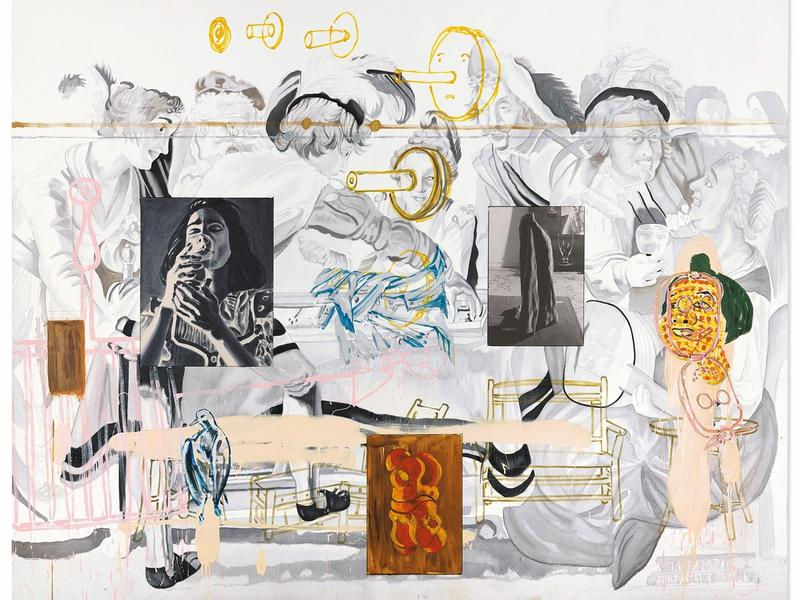
Dean Martin in Some Came Running (1990–1991) by David Salle is a large postmodern painting in oil and acrylic that exemplifies his characteristic layering of disparate imagery and cinematic juxtapositions, executed with three inset panels on the canvas. The work’s title references the 1958 film Some Came Running starring Dean Martin, while the painting itself combines historical tapestry motifs, modern figures, and fragmented visual elements to create a complex, non-narrative visual “chorus” typical of Salle’s style
Do you like what you just read and want to read more Thoughts? Subscribe today for free!
- the official blog of Aletheia Today Magazine.