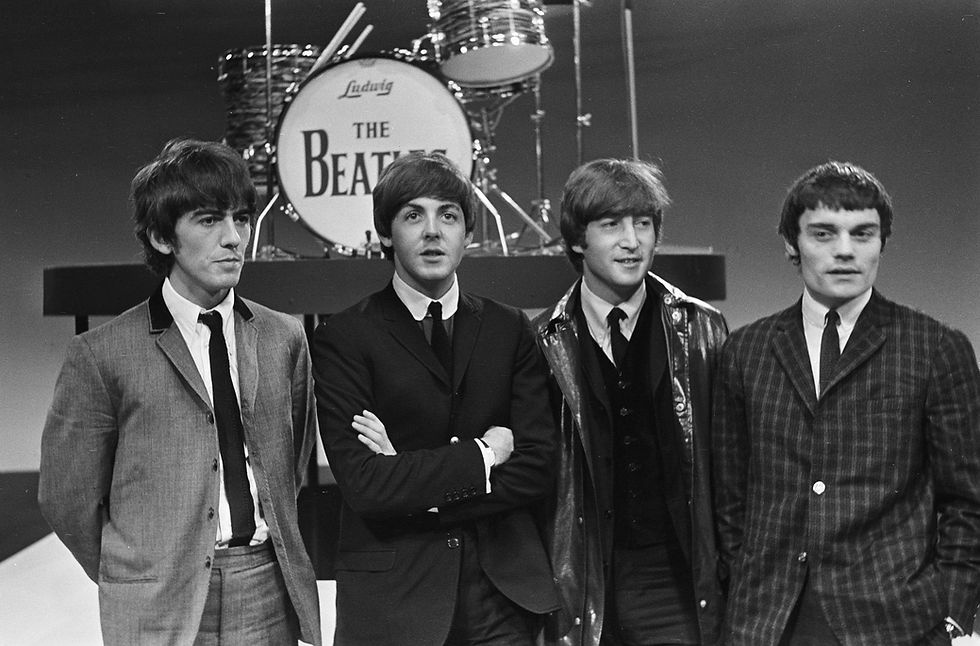
David Cowles
May 30, 2026
“The Beatles give us a model for the sanctification of everyday life…saints live in Time Square too.”
I don’t care about the Beatles. I don’t care about their fantastic music, their chaotic lives, their internal conflicts, their sad break-up or even John’s premature death. I only care about the work, the corpus, the lyrics they left behind and they “lead you to an overwhelming question” (Eliot): Do the Beatles’ songs and films contain coded messages with hidden meanings?
The Beatles may be the most iconic cultural phenomenon of the post-WW II era. Whether their corpus is to be taken at face value as pure, mindless entertainment, or whether it should be mined for cutting edge philosophical, cosmological, and spiritual insights, is absolutely central to any Intellectual History of this period.
And no one is more outspoken on this issue than the Beatles themselves. And their answer is a resounding No! Over and over again, the Beatles have told us that their music is just that, music, i.e. that ‘accidental lyrics’ are subservient to ‘essential melodies’.
They repeatedly made fun of fans seeking wisdom in pop culture and they dropped ‘fake clues’ throughout their work just to further confound misguided seekers. But of course, this is exactly the behavior you’d expect from someone concealing dangerous truths.
Those of you who frequently fly Air Aletheia (thank you, BTW) know that we have zero regard for the opinions ofcreators. The job of the creator is to create, and creation is always a blend of inspiration and perspiration. It is someone else’s job to evaluate, explain, or analyze the work. As St. Paul pointed out, there are those who speak in tongues and those who interpret tongues. They are separate charisms. (1 Cor. 12: 10b)
A full exploration of this question would be book length and might easily begin life as someone’s PhD thesis. Not mine! In today’s 1750 words, I can only hit a few highpoints, but a somewhat broader treatment can be found in the essays that make up the June 2025 issue of Aletheia Today Magazine.
I will not waste my ‘precious’ words on the Beatles’ spiritual odyssey or on the intellectual roots of their wisdom. Instead I will attempt a deep dive into what Lennon called a “throw away song,” Glass Onion:
I told you about strawberry fields
You know the place where nothing is real
Well, here's another place you can go
Where everything flows
Looking through the bent-backed tulips
To see how the other half lives
Looking through a glass onion.
An onion, glass or otherwise, is a powerful metaphor for human nature. Onions don't have a core in the way that apples do. Instead, an onion is made up of concentric layers of ‘leaves’ wrapped around a small, tightly packed center that is just the youngest, most tightly wound, of those leaves. To paraphrase Stephen Hawking, et al., it’s leaves all the way down.
Like onions, human beings have no core. We consist of concentric layers of ‘masks’, the faces we prepare to meet the faces that we meet (Eliot), carefully crafted to hide our true identities… from ourselves as well as from others. Fundamentally, each of us is neant (nothingness, Sartre , pure negation, the void.
“Everything flows” is the signature meme of Heraclitus of Ephesus (in Modern Turkey), the pre-Socratic precursor of Process Philosophy (Whitehead) and an early bridge between Asian mysticism and European materialism.
“Nothing is real” is an implied critique of British Empiricism, perhaps inspired by the Hindu concept of maya.
I told you about the walrus and me, man
You know that we're as close as can be, man
Well, here's another clue for you all
The walrus was Paul
The song appears to mock the theory, popular at the time, that Paul McCartney had died and been replaced by a doppelganger. That myth was in part based on lyrics contained in an earlier song, I am the Walrus. In fact, however, the citation draws our attention to the older song’s mystical core: “I am he as you are he as you are me and we are all together.”
This in turn reads as a reprise of Jesus’ Farewell Discourse as reported in John 13 – 16, especially “I am in my father, and you are in me, and I am in you.” (14: 20)
Standing on the cast iron shore, yeah
Lady Madonna trying to make ends meet, yeah
Looking through a glass onion
Oh yeah, oh yeah, oh yeah (yeah, yeah)
Looking through a glass onion
The onion is a metaphor for the many elaborate disguises that conceal the existential singularity that is our ‘core’ (or anti-core). Most onions are opaque; they do the job nicely. But the Beatles are proposing something different: a glass onion that would allow us to see through each other’s masks right down to our shared core. Just imagine! You keep your masks and I keep mine, but they are transparent now and we can see through them right down to our common core.
There is a strong parallel here with the New Testament Book of Revelation. John of Patmos, the purported author, is allowed to see eschatological reality (the existential void) but only by breaking in succession the 7 seals that conceal that reality from the world (What did John See) .
The glassification of the Beatle’s onion is the ontological equivalent of the breaking of John’s seals. In both cases the existential core is made manifest. But in John’s case, the masks (seals) must be destroyed (broken). According to the kinder, gentler Beatles, those masks may be left in place; they need not block our view of ultimate reality.
In the practice of meditation, beginners often complain of incessant distractions. The tendency is to resist them, like smashing John’s seals, but a better practice is just to let them be: don’t fixate on them, don’t feed them with your attention, just let them come…and watch them go. Glass Onion suggests we adopt a similarly tolerant attitude toward our masks.
‘Mother Mary, Lady Madonna’ plays an outsized role in Roman Catholic theology and in Beatle-ology. In an earlier post on this site Mother of God, following guidance from Pope Leo XIV, we spoke of Mary’s dual role as Jesus’ mother and the first fruits of his redemptive act. Who better to be first to see through the glass leaves?
The Beatles give us a model for the sanctification of everyday life. Holiness does not demand that we live ascetic lives in isolated desert huts; saints live in Time Square too.
On the other hand, there remains a cosmological role for the guru, the shaman, the holy man (sic) of God. Thomas Merton wrote that a few scattered contemplatives, praying continuously, hold the universe together. Drawing on ancient Sufi tradition, reprised by Shakespeare in King Lear, the Beatles refer to their shaman as a fool.
I told you about the fool on the hill
I tell you man, he's living there still.
The role of the fool is the most transparent part of this song. He is in every respect a traditional Sufi master and his appearance near the end should remove any lingering doubt re the Beatles’ mystical intent in Glass Onion. I mean, how else could you possibly interpret this?
“Day after day, alone on a hill
The man with the foolish grin is keeping perfectly still
But nobody wants to know him, they can see that he's just a fool
And he never gives an answer
But the fool on the hill sees the sun going down
And the eyes in his head see the world spinning around…”
I can’t imagine anything I’d rather have as my epitaph. Sadly, I don’t merit it.
Well here's another place you can be
Listen to me
Fixing a hole in the ocean
Trying to make a dovetail joint, yeah
Looking through a glass onion.
“Can God make a rock too heavy for him to lift?” Superlatives, like infinities, lead to logical contradictions. Nordic culture had a handle on this 500 to 1,000 years before its southerly neighbors (us). Tasked with fashioning an ‘unbreakable chain’ the Norse realized that they would need to use ‘exotic materials’, e.g. the sound of a cat’s footfall, a woman’s beard, a fish’s breath.
Intuitively, the Norse understood that arithmetic needed to expand beyond the set of Real Numbers to include trans-finite and imaginary numbers in order to be useful in the construction of real world models. Bumper Sticker: “Real World – not Real Numbers!”
Operations that are impossible according to conventional topology (above) might become possible once transparency (and permeability) is universal.
It's a goal, It's a goal, It's a goal , It's a goal, It's a goal , It's a goal, It's a goal.
The song’s final line recalls an enthusiastic radio announcer broadcasting a soccer match. A goal, of course, is a singularity: all play stops and resets. The fact that this meme repeats exactly 7 times may recall the 7 seals from Revelation (above).
Rather than making fun of the pseudo-mystical, the climax of Glass Onion utterly trashes our secular culture. An archipelago of contemporary sporting events has taken the place of a lifelong quest for meaning and redemption. Isn’t progress grand! The cry of the sportscaster replaces the call to prayer and the sound of angels smashing the locks on the gates of knowledge. We have become a pitiful lot indeed.
Of the Beatles’ many triumphs, none tops the successful hiding of the entire Sufi cannon in a string of pop songs and movies (Yellow Submarine). In 2200 CE, when the Intellectual History of the 20th century is rewritten for the umpteenth time, now by colonists on Europa, the authors will marvel at how so much information could have been so successfully hidden from view in an age as sophisticated as ours.
The credit does not go to the Beatles’ cryptologists. In many ways their codes are Hardy Boy transparent. But like any good magician (Magi = Sufi) they have distracted us…in this case with glorious melodies, ear catching poetry, psychedelic imagery, and their own deflecting, self-deprecatory commentary.
But enough is enough! It is high time, in fact it’s long past time, to break the seals and enjoy the fantastic insights embedded in the Beatles’ corpus. Welcome!
Do you like what you just read and want to read more Thoughts? Subscribe today for free!
- the official blog of Aletheia Today Magazine.