


Dante and The Beatles
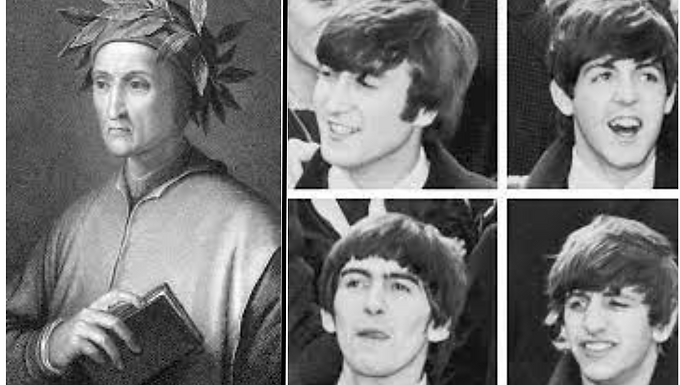
David Cowles
“If a world can or must…self-annihilate…then that world does not exist, never did exist, never will exist, cannot exist.”
“In the middle of the journey of our life I came to myself within a dark wood where the straightway was lost. Ah, how hard a thing it is to tell of that wood, savage and harsh and dense…So bitter is it that death is hardly more.” (Dante, Inferno, Canto I) “Liverpool can be a lonely place on a Saturday night… and this is only Thursday morning.” (Ringo Starr, Yellow Submarine)
650 years after Dante Alighieri completed his Divine Comedy, a rock and roll band from Liverpool, England, none other than the world-famous Beatles, retraced his steps. In 1968, they released a modern, ostensibly secular version of Dante’s great epic, a movie called Yellow Submarine.
Not that the Beatles necessarily knew that they were following in Dante’s footsteps – it probably never even crossed their minds. But inspired by intellectual and spiritual forces in their own lives, they ended up exploring many of the same themes that Dante had explored centuries earlier.
After spending a night isolated in the dark wood, unable to escape, Dante meets Virgil: “Thou must take another road if thou wouldst escape from this savage place…and I shall be thy guide and lead thee hence.” (Inferno, Canto I). The road Virgil has in mind is not through the spatio-temporal world of Tuscany but through a perpendicular world normally traveled only by the dead. Nor does he counsel flight. Instead, he leads Dante into and through the ‘belly of the beast’.
“Abandon all hope, ye that enter here,” reads the sign posted over the gate of Hell. Once inside, Dante comes to the shore of Acheron, the river of death. The souls gathered on the bank, awaiting Charon’s transport, “blasphemed God and their parents, the humankind, the place, the time, and the seed of their begetting and of their birth;” and yet “they are eager to cross the river for divine justice so spurs them that fear turns to desire.” (Inferno, Canto III)
The souls in Hell no longer have the capacity for change. They cannot repent, and they cannot influence events in the spatio-temporal world. They are defined now by their sins, and they are compelled to live out those sins forever. The sign atop the gate also reads, “Divine power made me…and I endure eternally.”
In Hell, all roads, all rungs, lead to Satan. As Dante and Virgil descend, Hell becomes colder and colder. At the very bottom, they find Satan encased in ice; here is the nadir of all being, a foretaste perhaps of the ‘heat death’ awaiting the cosmos.
But this is not the end of Dante’s journey. He and Virgil walk on and discover that the direction of their motion has changed. They are no longer descending, they are starting the ascent of Mount Purgatory: “…without caring to have any rest, we climbed up…so far that I saw through a round opening some of the fair things that Heaven bears; and thence we came forth to see again the stars.” (Inferno, Canto XXXIV)
Dante’s Purgatory is very different from his Hell. Unlike Hell and Paradise, in many ways Purgatory is reminiscent of life on Earth, except that the souls there are immaterial: “O empty shades, except in semblance! Three times I clasped my hands behind him and as often brought them back to my own breast.” (Dante, Purgatorio, Canto II)
Dante ascends Purgatory Mountain and at last crosses into Paradise. Dante’s Paradise is reminiscent of the Garden of Eden, but it encompasses the entire universe. The first and last verses of Paradiso sum it up: “The glory of him who moves all things penetrates the universe…the Love that moves the sun and the other stars.”
Let’s return now to England (c. 1968) and rejoin the Beatles as they prepare to embark on their own mystical journey. Trapped in the loneliness of Liverpool, Ringo meets the Beatles’ version of Virgil, Young Fred, the newly appointed Lord Admiral who has just escaped from Pepperland in a yellow submarine.
Pepperland has succumbed to an attack by a race of giants (from Norse Mythology?) known as “Blue Meanies”. The idyllic tranquility of this land has been shattered, its population “bonked” into a state of suspended animation and the land itself laid waste (as in the Grail Legends?). The once rainbow-colored countryside is now monochrome gray, all music silent, dancers frozen in place. Just as Eden was lost but later regained, so Pepperland has been lost and now must be regained.
Back in Liverpool, Ringo and Young Fred proceed through a gate of their own. The sign atop this gate reads “The Pier”, fitting because this will be the launch site for the Beatles’ journey to Pepperland. The Gate of Hell ushered Dante and Virgil into a land beyond imagination; so the Pier for the Beatles.
We enter a long, narrow corridor with doors every few feet on either side. Behind each door some event is unfolding, some apparently from ‘real life’, others obviously not. Plus, whenever our travelers’ attention is distracted, the corridor itself comes alive with all sorts of fantastic creatures, some of whom we will meet later in the “Sea of Monsters."
The journey to Pepperland runs through a series of “seas” (branes?) that challenge every preconception our travelers have regarding the nature of being. The first three seas deconstruct the phenomenal world into three basic elements: time, space, and objects or events. Each of these elements in turn will undergo its own deconstruction. First, the Sea of Time: “What time is it? …It’s time for time! …Look, the hands (of a clock) are slowing down…Maybe time’s gone on strike…” Here time flows at a variable rate…and it flows backwards as well as forwards.
It is ‘time for time’. Therefore, it is the womb of all possible versions of time, not just the ho-hum 9 to 5 time (or 7 to 7 these days) that we experience in our everyday lives. “I don’t want to alarm you, but the years are going backwards. If we slip back through time at this rate, we’ll all disappear up out of our own existence,” Young Fred warns. To ‘disappear up out of our own existence’ is very different from what people normally call ‘dying’.
If time is reversible (even just theoretically), then existence can be erased…retroactively. And since nothing can come from nothing (certain contemporary physicists notwithstanding), nothing is, ever was, or ever will be.
If our existence can be erased (even theoretically), how can we claim to have ever ‘been’ at all? If my existence is not a settled matter of fact (“I am”), if it can be annulled at any time – and if it can be annulled, it will be annulled - then at best I enjoy a sort of ‘virtual existence’.
John is undaunted. “Can’t we do something to the clock?… Move the hands forward, see what happens.” Outrageously, Yellow Submarine proposes that time is a function of the clocks that measure it, not the other way around as we had commonly supposed. Surprisingly, many 21st century cosmologists would agree.
The second sea, the Sea of Science, deconstructs space, showing that it can be represented just as well in 2 dimensions as in 3. Yellow Submarine suggests that a specific dimensionality is not an essential element of spatial extension. As with time, human representations of space (Cartesian grids, Platonic solids) determine what space is. The Beatles’ insight has been confirmed by Black Hole physics, String Theory, etc. The third sea, the Sea of Monsters, deconstructs objects and events. It shows that what we accept as ‘normal’ is, in fact, a very limited and highly selective subset of all the combinations of structures and qualities that spacetime could contain…and does. Here, the Beatles anticipate Stephen Gould’s Wonderful Life.
Just before Yellow Submarine was released, Hugh Everett published his famous “Many Worlds Interpretation of Quantum Mechanics”. According to Everett, everything that can happen does happen, but we can only be aware of one string of events out of innumerable actual strings. A bit like blockchain.
In the Sea of Monsters, all possible forms flourish. There is no distinction between organic structures and mechanical ones. Shape and form are indefinitely mutable. As in the seas of time and space, the stuff that appears to make up our world, i.e., objects and events, is an artifact of imagination.
This third sea is aptly named. All the creatures in this sea are indeed ‘monsters’, not because of how they look or how they are made but because of how they behave. Without exception, they are involved in activity destructive to themselves and to others. These monsters act exactly like the souls in Dante’s Inferno. Their natures are hard-wired, and they don’t have the capacity to overcome their ‘programming’. They are outside the state of grace.
Among the various monsters in this sea, one stands-out: the Vacuum Monster. As its name suggests, it is the nature of this creature to suck up everything it encounters. In this “monstrous sea”, every creature threatens other creatures, but the vacuum monster threatens them all…himself included. The vacuum monster is the Beatles’ version of Dante’s Satan, the agent of ‘nothingness’.
Sure enough, the Vacuum Monster sucks up all the other monsters. Then, seeing that there are no other monsters to suck, it sucks up the fabric of spacetime. Finally, it sucks itself, tail first, “into oblivion…or even further”. Like the souls in Hell, the monsters in Yellow Submarine are compelled to act out destructive patterns, even when that activity dooms them, both individually and collectively.
The first three seas en route to Pepperland closely resemble Dante’s Hell. Yellow Submarine suggests that all possible worlds must include an extensive continuum (e.g., spacetime) populated by actual entities (e.g., events), and it goes on to propose that any such world must necessarily be self-annihilating.
Why? First, there is no inherent reason why processes in the ‘extensive continuum’, the medium of evolution, should not flow backwards as well as forwards, inwards as well as outwards (i.e., why space should not be curled up into a point like the ‘rolled up’ dimensions posited in some versions of String Theory.)
Second, since the ‘actual entities’ are cannibalistic by nature, the incessant loom of combinations and permutations would inevitably give rise to a Vacuum Monster, a Satan, with the power to consume all things, itself included. Atomic scientist, Robert Oppenheimer, misquoted the Bhagavad Gita: “Now I have become death, the destroyer of worlds."
If a world can or must (‘can’ and ‘must’ both mean ‘will’) self-annihilate, retroactively as well as proactively, then that world does not exist, never did exist, never will exist, cannot exist. If being can be annihilated, it really isn’t ‘being’ at all, is it? Things can come and go but being itself either is…or isn’t. If being is actual, well then it is; but if it’s not…it’s not.
According to this model, without some reference point beyond itself, it is inevitable that any possible world would annihilate itself; and if all possible worlds are doomed to self-annihilation, then no such world can possibly exist. Yellow Submarine begins ostensibly as a secular ontology, but it ultimately proves that no consistent secular ontology is possible, other than hardcore nihilism.
Remember, Dante’s Hell is only possible because “Divine power made me…and I endure eternally.” The ontology of the Divine Comedy is not secular. The story of the Yellow Submarine builds on Dante’s insight and, as we shall see, forces the conclusion that all possible secular theories of Being are necessarily inconsistent; but back to our story…
Of course, the Vacuum Monster does his worst, and predictably we are left with no time, no space, no anything. Like Dante, our ‘lads’ have reached the nadir of being, an empty state which the Beatles appropriately call, “Nowhere Land”. This would seem to be the end of our voyage…and of our adventure...and of us. But not so! It turns out to be just the beginning. As Mary Tudor said, “My end is my beginning.”
Nowhere Land may be located at the nadir of Hell but, as Dante discovered, your very next step takes you in a different direction, up Mount Purgatory toward Paradise. Plus, it also turns out that Nowhere Land is not entirely empty after all. It is not a void. It is more like the world, as the Book of Genesis describes it, just before creation:
"…The earth was without form or shape, with darkness over the abyss and a mighty wind sweeping over the waters.” Not much of a vacation destination to be sure (though I’ve been to worse), but not quite empty either.
In Nowhere Land, there is a proto-being by the name of Jeremy Hillary Boob, Ph.D. The Beatles aptly call him “Nowhere Man”. Dr. Boob (‘JHB’) is quite literally what’s left of a world after its total destruction. JHB is pure information; but the information is so totally disorganized that it cannot know what it knows, and so it cannot be harnessed to do any ‘work’.
It does not have the power to make a difference, so neither does Jeremy. If the criterion for existence is “a difference that makes a difference” (to misapply a phrase stolen from Gregory Bateson), then JHB does not exist in any true sense of the word. He is being’s ghost.
Stephen Hawking showed that black holes have the power to annihilate everything that falls through their event horizons; but he also showed that these same holes radiate the information they consume back into the cosmos. Jeremy is that information; in Hawking’s terms, he is the black hole’s “hair."
According to the oldest-known Western philosopher, Anaximander, ‘actual being’ comes about only when two or more ‘potential beings’ grant each other “reck”. Unlike the souls in Dante’s Hell and the creatures in the Sea of Monsters, Anaximander’s proto-beings avoid the allure of mutual self-destruction and decide, independently of one another, to let each other be (Let it Be – Beatles). They do not do this out of any hope of personal gain or out of any expectation of reciprocity; they do it out of Love.
This is a decision that all of us in the living world have the opportunity to make every day. Every time we treat another as we would want to be treated, we co-create the universe with God. The souls in Hell do not have this opportunity; by their unrepented sins they have forfeited it. Neither do the creatures in Sea of Monsters; they are destined to destroy themselves and everything around them.
There is no Love in Hell, or in the Seas of Time, Science and Monsters. So, where does this totally selfless Love come from? What is its origin? In a universe powered by mutually assured destruction, the decision to let an adversary survive, risking your own doom in the process, is utterly ‘unnatural’. Therefore, it has to originate outside the ‘natural’ (spatio-temporal and material) world.
The Love that drives the universe must be transcendent. For Dante, that means Paradise; for the Beatles, Pepperland. Take your pick!
JHB does not (actually) exist, but he does have the potential to exist. He needs someone (or something) to grant him reck and for him to grant reck to. Enter the Beatles! They choose to befriend the Nowhere Man: “Mr. Boob, you can come with us if you like.” “You mean you’d take a nowhere man?” “Come on, we’ll take you somewhere.”
As a member of the crew, the Boob finds purpose and with that purpose, he begins to organize his information, so he can use it to ‘make a difference’…which, ultimately, he does. He becomes a full-fledged ‘person’ after all, a Pinocchio, a ‘real boy’.
The Beatles and the Boob grant each other reck and, as Anaximander predicted, ontogenesis results! But to be born out of mutual reck, out of Love, is not to exist merely in the spatio-temporal, material realm; it is also to exist in an eternal realm. To be is necessarily to transcend the limitations of space, time and matter/energy. It is our thesis that a cosmos limited to space, time and materiality, i.e., a secular universe, could not exist.
From Nowhere Land, the Beatles’ journey is now upwards toward Pepperland, just as Dante’s journey was upwards toward Paradise. Next stop: the “Foothills of the Headlands”. This is the land of disembodied thought. Its inhabitants desire to help the Beatles on their journey, but they cannot. Like Dante’s souls in Purgatory, these creatures are immaterial and powerless to bring their goals to fruition.
After the Headlands comes the Sea of Holes. Here we pass into the realm of ‘negative space’. The usual relations of figure and ground are reversed. The sea itself is the ground, and the holes in that ground constitute the figure. Nothingness has become concrete, so concrete that Ringo is actually able to put a ‘hole’ into his pocket.
The topology of this sea is radically non-orientable. There is no consistent sense of directionality, no spatial ordering. It’s like an Escher drawing on steroids. But if the Sea of Holes is evidently non-orientable, then the entire universe in which it is embedded, including Liverpool and Pepperland, must also be non-orientable, albeit less obviously so.
We may say that the universe is locally orientable but globally non-orientable because it has the Sea of Holes embedded in it. Think of the world we live in: earth appears flat (locally) but it is round (globally).
In the words of the Paradiso, “The glory of him who moves all things penetrates the universe and shines in one part more and in another less.”
Here, Yellow Submarine diverges slightly from the Divine Comedy. Dante has the experience of non-orientability when he is on the threshold of Purgatory. “I raised my eyes and thought to see Lucifer as I had left him; and I saw his legs held upward.” (Inferno, Canto XXXIV)
Just as Dante and Virgil turn to leave Hell, Dante looks back and is surprised to see Satan upside down, a reversal of directionality that is the trademark of non-orientable spaces. Passing through the Sea of Holes, the Beatles experience that same signature reversal of orientation.
The Sea of Holes leads to Pepperland…but not so fast! You may only enter through an infinitely thin membrane (an event horizon?) called the “Sea of Green”… and only one of the holes in the Sea connects to the Sea of Green. There are innumerable holes to choose from.
Conceivably, one could spend ‘a lifetime plus’ searching for the one hole that connects with the Sea of Green, then on to Pepperland…and never find it. Neither Dante nor the Beatles can reach their goal without the intervention of grace.
Fortunately, our Argonauts do find the Sea of Green, and when they do, they immediately find themselves in Pepperland. Remarkably, Pepperland looks a lot like Liverpool, i.e., it’s drab…and lonely. But the Beatles quickly “unbonk” the Lord Mayor with “a snatch of a tune” and “ready the land to rebellion”. It is now that they discover that they bear an “uncanny” resemblance to four of Pepperland’s permanent residents, the members of Sergeant Pepper’s Lonely Hearts Club Band.
In fact, the Beatles are Sergeant Pepper’s band! They are Beatles under the aspect of spacetime, but they are Sergeant Pepper under the aspect of eternity.
Together, the historical Beatles and the eternal Pepper Band use music to restore Pepperland to its former glory. Their battle hymn: All you need is Love! The Blue Meanies are routed. But in the spirit of Love, the Beatles offer reconciliation: “Hello there, blue people. Won’t you join us?” And of course, they do: “Yes, let’s mix, Max!” It is said that the fundamental question of philosophy is: “Why is there something rather than nothing?” The myriad answers proposed seem to fall into three categories:
Chance. Being is an accident. There might just as well not be Being, but it just so happens that there is.
Necessity. Being is a necessity. It is in the nature of Being that it must be. (Ontological Argument)
Choice. Here one is reminded of the great words from Deuteronomy: “I set before you Life and Death…therefore choose Life.” (Deut. 30: 19) Dante and the souls in Paradise choose Life; so do the Beatles and the Boob.
Choice is not the same thing as chance. Choice can only be motivated by values, and all value ultimately boils down to Love: All you need is Love!
For Anaximander, Love is mutual ‘reck’; for the Beatles, that Love is embodied in music; for Dante, Love is Paradise itself, “the Love that moves the sun and the other stars.”
In his master work (Process and Reality), British philosopher Alfred North Whitehead combines these views. All values come from the “Primordial Nature of God”, i.e., God’s eternal valuations, outside of space and time; but those values in turn are only fully realized in the “Consequent Nature of God”, which includes spatio-temporal, material events. The Consequent Nature of God reconciles all things to each other and with God’s primordial values (I Cor. 15: 24 – 28).
Welcome to Paradise! And a special thanks to Dante and the Beatles for showing us the way.

David Cowles is the founder and editor-in-chief of Aletheia Today Magazine. He lives with his family in Massachusetts where he studies and writes about philosophy, science, theology, and scripture. He can be reached at david@aletheiatoday.com.