Search Results
Search this site
1265 results found with an empty search
- Do Nebulae Think? | Aletheia Today
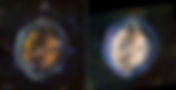
< Back Do Nebulae Think? David Cowles May 17, 2026 “If nebulae do think they, if they are conscious, we may assume that they integrate information…across light years.” 1300 words, 6 minute read In 1974 Thomas Nagel earned himself a permanent position in the Intellectual Pantheon of the Western World. His signature essay, What’s it like to be a Bat , catalyzed the Search for Intelligent Life on Earth (SILE): “There is something that it is like to be a bat…what it is like for a bat to be a bat…because we know what it is like to be us.” (Do we really?) At least in the Judeo-Christian West, folks have long imagined themselves ‘little less than angels’. (Psalms 8: 5, Heb. 2: 7 – 9) Prior to Darwin, any suggestion that we were more Gorilla than Gabriel would have been considered preposterous. And prior to Nagel, extending monikers like ‘conscious, intelligent, sentient’ to non-human life forms was a non-starter. Besides, we were occupied with more serious questions: Should we extend these monikers to women, to children, to members of other races, other ethnic groups, other nationalities, other age cohorts, other political parties, other social castes? Heady stuff! I’m pleased to report that we’ve made uncharacteristically significant progress in these areas over the half-century since Nagel, and there is now something approaching consensus that even certain non-human life forms are intelligent and conscious. Primates and Sea Mammals make almost everyone’s list. Corvids (ravens, parrots, crows), Cephalopoda (octopus), and Pachyderms (elephants) show up frequently as well. They know what they know, and they know that they know it, and they project similar self-awareness onto others in their community (so-called ‘other minds’). There is even serious conversation now about the mental status and intellectual life of forests, plants, fungi, and…wait for it…unicellular organisms. The average adult human body consists of about 30 trillion of these little critters – we call them ‘cells’ - working together to promote the survival (and fecundity) of a single host: You! Researchers at Carnegie Mellon University have recently shown that bacteria (prokaryotes) can learn from past experiences, store memories and access those memories when deciding future behavior. Snooze fest? Ok then, how about this? They can pass these memories on to future generations - something we can only approximate via our elaborate cultural superstructure. And they can use remembered experience when imagining and evaluating novel responses to changes in their environment. Did I mention, they do all this without a nucleus, much less a brain or nervous system? *** Phenotypically, life on Earth could not be more varied - from figs to ferns, bats to bacteria, cabbages to kings. But structurally, behaviorally, even morphologically, all life on Earth is remarkably similar. Birds fly, so do bats, so do bugs, and so do we (thanks to our technology). Different structures support similar functions. For example, many animals have a sense of sight but the organ of sight, the eye, has evolved many times, independently and differently, across multiple species. Apparently being able to see is a useful trait. At the same time, similar structures enable different functions. For example, fish have gills for breathing, but we use ‘their’ gills for hearing. Gills and ears have the same structure but very different functions. Evolution, the wellspring of biodiversity, is also convergent: several organisms from different limbs on the tree of life may evolve similar traits/structures via radically different pathways. The features in question confer survival (reproductive) advantage across phyla and a variety of unrelated structures can serve as ground zero for their development. Plus every member of every species now living on Earth is descended from a single DNA molecule synthesized about 4 billion years ago. How’s that for bio-similarity? So on the one hand, no two cells are identical (mutation, epigenesis) but on the other hand, all cells are clones of a single aboriginal cell. Can we find similarly homologous structures in the inanimate world as well? *** No self-respecting 6 th grade geek has failed to notice similarities in the structure of atoms, a fundamental unit of physics, and that of eukaryotic cells, a fundamental unit of biology. “Nucleus & Electrons, meet Nucleus & Mitochondria” - not bad for the first day of middle school. Our cognitive lenses seem to work better as a microscope than as a telescope. We can detect congruent patterns in regions of the cosmos twenty orders of magnitude smaller than us, and we are not shy about attributing common functions to such congruent structures. For example, recent studies reinforce our conviction that bacteria have functioning memories, learn from experience, and calculate behavioral strategies. But we are less apt to recognize structural congruence on larger scales, and we are much less willing to posit homologous function on that scale. The same structure we noticed in atoms and eucaryotic cells appears in solar systems, galaxies, and galactic sheets. At the highest level of generality, the network of galaxies in the universe forms a pattern eerily similar to the network of neurons in the human brain (nodes and filaments). A recent photo taken by the JWST of Nebula PMR 1 (left image, above), stretching more than 5 light years across and located some 5,000 light-years from Earth, reveals a structure similar to that in an MRI (right image) of an unremarkable human brain. Note especially (1) the inner concentration of structural elements protected by an outer membrane, and (2) a division of those elements into two hemispheres, separated by a longitudinal fissure. Co-incidence? Sure. An example of the self-similar organization of the cosmos? That too! According to the popular holographic model of cosmology, the universe is self-similar across all scales, so we will not be surprised if it turns out that the Cosmos is similar to the Quantum. *** Consciousness is strongly associated with patterning: Consciousness seems to be emergent in entities with certain structural similarities, and it consists of the patterns it discovers. (There is a strong argument that we are only conscious of patterns; true one-offs go unregistered.) Finally, consciousness appears to impose its own patterns when confronted with random sensory input: “Rows and flows of angel hair and ice cream castles in the air…It’s clouds Illusions (patterns) I recall, I really don’t know clouds at all.” (Joni Mitchell) Patterns are often self-similar across scales and across various material substrates. To bastardize Stephen Hawking, et al., “it’s patterns all the way down”. Perhaps a more useful phrasing would be, “it’s patterns discovering patterns,” suggesting that the propensity to form patterns ( logoi ), may be substructural, applying equally to the percipient and to the perceived. There is growing unease among biologists re the shortcomings of the Neo-Darwinian framework. Epigenetic effects are not only real but critical for the evolution of cells and, contrary to long held beliefs, epigenetic modifications can be inherited. The ‘sins’ of the father (and mother) are indeed visited on future generations. Further, it is increasingly clear that the central assumption of Neo-Darwinism, that mutations occur randomly and that natural selection simply operates to conserve the most adaptive variations, is wrong. It is virtually certain that cells control gene expression by the decisions and choices they make . Likely, all cells are sentient and self-aware and capable of decision-making and problem-solving at some level. These cellular faculties rely on information integrated across the entire cell. Consciousness seems unrelated to the volume of information. Instead it is a function of, and a driving force for, information integration and so ‘interconnectedness’ becomes the measure of consciousness. If nebulae do think, if they are conscious, we may assume that they integrate information, not across nanometers but across light years. So are the patterns of celestial objects in Nebula PMR 1 and neurons in our skulls sufficiently similar to allow both to support consciousness ? Has PMR 1 discovered the meaning of life? Share, please! Previous Share Next Do you like what you just read and want to read more Thoughts? Subscribe today for free! Thoughts While Shaving - the official blog of Aletheia Today Magazine. Click here.
- I Shop, Therefore I Am | Aletheia Today
< Back I Shop, Therefore I Am David Cowles Aug 11, 2022 I before me except after T (Theos) According to Genesis, "...God said: Let there be light and there was light, and God saw that the light was good ." (Gen. 1:4) From the outset, Being and Value have been inseparable... for God, and for us! We evaluate whatever we experience, and we experience only that which we evaluate. Experiencing and evaluating, apparently so different, are, in fact, two aspects of one process. Life according to Schrodinger: nothing has ‘value’ until someone measures (evaluates) it. Our experience of things is always in terms of our wants and needs. Utility is proto-value . “This is good for that,” “that is better than this,” ad infinitum . We retrace God’s steps on our own road to consciousness. Genesis says that we are made in God’s image and likeness. Well, in that case, the apple didn’t fall too far from the tree. We build what we imagine to be a map of the world ‘as it is,’ but, in fact, what we are building is a map of comparative utility. What works becomes the cities and roads that dot and criss cross our map; and what doesn’t work? “Here, there be monsters!” We end up with what looks like a schematic for assembling a child’s toy on Christmas Eve. We are looking at the display case (‘the window’ in the language of retail), not the inventory (‘the warehouse’). According to Sartre, our map is ‘hodological,’ not ‘existential.’ We are not sketching the world ‘as it is;’ rather, we are modeling the world as a multiplicity of levers, some furthering our projects, some inhibiting them. Like the Beatles in Yellow Submarine , we ‘Liverpudlians’ are born Leverpullers . We are like Christopher Columbus, searching for India, finding South America, but calling it ‘India’ nonetheless. We set out in search of the world but all we find are the footprints of our own needs and desires. What we imagine to be ‘the substructural world’ is really a superstructure of obstacles and tools, at least as far removed from the substructure as Kant’s phenomena are from his noumena. It is through our needs and desires that we first access the world. Consider a baby, a newborn, experiencing hunger, i.e., the need and desire for food. The newborn has no map, at least nothing worthy of the name, but that’s about to change. The baby soon learns that some behaviors are instrumental for the satisfaction of hunger, other behaviors not so much. Et voila, a map is born! The map fills in with more detail as baby discovers additional behaviors associated with the satisfaction of hunger and other behaviors efficacious for the satisfaction of other wants and desires. For human beings, at least, map building is synonymous with living. How do I get my first taste of food becomes how can I get my last shot of morphine. Life is one long, continuous, but never boring, game of Battleship . We are constantly probing: ‘there’ is safe, but ‘here’…not so much. It is perhaps more accurate to say, “I shop, therefore I am,” than it is to say, “I am, therefore, I shop”. For human beings, doing precedes being (per Sartre, my existence precedes my essence). I act …therefore I am; I am …therefore I react . It’s a bat’s life! Like Noah releasing a dove to measure the course of the Flood, I too release reconnaissance drones into the world. Like Noah, I learn as much, maybe more, from the drones that don’t return as I do from the ones that do. For our part, we are continually sending unguided missiles into the undifferentiated environment; we wait for feedback. So, we have to stand Rene Descartes on his head (what a sight!). "I think, therefore I am" becomes "I am, therefore..." I am before I am. I before me except after T ( Theos , God). Our primal experience is not one of thinking, or even of doing, but of being – being, initially undifferentiated between 'self' and 'other', far below the level of conscious thought, a 'still small voice', the small 'I am' that echoes the great 'I AM' (Ex. 3:14). Essentially, God is Good; existentially, God is Being. Therefore, Being is Good. When sipping espresso at your favorite sidewalk café in Paris, it is fashionable to talk of essence sans existence and existence sans essence. But what happens in Paris stays in Paris! In the world the rest of us live in, nothing is unless qualities are manifested, and qualities are 'insufficiently real' until they have been exemplified in the constitution of an actual being. Thoughts While Shaving is the official blog of Aletheia Today Magazine ( ATM) . To never miss another Thought, choose the subscribe option below. Also, follow us on any one of our social media channels for the latest news from ATM. Thanks for reading! Previous Share Next Do you like what you just read and want to read more Thoughts? Subscribe today for free! Thoughts While Shaving - the official blog of Aletheia Today Magazine. Click here.
- Our Inanimate Neighbors | Aletheia Today
< Back Our Inanimate Neighbors “Awareness is always dynamic; it has no spatio-temporal location… Awareness is not a property of entities, or even of organisms; it is a property of networks.” David Cowles Do you ever wish that you’d still be alive when all of life’s biggest questions are finally resolved? Job said that dying without knowledge was the worst fate that could befall a human being. If so, it often seems as if that fate-worse-than-death is in store for all of us. But good news, you can relax! Problem solved; quest completed; target acquired; Grail in hand. You did it. You lived to see perhaps the most pressing problem of philosophy solved, right here, right now, in your lifetime, before your very eyes. But to appreciate that, we need a little background. Who am I and who is my neighbor? Two of the most profound, and contentious, questions in human history. According to Descartes, I am a being that thinks ( cogito ergo sum ). Such cognition must include awareness of an environment and awareness of an awareness of that environment. Cognition is recursive. It is its own object. Logically, then, anyone (or anything) that displays similar ‘recursive awareness’ must be my neighbor. So far so good, but the converse is pernicious: if you are not my neighbor, you cannot have recursive awareness. To our 21st century sensibility, the way forward seems obvious: draw up a list of beings who are capable of ‘recursive awareness’, like me, et violà – meet the neighbors! Instead, though, we begin by drawing up lists of our neighbors. Not on the list? Sorry, you must not possess recursive intelligence. How 20th century! Being neighbors is like belonging to an exclusive country club. To join, you need sponsors, and you need the approval of the other members. “I’m so sorry that you didn’t get in. Better luck in your next reincarnation!” For untold millennia, my neighbors were the members of my tribe . Beginning with my extended family, the concept of ‘tribe’ radiates outward: my village, my culture, my race, my class, my nationality, etc. A defining feature of tribalism is its insistence on dehumanizing, then marginalizing, everyone and everything that does not belong to my tribe. Membership does have its privileges (apologies to American Express). If you’re not my neighbor, then what are you? At best, you are a ‘proto-human’, a neanderthal or perhaps a yeti; less fortunately, you may a ‘beast’ or a ‘zombie’ or an ‘alien’ or even an inanimate object. Pity the lonely, inert paperweight, sitting on my desk. It wanted to join my club but got turned down; now it is forced to interact with me every day knowing that it didn’t measure up. I feel sorry for it but what can I do? A lowly paperweight is just not a member of my tribe! Or is it? On this website ( www.aletheiatoday.com ), we have spent some time visiting with the Piraha , a small, semi-isolated tribe in the Brazilian Amazon. Although the tribe graciously welcomes “European” traders, missionaries, anthropologists, linguists, etc., they do not regard these visitors as ‘fully human’. Tribalism is a virtually universal phenomenon in human culture. And us today? Are we still tribal? You bet we are! Grade school possies, middle school cliques, college frats (sic), country clubs, the Mafiosi. For all its endearing features, tribalism is a nightmare from which humanity is struggling to awake (apologies to James Joyce). Did Jesus kick-off this awakening some 2,000 years ago when he told the parable of the Good Samaritan? (I mean, if a Samaritan can be my neighbor, who can’t be?) Or was it Mister Rogers? Either way, in our lifetimes, a radical but welcome consensus is finally emerging: all human beings are my neighbors! Even if you don’t share my race, my class, my religion, my political party, or my nationality, you’re still my neighbor, i.e., you are my ontological equal. You exhibit recursive awareness. Red state? Blue state? Still a state! But before we get too self-congratulatory, we need to ask what the meaning of ‘all’ is (apologies to Bill Clinton). For example, does it include the ‘unborn’ and if so, when? At conception? At viability? At birth? How about babies likely to be born with serious birth defects? Does it include the very old? The disabled? The mentally ill? The ‘cognitively challenged’? How about someone who has been declared ‘brain-dead’? Or convicted of a capital crime? Not so simple after all, is it? Still, we have made progress. In fact, in recent decades, we have begun to consider whether the franchise tag (“neighbor”) should be extended beyond the boundaries of our species. What about certain primates (e.g., gorillas)? Sea mammals (e.g., whales)? Corvids (e.g., ravens, parrots)? And what about Spot, the family pet? What of our siblings in the Vegetable Kingdom? For example, how about trees, networked in a forest, that apparently communicate with each other and engage in purposive, collective, and, unlike some humans, consistently eleemosynary behavior? Yup, we’ve come a long way…but we have miles to go before we sleep (apologies to Robert Frost). Below this terrain, “Alph, the sacred river, ran through caverns measureless to man (sic).” (Coleridge) I’m talking metaphorically about the underground river of panpsychism . From Greek philosophy (Anaximander) to Monasticism (St. Francis), to Native American spirituality, to Hasidism (the Baal Shem Tov), to Process Philosophy (Alfred North Whitehead), to modern-day Druids and Greens (Gaia), there have always been people proposing to extend the ‘neighbor tag’ beyond the human species, beyond the Animal and Vegetable Kingdoms, perhaps even to so-called inanimate objects . If these folks are right, literally everything changes! There is no more we and they ; there is always just us . There are no more subjects and objects ; now there are just entities . There are no more active or passive verbs ; there are only events. Nothing is secular or profane; everything is sacred. Recursive awareness is everywhere. The universe is alive…and conscious! But are these people right? (Smart money says otherwise.) Yet, an article recently appeared in Nature Communications (link below) and was summarized by “Astrobiology”. Let’s sample that summary: From a distance, they looked like clouds of dust. Yet, the swarm of microrobots in author Michael Crichton’s bestseller Prey was self-organized. It acted with rudimentary intelligence, learning, evolving, and communicating with itself to grow more powerful. “Basically, these little nanobots become self-organized and self-aware,” said Igor Aronson, Huck Chair Professor of Biomedical Engineering, Chemistry, and Mathematics at Penn State, explaining the plot of Crichton’s book. A new model…inspired by Crichton’s novel, describes how biological or technical systems form complex structures equipped with signal-processing capabilities that allow the systems to respond to stimulus and perform functional tasks without external guidance… Taken individually, the material has no intelligence or functionality, but collectively, the material is capable of responding to its environment with a kind of emergent intelligence, Aronson explained: “What I’m working on is distributed artificial intelligence. Each element doesn’t have any intelligence, but once they come together, they’re capable of collective response and decision-making… We identify the decision-making machinery of the individual active agents as the driving mechanism for the collectively controlled self-organization of the system.” ( Multi-scale organization in communicating active matter , Nature Communications - open access.) Continuing in my own voice, I have fingernails, I am aware that I have fingernails, and I am aware that I am aware that I have fingernails…and they are to be found at the ends of my fingers. I enjoy recursive awareness (aka consciousness). I am aware that I enjoy recursive awareness, and I am even aware that I am aware that I enjoy recursive awareness. And where is that consciousness located? Not in my brain, not in my neurons, not even in my entire organism per se . Consciousness is an emergent property, an emergent property of a network, in my case, a neural network. It is a process; it is dependent on an underlying structure, but it is neither the structure itself nor the element of that structure. Awareness is always dynamic; it has no spatio-temporal location. The entities that form the structures that support awareness are located in spacetime, but the awareness itself is not. Awareness per se is spaceless and timeless, even though the object of that awareness occupies a region in spacetime. So, what’s changed? Only everything! It had been thought that only certain types of entities (e.g., neurons) could network to support awareness. Now it seems that that is not true. A network of entirely inanimate objects can support awareness. Awareness is not a property of entities, or even of organisms; it is a property of networks. Even the unholy trinity, ‘me, myself and I’, is not aware per se . I am simply the locus of a network that supports awareness. This, in turn, solves a major mystery: how is it that patients under anesthesia are not aware and not aware that they are not aware? For them, an entire region of spacetime has been obliterated. Why? Because the network they house is temporarily shut down. It’s a whole new world out there! And we will need new science and new philosophy to accommodate it. Turns out, this is a great time to be alive after all. David Cowles is the founder and editor-in-chief of Aletheia Today Magazine. He lives with his family in Massachusetts where he studies and writes about philosophy, science, theology, and scripture. He can be reached at david@aletheiatoday.com . Share Previous Next
- Do you Know *What I am*?
“I am my own great-grandmother (‘Eve’). Eerie…not to mention incestuous.” < Back Do you Know *What I am*? David Cowles Dec 1, 2023 “I am my own great-grandmother (‘Eve’). Eerie…not to mention incestuous.” I came to be sometime during the month of December, not nine months later, as is usually supposed. On a cold winter’s day, two chromosome-deficient sex cells, one from a biological woman and one from a biological man, fused to form a single, chromosome-sufficient cell, me . So, I am a unicellular eukaryotic animal (a cell with a nucleus). That nucleus houses my genome (DNA), combining genes inherited from my father's cell and from my mother's cell. Absent random mutations, this DNA molecule contains all the information needed to generate the organism that is currently writing and typing this article. So, I am an organic molecule (DNA). 4 billion years ago, give or take, a bunch of prebiotic molecules on a newly formed planet (Earth) combined to form the first DNA molecule. Every life form on Earth is powered by DNA, and, as far as we know, DNA evolved on Earth only once. All terrestrial organisms, even me, are descended from this one primordial DNA molecule. “Hello Eve! Or would you prefer I called you ‘Granny’?” Unicellular animals usually reproduce asexually. After cell division, there is no more ‘parent cell’ per se , just two ‘daughter cells’, but those daughter cells, ab initio , are both identical to the sublimated parent cell. Therefore, we could just as well say we are left with two ‘parent cells’. So I am the primordial DNA molecule whose clones power all life on earth. According to James Joyce ( Ulysses ) Hamlet was his own father’s ghost; now I find out that I am my own great-grandmother (‘Eve’). Eerie…not to mention incestuous. Immediately, primordial DNA used its protein-building capabilities to construct a moat and an outer membrane (cell wall) to protect itself from the environment. The membrane is sufficiently porous to permit alimentation, elimination, respiration, and hydration. We call this fortified entity a cell. All terrestrial life consists of cells, singularly or in various aggregations, and all cells embody copies, however altered, of the primordial DNA molecule. Thus, all cells are direct descendants of the primordial cell, me . The primordial cell was probably a close ancestor of what we now recognize as bacteria. I hear that on the grounds of certain posh primary schools, it is common for bullies to berate their victims, crying, “You bacterium!” Well, I am a bacterium and proud of it – deal with it! I am a bacterium, and I also provide shelter and succor to other bacteria. Billions of Eve’s descendants are swimming around in my intestines right now…and thank God for that! I literally could not leave home without them. About a billion years later—who’s counting?—one bacterium engulfed another, probably with the ‘intention’ of consuming it, but for some reason, it changed its ‘mind’. In the terminology of Anaximander, the grandfather of Western philosophy (c. 500 BCE), these two bacterial cells ‘gave each other reck’. They traded ‘Dog eat Dog’ for ‘Live and Let Live’. The wolf lay down with the lamb, and the Judeo-Christianity ethic was realized. “Blessed are the peacemakers – they will be called children of God.” (Matthew 5:9) Shalom! In the words of Humphrey Bogart ( Casablanca ), this was ‘the start of a beautiful friendship’. The two bacteria formed a symbiotic relationship that ultimately gave the world T-Rex, bonobos, and me ! So, don’t let anyone tell you that Love doesn’t make the world go ‘round; it sure does! When primal great grandad reproduced, he produced cells already fitted with DNA harboring nuclei. Sensing a new lifestyle opportunity, other bacteria wandered across the porous external membranes of eukaryotic cells. Should I compare these host cells to black holes…or to Hotel California? Either way, what goes in does not necessarily come out. Like feudal vassals, these bacteria yearned for the relative safety of life behind cell (manor) walls. Unlike Benjamin Franklin, they willingly traded independence for security. But it was not such a terrible bargain! These late-coming bacteria set up shop in the cytoplasmic sea that surrounds a host cell’s nucleus. Cytoplasm, a biotic soup, is insulated from the cell’s external environment and from its internal nucleus and other organelles by a network of protective lipid membranes. But would these host cells allow these invading freeloaders to enjoy the comforts of intracellular life at no cost? We’ll never know. The hosts’ generosity was never tested because these ‘invaders’, like medieval craftsmen, immediately went to work, making themselves useful to their landlords. Smart cells! This second wave of in-coming bacteria became mitochondria, the primary energy-producing organelles in a modern eukaryotic cell. Numbers vary, but the average cell harbors (and exploits) about 1,000 of these mitochondria. Yet, this is not exactly ‘slavery’. In exchange for their labor, these mitochondrial bacteria are given a lease that covers them and their descendants in perpetuity … i.e., ‘for as long as they both shall live’ (host cell and mitochondria, that is). For better or worse, the fates of the host cell and its tenants are bound together inextricably. As the original host cell divides, each new cell clones the original cell’s nucleus and mitochondria. My career as a solitary unicellular organism lasted only 4 days; then I began to divide: 2 x 2 x 2… I gradually transitioned from a single cell into a ‘society’ of cells, initially in the shape of a hollow ball. I am that ‘Bucky Ball’ . This ball of undifferentiated cells developed into an organism in which different cells perform vastly different functions (e.g., skin cells vs. blood cells), all in service of a common multicellular host. I am that host . I have two cousins: one is an attorney, the other an accountant. The attorney could have been an accountant, and/or the accountant could have been an attorney, but they weren’t. They could both have become accountants…or both attorneys. But in what world do we need more of either? (Do you know…) Most, of course, died long ago, outlived by their superannuated host. Like cells, my cousins differentiated, more or less randomly and more or less unconsciously, to maximize their value to ‘society’. They were not motivated by desire to maximize value; the laws of nature (economics) gently guided them to their choices. Of course, they were both free to join the circus instead, but that’s why evolution works best when a population is large enough to welcome, or at least tolerate and survive, random deviations from the norm. Today, that ‘primal society’ (me) has grown to more than 30 trillion members, i.e., cells, each a fundamentally independent life form, cooperating with one another in service of their meta-host. I am each one of those cells…and now I am their meta-host as well. If I live to normal life expectancy, more than 100 trillion cells will have participated at one time or another in the ‘phenomenon of me’. (Thank you very much!) Most, of course, died long ago, outlived by their superannuated hosts. Did they die of natural causes? Old age? Nope! They killed themselves…and they did it for me. Most of the dearly departed committed a form of suicide called apoptosis . How come? So far as we know (but who really knows?), they were not depressed. Apparently, trillions of my fellow travelers are prepared to sacrifice their lives for me. It’s an awesome responsibility! Cells continually ‘monitor’ themselves, scanning for transcription errors, mutations, and environmental stresses. When they judge a particular flaw to be ‘beyond repair’ or an environmental stress to be ‘life-threatening’, they ‘do the right thing’ for the welfare of the organism as a whole (me); they kill themselves! To be or not to be – it’s the question posed by every cell at every moment of its life. Hamlet thought he was on to something…and he was - too bad, his famous meme had already been copyrighted by a bacterium some billions of years ago. So let’s trace our progress. We started with a single DNA molecule (me); DNA became a cell (also me), and that cell acquired a nucleus and mitochondria and built a network of fortifications for its protection. I’m cooking with gas…but we're not done yet. I reproduced, resulting in millions of more or less exact copies of me . What could be better than that? These related cells formed a society (me). As in other societies, members (cells) of this primordial society differentiated their functions (chose various jobs), all in the service of the society itself (also me). Ultimately, this society evolved into a meta-organism (me), and so our story ends, right? No way! Now it’s time for meta-me (I’m 11 today) to produce my first male sex cells (me); many, many years from now, one of those sex cells may find a female partner and the entire process start over again. Meet Me. Jr. – I’m a little cranky right now; I just woke up from my nap. And what about meta-me? Well, I’m a member of multiple societies. I have a job, I live in a neighborhood, I belong to a town, a state, or a nation, I’m a member of a church and a bowling league, and of course, I am a citizen of the world. If past is prologue, one or more of these societies will evolve into its own meta-organism (me?). So, now do you know ‘What I am’? Hope so…’cause I sure don’t. David Cowles is the founder and editor-in-chief of Aletheia Today Magazine. He lives with his family in Massachusetts where he studies and writes about philosophy, science, theology, and scripture. He can be reached at david@aletheiatoday.com . Return to Yuletide 2023 Share Previous Next Do you like what you just read? Subscribe today and receive sneak previews of Aletheia Today Magazine articles before they're published. Plus, you'll receive our quick-read, biweekly blog, Thoughts While Shaving. Subscribe Thanks for subscribing! Click here. Return to Table of Contents, Winter 2023 Issue Return to Table of Contents, Holiday Issue Return to Table of Contents, Halloween Issue Return to Table of Contents, September Issue Return to Table of Contents, Beach Issue Return to Table of Contents, June Issue
- Deborah Rutherford
< Back Deborah Rutherford Contributor Hi. I am Deborah Rutherford, a Christian wife, passionate about Jesus and her family. I am currently a writer, makeup artist, and sometimes singer. You can find me on my blog at www.deborahrutherford.com. The Sacred Pause of Autumn Embracing the Sacred Season of Summer: Who Will You Be at the End of Summer The Dance of Autumn Prayer for Resting in God's Timing, Ways, and Rhythm
- Meet the Piraha | Aletheia Today
< Back Meet the Piraha David Cowles Oct 1, 2026 Piraha has no words for numerals (1, 2, 3) or for colors (red, green, blue). 1500 words, 6 minute read In Don’t Sleep, There are Snakes , Daniel Everett (2008) tells the story of his work as a Christian missionary, anthropologist, and MIT linguist studying the Piraha tribe in a semi-secluded section of Brazil’s Amazon Rain Forest. The Piraha have a most unusual language. So far as we can tell, it is not directly related to any other living language. ‘One-off’ languages like this are rare but not unheard of, e.g. Basque (spoken in Northeast Spain and Southwest France) has no known relatives. But that’s just the tip of the iceberg (no mean feat, keeping an iceberg intact in the Amazon jungle). Piraha has features that, so far as we know, are unique among human languages. For example, Piraha lacks a syntactic element known to linguists as ‘recursion.' Example : “The man, who was tall, played basketball.” Pretty simple concept, right? Not for the Piraha! This everyday English sentence has no equivalent in their language. (Of course, the Piraha could say, and do say, “The man was tall. The man played basketball.”) But perhaps the Piraha are on to something here. The hidden censor in our Euro-brains whispers inaudibly, “Where there’s smoke, there’s fire, so why would a speaker place ‘tall’ and ‘basketball’ in the same sentence unless they were somehow connected?” But this assumption comes with a price tag. In English, the recursive juxtaposition of ‘being tall’ and ‘playing basketball’ in the same sentence carries a faint whiff of causality, even if the speaker has no such connection in mind. We come away with the generally true idea that height is correlated with basketball prowess. We neglect guys like Yuki Kawamura (5’ 7”), currently playing in the NBA…or David Cowles (your author), the tallest boy in his 7 th grade class, who apparently thought ‘the rim’ referred to a topological feature on the surface of Neptune. Our sentences regularly connect loosely related predicates with their subjects, suggesting structural relationships that are that may or may not exist and may or may not have been intended by the speaker. Does that ever cause any problems? What do you think? An advocate for Piraha might point out the obvious, “If there’s no necessary connection between being tall and playing basketball, why put the two ideas together in the same sentence?” Why indeed! In Piraha , being tall and playing basketball are simply presented as serial attributes of a single human being: I took a shower and I went to the store. We could copy the Piraha. We could craft sentences like “John is tall, he likes Bach, he reads comics, and he snores when he sleeps.” The sentence enumerates certain facts about John without in any way suggesting that these attributes are causally connected. In our defense, we’re learning: Piraha -like, non-recursive sentence structure is more often found in the 20 th century writing of Gertrude Stein and Ernest Hemingway than in the works of Tony Trollpe or Bill Thackery. Traditionally, our language is a petri dish for stereotypes. Its recursive syntax encourages us to confuse statistical correlation with physical causation – a logical fallacy, enshrined more or less forever in English grammar. Again, Piraha is the only known human language that lacks recursion. It had been thought that ‘recursion’ was the defining characteristic of human language until Piraha apparently disproved this assumption. Now a new study, conducted by a team of scientists including Martin Surbeck (Harvard University) and posted September 21, 2026, attacks this premise from the other side. Recursive syntax has apparently been detected in the verbal communications of several non-human primates (bonobos, olive colobus monkeys, and common marmosets). Once again, just when we’re sure we know everything, we discover we know nothing. Science and its pesky Method! It’s an outrageous inconvenience to have to study things as they are rather than as we think they should be! And we’re only just beginning to unravel the idiosyncrasies of Piraha . For example, the language has no words for numerals (1, 2, 3) or colors (red, green, blue). It does have quantitative concepts like ‘greater than’ and ‘less than’ and words that describe an object’s visual appearance - just no words for numerals or colors per se . Example : I have a ‘whole fish’. I start cutting the fish into pieces so that I can share it with my friends. When I’m done, I still have a ‘whole fish’ but now each of my friends has a ‘whole fish’ too. One cannot help but be reminded of Jesus’ multiplication of fishes. A number of indigenous cultures have what we would consider ‘truncated’ number systems. For example, we find many cultures that distinguish only three quantitative states: 1, 2, > 2 (or ‘many’) – a far cry from Sister Mary Martha’s 3rd grade multiplication tables. Yet, the mathematically inclined among us will correctly point out that we can reconstruct the entire set of rational numbers from just these three elements (1, 2, > 2). After all, computers do it with just 0’s and 1’s. But not so among the Piraha. The Piraha have no numerals, period, not even 0, not even 1. They just have fish, whole fish! Philosophers, linguists, and anthropologists, explore the relationship, if any, between the languages we use and the ways we experience the world. Based just on this cursory review of Piraha , it is hard to imagine how anyone could argue that the Piraha see the world in the same way we do. For example, linked to our concept of quantity, we see things (objects & events) arrayed in strings or grouped in bunches. Our view of the world is horizontal . The world consists of things in relationships with other things. To be is to be related and we measure relatedness in numerical units of space and time. Without the concept of sets or numbers, the Piraha may see the world vertically . Each thing stands alone; it is its own self . Where we see things grouped, perhaps Piraha see them embedded. What we see as ‘moments in time’ the Piraha might see as ‘pulses in space’. If we hear the world as melody, the Piraha may experience it as rhythm. In a vertically organized world, we can imagine that things continually emerge out of an undifferentiated background and recede back into that background. They are perpetually unfolding and enfolding. This thinking takes us neo-Europeans back to a time before Plato, back to 5 th century BCE Greece. In my view at least, Parmenides , the father of Western philosophy, believed that the world is fundamentally, universally and eternally “whole, single-limbed…now, all together, one, continuous,” ( Aletheia ) and that it unfolds contingently, locally, and temporally as events, objects, and qualia ( Doxa ). The Piraha might have felt at home with this cosmology! Now it’s time to get controversial! Does it make any difference to you that the cosmology of Parmenides and the Piraha is right …or at least more right than that of Plato and Newton, i.e. more internally consistent, empirically faithful, and heuristically powerful? (1) We perceive things only in their unfolded state ( Doxa ). Multiple unfolded states of the same entity may give the appearance of a trajectory, i.e. motion, growth or change. We do not directly perceive the world in its fundamental, uniform enfolded state ( Aletheia , above). But Zeno (d. 430 BCE) proved that our idea of continuous motion (calculus) is incoherent; his view was endorsed in the 20 th century by none other than the mathematician-philosopher Bertrand Russell and later confirmed by the scientist Max Planck. (2) Several popular, contemporary models of the Cosmos are based on the concepts of fractals and/or holograms: multivarious moments of experience ( Doxa ) are elaborations of a uniform, fundamental pattern ( Aletheia ) through the agency of Logos (Heraclitus and John the Evangelist). (3) We propose that the idea of a time-line needs to be replaced by a time-plane. What we call Present is an axis of Time that runs perpendicular to the Past/Future ‘continuum’. Events origin ate (center) at discrete points on the timeline and have durations measured by the radius of a semi-circle inscribed in the time-plane and intersecting two points on the timeline and one point on the Present-axis. Within the unique planar region subtended by each event, discrete sub-events can occur subject to the constraints of Ultrametric arithmetic . We’ve come a long way, baby, from the proto-philosophy of Parmenides and Zeno, and our industrial civilization has all but eclipsed the hunter-gatherer lifestyle of the Piraha; but the question must be asked: Have we made forward progress? Thoughts While Shaving is the official blog of Aletheia Today Magazine ( ATM) . To never miss another Thought, choose the subscribe option below. Also, follow us on any one of our social media channels for the latest news from ATM. Thanks for reading! Previous Share Next Do you like what you just read and want to read more Thoughts? Subscribe today for free! Thoughts While Shaving - the official blog of Aletheia Today Magazine. Click here.
- September 2022 | Aletheia Today
Philosophy, theology, and science merge in Aletheia Today, the magazine for people who believe in God and science. Process philosophy, scripture study, and critical essays bring science and faith together with western philosophers like Alfred North Whitehead and Jean-Paul Sartre. Deep dives into the meaning of the Old Testamant, the New Testament, and where the Bible fits into modern-day society. Is God real? Does Heaven exist? Find your answers to life's questions at Aletheia Today. Inside This Issue The Great Convergence Science & the Yellow Submarine – Part II In this issue of ATM, we will finish our journey. We will visit all the remaining “seas” (I promise), plus Pepperland itself. So, hang on tight! The Nature of Time Confining events within a single order of magnitude reinforces our tendency to categorize events as past, present, or future. After all, if a quantum of experience can be no more than one second long, almost everything must seem past or future from that perspective. Philosophy Imagine! Ridding the world of values comes at a very great price: “…they paved Paradise and put up a parking lot!” Parmenides I Who says there was no Facebook before Zuckerberg? It was just called ‘philosophy.’ Speaking Piraha The hidden grammar censor in our Euro-brains whispers inaudibly, “Where there’s smoke, there’s fire. Why did the speaker place ‘tall’ and ‘basketball’ in the same sentence, unless they are somehow connected?” A major fallacy that comes with a huge price tag. Seen or Unseen, why the Background Matters If a tiny thread had the power to ruin a movie, what in my own life, deep in the background, bears such importance to my bigger picture? And if it’s so important, why isn’t it front and center? Theology Corinthians How is it that God can perform the miracle of Incarnation? Or to put it more accurately, how is it that God is the miracle of Incarnation. The Final Psalms Ultimately, the Kingdom of Heaven is the transfiguration of the historical realm into the eternal realm, according to God’s values. Culture & The Arts Learn to Swym “Language Endures. We Don’t” – now that is a bumper sticker! Social Dynamics Pulling that off was more artistic in his opinion than any of the “new age” stuff out there pushing the envelope. Tweens, Teens, & Young Adults Alice In Looking-glass world, there’s plenty of there and then, but not a whiff of here and now. Xiako Can't Count So, what’s up with the Piraha? How can they get by without numbers? Spirituality Judas Taught Me the Beatitudes This nasty turn unnerved me, so I gathered myself together and drew a table with my comfortable beatitudes on one side and my uncomfortable ones on the other... BeHukkotai: Why Land is Different Land is imbued with holiness, which means that, like God, it is beyond human measures of usefulness or control. The Serenity Prayer Is the Sermon ‘in the can’ after all? Prayer to Combat Disillusionment in Faith Readers React What's the buzz about? Our readers' reactions to Aletheia Today... Additional Reading Can't get enough of Aletheia Today's content? Check out the books that inspire our magazine.
- What’s the Matter with Santa Claus? | Aletheia Today
< Back What’s the Matter with Santa Claus? David Cowles “Do you remember when and why you stopped believing in Santa?” I have always been bothered by Santa Claus . He was a big part of my growing-up and I remember clearly ‘the hour I first disbelieved’ (c. age 6). The idea of adults teaching their children something they know to be untrue is troubling to say the least. I mean, we teach them enough falsehoods without meaning to; there’s no reason to exacerbate our crime with deliberate deceit. Adults justify their behavior with the age-old soporific, “It’s for the children.” If only! In fact, whenever someone says, “It’s for the children,” or “It’s for their own good,” you know it isn’t. We teach kids about Santa Claus in an attempt to recapture some trace of the forgotten wonder of our own childhoods. But kids have no need for our foolish nostalgia. They already live in an enchanted world. Made-up talismans only serve to confuse them as they try to piece together a map of that world. Lying is probably not best practices , but I justify telling lies every single day – to my fellow jaded adults; and I’m not apologizing for it. Lying to children, on the other hand, can be a serious offense. We have no less than Jesus for an authority, “Whoever causes one of these little ones who believe to sin, it would be better for him if a great millstone were put around his neck and he were thrown into the sea.” (Mark 9:42) Not the end I was hoping for! Do you remember when and why you stopped believing in Santa? For me at least, as I continued to work out my mappa mundi , Santa gradually emerged as an ‘odd man out’. The more I learned about ‘the real world’, the less space I found for an inhabited North Pole, flying reindeer, chimney transport, and a global same day package delivery service. (This was long before FedEx.) Eventually, the cognitive dissonance became unbearable. It was suddenly easier to reconcile the idea that adults were lying to me than that Sidney Greenstreet (‘a certain fat man’ – Casablanca ) was responsible for my Christmas morning. I remember that day, where I was and who I was with, because it was a really big moment. It was a ‘Station of the Cross’ for me. It was also the day when everything began to fall into place: “Maybe I can make sense of this world after all. Maybe, if I rule out every sort of magic, any trace of enchantment…” And so, I took a bite of the apple, gained knowledge, and ‘grew up’. Sorry, Peter (Pan, not Cephas). So of course, when I became an adult and had children and grandchildren of my own, there was no Santa Claus in our house, was there? You bet there was! I’m every bit as much a wimp as you. Maybe we didn’t push Santa quite as hard as my parents had: no letters to the North Pole, no cookies and milk. But still…we had Santa. Now that I am on the ‘other slope’ of that giant Gaussian Mountain (aka Bell Curve) we call a ‘human life’, I’m realizing that the world is enchanted after all. I mean, come on! Big bangs, quantum tangles, half-live cats, DNA – it’s a wonderland. But it’s not easy to overcome my primal disenchantment. I’m jaded now. So just as I tried to retain Santa as a part of my six-year-old’s world view, now I try to reduce experience to fit into the categories of so-called Science . Just as I once struggled to keep a place for Santa on my ‘world map’, now I struggle to keep out every trace of enchantment. As a stepchild of the 20th century ( nee c. 1200 CE), I feel compelled to explain the universe entirely in terms of itself…despite overwhelming evidence to the contrary. I need to give that up. I need to rediscover wonder, but on my way, I’ll need the support of some authorities. Once again, I turn first to OG Jesus of Nazareth (aka, the Christ), “…Unless you turn and become like children, you shall not enter the Kingdom of Heaven.” (Matthew 18: 3) For my second source, I turn, appropriately, to a child. One morning, my youngest daughter heard two of my grandsons arguing: A: “You don’t believe in Santa Claus.” B: “Yes I do!” A: “Santa Claus doesn’t exist.” B: “Everything exists !” One grandchild (B) had a broader, more inclusive ontology than his brother (A). A few years later, he might have retorted, “There are more things in heaven and earth, A, than are dreamt of in your philosophy.” Keep the conversation going. 1. Click here to contact us on any matter. How did you like the post? How could we do better in the future? Suggestions welcome. 2. To subscribe (at no cost) to TWS and ATM, follow this link . 3. We encourage new articles and reprints from freelance writers ; click here to view out Writers’ Specs. Previous Next
- Achilles and the Tortoise | Aletheia Today
< Back Achilles and the Tortoise David Cowles Aug 23, 2021 You’ve no doubt heard about the race between Achilles and the Tortoise. My 8 year old grandson has so I assume you have too. It took place 2,500 years ago. The tortoise challenged Achilles (an anachronism in itself) but asked Achilles to give him a head start (1/2 the distance to the goal line). Supremely confident , Achilles agreed. You’ve no doubt heard about the race between Achilles and the Tortoise. My 8 year old grandson has so I assume you have too. It took place 2,500 years ago. The tortoise challenged Achilles (an anachronism in itself) but asked Achilles to give him a head start (1/2 the distance to the goal line). Supremely confident , Achilles agreed. While the bookies were taking bets, a philosopher named Zeno proved, using just the universally accepted assumptions of ordinary math and logic, that Achilles not only would not win the race but could not win it. I won’t repeat the proof here…maybe another time. Where the betting had overwhelmingly favored Achilles, now it swung over to the tortoise. The race began and ended in seconds: Achilles 1, Tortoise 0. You can imagine that Zeno’s neighbors were none too pleased. Was Zeno’s argument flawed? In my opinion, it was not! So, what went wrong? Zeno hadn’t proved that Achilles would lose the race; what he had proved was that there is something terribly wrong with our logical and mathematical assumptions. More on Zeno in later posts. Previous Share Next Do you like what you just read and want to read more Thoughts? Subscribe today for free! Thoughts While Shaving - the official blog of Aletheia Today Magazine. Click here.
- Consciousness | Aletheia Today
< Back Consciousness David Cowles Nov 4, 2026 “Consciousness is the indispensable agent and inevitable expression of identity.” 900 words, 4 minute read The idea of free-floating consciousness is absurd. Consciousness is not some sort of disembodied pseudo-substance, detectable in theory and in practice only through its otherwise inexplicable manifestations; it is not a ghost in a machine! (Gilbert Ryle) Consciousness is not inferred from data; it is the experience of data, including an awareness of that data as data and an awareness of being aware . Consciousness is recursive; it is paradigmatic non-linear, auto-reinforcing process. It is the final stage in the integration and unification of elements that constitute an actual entity . Consciousness is an indispensable agent and an inevitable expression of identity. Therefore, every entity, to the extent that it is an actual entity, is conscious . Consciousness is the actualization of a discrete entity out of an amorphous multiplicity of potential elements; it is what makes an entity actual ! That said, the subjective intensity of consciousness varies widely from one actual entity to another. The idea of hard-wired consciousness is equally absurd. Consciousness cannot be reduced to some sort of physical structure, e.g. a network of molecules or cells, but that is not to say that physical structure might not be required for its expression (see above). But if consciousness is neither free-floating nor hard-wired, what is it? Consciousness emerges from a nexus of elements; it is characteristic of certain patterns among those elements. Analysis shows that those patterns are invariably non-linear and recursive (above). In the process of conferring actuality, consciousness is homeostatic: it defines, supports, and sustains identity. Ontogenesis is an atemporal process. It is entirely unrelated to what we call causality (a spatiotemporal phenomenon). Every nexus includes the entire multiplicity of events that it subtends. The nexus is the multiplicity, ordered so that it can function as patterned raw material for the emergence of a novel actual entity (an event). In one sense, a nexus logically precedes the formation of an actual entity (causality) but, in another sense it is the actual entity that constitutes the multiplicity as a nexus in the first place (teleology). The process of ontogenesis discloses no consistent vector in space or in time. In fact, an actual entity is a hole in the fabric of spacetime. Therefore, ontogenesis must be an atemporal process, meaning that the resulting entities must be eternal . Sidebar : We regularly confuse eternal and immortal . The ‘immortal’ endures forever in time : T = ∞; the ‘eternal’ occurs outside of time: T = ø. It never was, it never won’t be; it just is! It is the actual entity that confers identity on the nexus and so gives the nexus its defining character . It is as a nexus that the activities of the independent elements of the omni-potent multiplicity (think Aristotle’s ‘matter’, i.e. pure potentiality ) align (think metal filings in a magnetic field) in the initial stage of the formation of an entity. Like species defined by their DNA, nexus (pl.) share certain elements in common. In fact, the elements of a nexus are likely to overlap, often massively, with its cousins’. But that doesn’t mean that the entities that ultimately emerge from overlapping nexus (pl.) will be phenomenally similar; far from it! I share 70% of my DNA with a fruit fly; it is my brother from another mother. Structurally, I am 70% insect; behaviorally (lie quiet Kafka), I may be less so. Only an actual entity ‘creates’, i.e. integrates qualia (values) and logos (structure). Therefore, in a theistic ontology, God must be an actual entity. Only an actual entity can contribute unity and novelty to an otherwise monotonous and disordered world, “without form, void and dark with a mighty wind sweeping across its surface.” (Genesis 1: 2) In fact, to borrow a construction from Keats, unity is novelty and novelty unity – that is all ye know on earth and all ye need to know! The idea of unity sans novelty, or novelty sans unity, is oxymoronic. It is novelty that confers unity and unity that ensures novelty. Bottom line : each unique nexus constitutes a unique actual world associated with a unique actual entity. The interaction that takes place between an Actual World and an Actual Entity is quite complex – too complex for this venue. (Check out Process and Reality – Alfred North Whitehead.) It involves values, objectives, feelings, choices, contrasts, etc. The culmination of the process is (1) the emergence of a unique actual entity (event) and (2) the projection of that entity into the vast multiplicity of events that are available to be ordered in novel nexus (pl.) so that it can function as an element in the emergence of other novel actual entities. The identity of the actual entity is its conscious self-awareness. It gives each entity its unique character but it is also the defining characteristic of ‘actual entity’ per se . Just as beauty, truth and justice are manifestations of the Good as we experience it in different contexts, so unity, identity, novelty, and consciousness are manifestations of Actuality as we variously experience it. Consciousness studies are fascinating and productive and yes, the nature of consciousness is a ‘hard problem’. (David Chalmers) However, the basic structure of consciousness and its role in cosmology (and ontology) is surprisingly straight forward. Cogito ergo sum , after all! Previous Share Next Do you like what you just read and want to read more Thoughts? Subscribe today for free! Thoughts While Shaving - the official blog of Aletheia Today Magazine. Click here.
- Finding Light: A Prayer for Wisdom and Forgiveness | Aletheia Today
< Back Finding Light: A Prayer for Wisdom and Forgiveness Bryon David Embracing clarity, forgiveness, and purpose Despite life's events, the acts I've chosen to participate in, even the most perspective-shifting times I've been through, leave me with the same sense of self I've always had. I thank God for the peace of having an immovable, strong place to return to. Choices are the sole navigation tool I've found to help keep me there. I don't choose what thoughts come, but I decide what to do with them. I don't always remember to hold myself to that level of responsibility, and I get off track. I will myself, with the help of the spirit I want with me versus the ones who are always attempting to mislead me, to find myself in a place that feels right. Some questions beginning to arise at this point include: how, knowing of all the great and small tragedies of the world, am I ever supposed to feel easy? Of the times I've chosen wrong, am I forgiven? How do I find forgiveness, and how much of my perspective is the same as others around me? Am I alone? A place I find myself in is looking at the meaning of infinity, full of fear but more full of hope. The vastness of it leaves a sense of loneliness, even when I know I’m not alone. It could all be a dream teaching me to be a certain way or produce something, but why me? I am convinced by reality. What is my goal, or what goal does God have for me? Is it the same for all of his followers? Jesus wants us to Love each other, be truthful, find understanding in him, and help or comfort anyone we can. Personally, my biggest struggles have been centered around truthfulness. In the confusion of the thoughts that arise, remember how to return to this or whatever your motivation may be. Stay with thoughts you know are true. A thought I can think of is always there if I’m awake. I am awake, but why am I here? This one always hits me. I was born, I have lived through my time, and every choice has led me here. Am I happy here? It’s hard to say I’m satisfied for reasons I’ve already mentioned, but what am I doing to help those I worry about? I work to help my family and feed myself, but what good do I do outside of them? I ask for help. Lord Jesus, let me hear and understand where the real problems are that I am supposed to work out, and help me act on them with the help of your spirit. Thank you for the opportunity to live and for all you do for us. Amen. Image: Feelings. Painted by Bryon David. Bryon David is just one “weird” person and a sinner trying to do his best. “I believe Jesus Christ is the one true God and my only hope. I believe this after much time spent challenging this belief in many ways. He truly is the only way I know. I write when I feel inspired–fiction, true stories, thought trains, and prayers when they can help someone.” Click above to return to Winter 2024. Previous Next
- Who am I? I’m Jean Valjean… | Aletheia Today
< Back Who am I? I’m Jean Valjean… David Cowles Dec 5, 2024 “…a Quantum of Being.” In England, I’m Claire Sinclair; in Russia, I’m Ivan Ivanov; in Sicily, Nemo; in France, Jean Valjean. In other words I am a Quantum of Being (QB) …wherever and whenever. As such I am simple, I am inert, the same at the hour of my death as at the moment of my conception, the same at 80 as at 8. I cannot be divided into parts, displayed as aspects, or reduced to qualia ; I am the Aletheia behind all that crazy Doxa . Everything about me changes: my environment, my personality, my behavior, my appearance; even the cells that make up my body recycle every 7 years or so. “I seem to be a verb” (R. B. Fuller), but through all this, I never change . There’s nothing to change! ( Not that I’m perfect, mind you.) There’s nothing to change because there’s nothing that is subject to change, nothing changeable. Assuming that you are real, and my ontological equal, there’s no reason to doubt that you too are a Quantum of Being. We saw (above) that a QB has no hair! (Hawking? Kojak?), no qualia , nothing to distinguish one QB from another. My QB constitutes an identity: QB 8 = QB 80; not just an equivalence, an identity! Same goes for you, I’m sure, but let’s go further. My QB 80 is my QB 8 and vice versa. There is only one UB Me. Same for you, right? Then why shouldn’t my QB 8 and your QB 8 also constitute an identity? “R U Mad? I is me and you is you, end of! You are not me; in philosophy you are known quite simply as ‘the other’ (reminds me of an episode from Lost ).” Imagine yourself as a singularity…wait, you are a singularity. What you ‘are’ sits on your ‘event horizon’. Believe me, I’m looking at it and it’s one hairy mess! Don’t they have barbers, excuse me ‘scalp sculptors’, where you come from? But that’s outside of you. You are the undifferentiated, hairless ‘black hole’ beneath that horizon. Beyond our respective horizons, we have not a mote of dust in common; inside those horizons we are indistinguishable and what is indistinguishable is identical (i.e. constitutes an identity). My ontological equals are all singularities with unique mops of hair covering a single featureless interior (Quantum of Being). So, your QB and my QB are one and the same QB. In fact, there is only one QB though it is shared by innumerable entities. “Ridiculous! You were born in the castle, a prince of the realm; I was born a slave in your fields. You were raised on quail eggs and poached salmon; I was raised on a root broth and some gruel.” But none of this has anything to do with us, with what or who we are! Let’s play Prince & Pauper (not really playing) except that we change places every night. Who is the real prince, who is the real slave? After a certain period of time, they become two roles played by a single person. One of the many errors of the Enlightenment was the idea that we are what we experience. Hence, genetics, nutrition, psychology, even travel. A whole generation was raised on the meme, “You are what you eat!” – it’s in the running for MLP honors (‘Most Ludicrous Proposition’). You are not your circumstances. You are not the accidental things that happen to you throughout your life. You are not what you eat! On the contrary, you sh*t what you eat; what you eat is precisely what you are not . To eat is to incorporate the ‘other’ into yourself, and at the other end of the line, you graciously return the ‘other’, albeit modified, to its natural habitat. Jesus said it best, didn’t he? (He usually does.) “It is not what goes into a person’s mouth (food) that defiles them, but what comes out (speech).” (Matt. 15: 11) We’ve got everything backwards, don’t we? (We usually do.) Nothing you experience is you. If you were what you experienced, you would not be there to experience it. ‘Experience’ requires differánce (Derrida). A quantum of difference. Identity is the complete absence of differánce . So your QB and my QB are one and the same QB. What about your pet monkey and my pig? Do they have Quanta of Being? Do they have identity? Do they experience ? Of course they do! And now for the question we’ve been avoiding, and you’ve been anticipating, drum roll please: “If your QB and my QB are the same and if pigs and monkeys also have Quanta of Being, do they share a common QB and, if so, is that the same QB that you and I share?” Nothing’s more fun than London on election night. At 10PM sharp, the neon signs in Piccadilly Circus go dark…and immediately relight with a single number flashing over and over again (red or blue) on a screen. It’s the number of seats the winning party will have in the new Parliament. This is like that! Do you share QB in common with my pig? YES! YES! YES! I mean what else could the answer be. A QB has no hair so there’s nothing that allows us to distinguish one QB from another. There can only be one QB because every possible QB must be identical to every other QB. So, “QB or not QB, that is the question.” (Come on, be honest, you knew that was coming, didn’t you?) So you and I have a complex relationship. On the level of pour soi , you and I share a common QB – we are identical. On the level of en soi , we have nothing whatsoever in common. We share nothing; we are pathologically distinct, strangers in the night. It is the intersection of identity and difference that gives rise to what we call society and taxonomy and it is what constitutes solidarity! Keep the conversation going. 1. Click here to contact us on any matter. How did you like the post? How could we do better in the future? Suggestions welcome. 2. To subscribe (at no cost) to TWS and ATM, follow this link . 3. We encourage new articles and reprints from freelance writers ; click here to view out Writers’ Specs. Previous Share Next Do you like what you just read and want to read more Thoughts? Subscribe today for free! Thoughts While Shaving - the official blog of Aletheia Today Magazine. Click here.