Search Results
Search this site
1255 results found with an empty search
- Heresy, Now and Then | Aletheia Today
< Back Heresy, Now and Then David Cowles Aug 8, 2023 “The Illuminati prefer their 19th century ideologies to science’s 20th century discoveries… the ‘sin’ of heretics, then and now, is narrowness of vision.” A single thread runs through the Intellectual History of the Western World. It occupied the Pre-Socratics in the 5 th century BCE; it dominated Christian theological speculation in the first centuries CE; and it is a major concern of non-analytic philosophy and theoretical science today: How can we account for the Unity of Universe and the Plurality of ‘things’ (e.g. events) that constitute it? Alfred North Whitehead (c. 1930), the last great systematic philosopher in the Western tradition (Plato through Hegel), grounded his magnum opus, Process and Reality , on this observation: “Creativity, many, one are the ultimate notions.” According to Whitehead, the World is a process (creativity) by which many become one and one becomes many. Whitehead’s project, the conciliation of unity and plurality, is no longer a focus for most philosophers but it has become an obsession for many scientists: The relationship between the Quantum Wave Function and its discrete measurements. The distillation of elementary particles and forces from the Big Bang singularity. The phenomenon of non-locality (Bell’s Theorem, 1964). The hypothesis of Dark Matter/Dark Energy. ‘Cutting edge’ is what’s happening at MIT, not Harvard, at Cambridge, not Oxford. (Ok, a gross overgeneralization…but you get my point!) Bad philosophy, bad theology, and bad science share one feature in common: they cannot accept the radical implications of their own discoveries (viz. Surely You’re Joking Mr. Feynman ). John Bell, Edwin Hubble, and the early Quantum Mechanics were subjects of the most vitriolic attacks. They had shamelessly shunned Empiricism & Rationalism, the twin pillars of modern Western thought. The reaction of the philosophical and scientific communities made it clear that the Illuminati prefer their 19th century ideologies to science’s 20th century discoveries. Even Einstein weighed in, “God does not play dice!” Sez who? Of course, he does; in fact, he’s a Craps Master . His picture hangs over the pit at Bellagio . Despite a century of effort by “the best minds of my generation” (Ginsberg, Howl ), not a single shred of evidence has been adduced to debunk any of these counter-intuitive models (above). “It’s yesterday once more!” (Carpenters, 1973) We’re back in the early centuries of the Christian Era. The Council of Nicaea (c. 325 CE) has just put the final stamp of orthodoxy on the Cosmology implicit in New Testament scripture and in the writings of the early Church fathers: “I believe in one God, the Father almighty, maker of heaven and earth…I believe in one Lord Jesus Christ, the Only Begotten Son of God, born of the Father before all ages…true God from true God, begotten, not made, consubstantial with the Father… By the Holy Spirit (he) was incarnate of the Virgin Mary, and became man…I believe in the Holy Spirit…who proceeds from the Father and the Son, who with the Father and the Son is adored and glorified…” The theological heretics of that age, like scientific heretics today, could not accept the implications of the orthodoxy that alone can account for our everyday experience of unity, plurality, and creativity. St. Hilary of Poitiers, writing c. 350 CE ( De Trinitate ), called out several heretics by name: ‘On Valentinus, Manichaeus, Sabellius, Hieracas, on Arians, Dasher, Donner and Blitzen’. These men (and deer), much as they disagreed among themselves, all rejected orthodox Christology as defined at Nicaea. Specifically, they could not get their heads around the relationship between God the Father and God the Son. I will not take you through the details of each heresy. Collectively (but not uniformly), these heretics could not accept (1) that Father and Son could both be wholly God, (2) that the Father could beget the Son with no diminution of the Father’s divinity, (3) that the divinity of the Son did not compromise in any way the divinity of the Father, (4) that a Son could be born of the Father and of Mary and yet be co-eternal with the Father, and (5) that Father and Son could be two distinct persons sharing a single substance ( ousia ). The Church is right to condemn these heresies with extreme prejudice. Had any of them prevailed, Christianity would not be the intellectual force it is today. And the heretics themselves? Burn them, of course? Not so fast! Orthodox Christology is a tough sell to any crowd. As Muslims are fond of saying, “God forbid that Allah should have a son.” Hilary’s heretics share a common, dysfunctional ideology: 1 + 1 ≠ 1. When anything (even Godhead) is shared, it must be diluted; when something is one, it cannot be two or three. Similarly, if A is in B then B cannot be in A: ‘a mouse in the house’, not ‘a house in the mouse’. These reservations seem reasonable, and they may indeed apply within a certain range of experience; but the cosmology they represent is inadequate to account for the entirety of that experience. Similarly, Euclidean geometry and Newtonian physics ‘work’ within a certain range but do not constitute viable models of Universe. Ultimately, the ‘sin’ of heretics, then and now, is narrowness of vision. Infinity (∞) is, well, infinite, so ∞/2 is still ∞. The Son is the Word ( logos ) of God: “All things came to be through him. Without him nothing that is came to be.” (John 1: 3) But the relationship between God and Universe cannot be vectored (→); it must be reciprocal (↔): covenant, not just commandment. “In the beginning was the Word…and the Word was God… (and) The Word was made flesh and dwelt among us.” (John 1: 1, 14) The Eternal had to ‘happen in spacetime’ so that whatever happens in spacetime might be eternal. Perhaps Hilary’s ‘heretical five’ should be forgiven for not fully understanding this…but that makes the achievement of Nicaea all the more astonishing. Image: The Pharisees and the Sadducees Come to Tempt Jesus. Opaque watercolor over graphite on gray wove paper. Created by James Tissot (1836-1902). Brooklyn Museum, Brooklyn, New York. Keep the conversation going! 1. Click here to comment on this TWS. 2. To subscribe (at no cost) to TWS and ATM, follow this link . 3. We encourage new articles and reprints from freelance writers ; click here to view out Writers’ Specs. 4. Aletheia Today Magazine (ATM) will be devoting its entire fall issue (released 9/1/23) to artificial intelligence (AI). What are the philosophical, theological, cultural and even spiritual implications of AI powered world? If you’d like to contribute to the AI Issue, click here . Previous Share Next Do you like what you just read and want to read more Thoughts? Subscribe today for free! Thoughts While Shaving - the official blog of Aletheia Today Magazine. Click here.
- Do Nebulae Think? | Aletheia Today
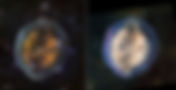
< Back Do Nebulae Think? David Cowles May 17, 2026 “If nebulae do think they, if they are conscious, we may assume that they integrate information…across light years.” 1300 words, 6 minute read In 1974 Thomas Nagel earned himself a permanent position in the Intellectual Pantheon of the Western World. His signature essay, What’s it like to be a Bat , catalyzed the Search for Intelligent Life on Earth (SILE): “There is something that it is like to be a bat…what it is like for a bat to be a bat…because we know what it is like to be us.” (Do we really?) At least in the Judeo-Christian West, folks have long imagined themselves ‘little less than angels’. (Psalms 8: 5, Heb. 2: 7 – 9) Prior to Darwin, any suggestion that we were more Gorilla than Gabriel would have been considered preposterous. And prior to Nagel, extending monikers like ‘conscious, intelligent, sentient’ to non-human life forms was a non-starter. Besides, we were occupied with more serious questions: Should we extend these monikers to women, to children, to members of other races, other ethnic groups, other nationalities, other age cohorts, other political parties, other social castes? Heady stuff! I’m pleased to report that we’ve made uncharacteristically significant progress in these areas over the half-century since Nagel, and there is now something approaching consensus that even certain non-human life forms are intelligent and conscious. Primates and Sea Mammals make almost everyone’s list. Corvids (ravens, parrots, crows), Cephalopoda (octopus), and Pachyderms (elephants) show up frequently as well. They know what they know, and they know that they know it, and they project similar self-awareness onto others in their community (so-called ‘other minds’). There is even serious conversation now about the mental status and intellectual life of forests, plants, fungi, and…wait for it…unicellular organisms. The average adult human body consists of about 30 trillion of these little critters – we call them ‘cells’ - working together to promote the survival (and fecundity) of a single host: You! Researchers at Carnegie Mellon University have recently shown that bacteria (prokaryotes) can learn from past experiences, store memories and access those memories when deciding future behavior. Snooze fest? Ok then, how about this? They can pass these memories on to future generations - something we can only approximate via our elaborate cultural superstructure. And they can use remembered experience when imagining and evaluating novel responses to changes in their environment. Did I mention, they do all this without a nucleus, much less a brain or nervous system? *** Phenotypically, life on Earth could not be more varied - from figs to ferns, bats to bacteria, cabbages to kings. But structurally, behaviorally, even morphologically, all life on Earth is remarkably similar. Birds fly, so do bats, so do bugs, and so do we (thanks to our technology). Different structures support similar functions. For example, many animals have a sense of sight but the organ of sight, the eye, has evolved many times, independently and differently, across multiple species. Apparently being able to see is a useful trait. At the same time, similar structures enable different functions. For example, fish have gills for breathing, but we use ‘their’ gills for hearing. Gills and ears have the same structure but very different functions. Evolution, the wellspring of biodiversity, is also convergent: several organisms from different limbs on the tree of life may evolve similar traits/structures via radically different pathways. The features in question confer survival (reproductive) advantage across phyla and a variety of unrelated structures can serve as ground zero for their development. Plus every member of every species now living on Earth is descended from a single DNA molecule synthesized about 4 billion years ago. How’s that for bio-similarity? So on the one hand, no two cells are identical (mutation, epigenesis) but on the other hand, all cells are clones of a single aboriginal cell. Can we find similarly homologous structures in the inanimate world as well? *** No self-respecting 6 th grade geek has failed to notice similarities in the structure of atoms, a fundamental unit of physics, and that of eukaryotic cells, a fundamental unit of biology. “Nucleus & Electrons, meet Nucleus & Mitochondria” - not bad for the first day of middle school. Our cognitive lenses seem to work better as a microscope than as a telescope. We can detect congruent patterns in regions of the cosmos twenty orders of magnitude smaller than us, and we are not shy about attributing common functions to such congruent structures. For example, recent studies reinforce our conviction that bacteria have functioning memories, learn from experience, and calculate behavioral strategies. But we are less apt to recognize structural congruence on larger scales, and we are much less willing to posit homologous function on that scale. The same structure we noticed in atoms and eucaryotic cells appears in solar systems, galaxies, and galactic sheets. At the highest level of generality, the network of galaxies in the universe forms a pattern eerily similar to the network of neurons in the human brain (nodes and filaments). A recent photo taken by the JWST of Nebula PMR 1 (left image, above), stretching more than 5 light years across and located some 5,000 light-years from Earth, reveals a structure similar to that in an MRI (right image) of an unremarkable human brain. Note especially (1) the inner concentration of structural elements protected by an outer membrane, and (2) a division of those elements into two hemispheres, separated by a longitudinal fissure. Co-incidence? Sure. An example of the self-similar organization of the cosmos? That too! According to the popular holographic model of cosmology, the universe is self-similar across all scales, so we will not be surprised if it turns out that the Cosmos is similar to the Quantum. *** Consciousness is strongly associated with patterning: Consciousness seems to be emergent in entities with certain structural similarities, and it consists of the patterns it discovers. (There is a strong argument that we are only conscious of patterns; true one-offs go unregistered.) Finally, consciousness appears to impose its own patterns when confronted with random sensory input: “Rows and flows of angel hair and ice cream castles in the air…It’s clouds Illusions (patterns) I recall, I really don’t know clouds at all.” (Joni Mitchell) Patterns are often self-similar across scales and across various material substrates. To bastardize Stephen Hawking, et al., “it’s patterns all the way down”. Perhaps a more useful phrasing would be, “it’s patterns discovering patterns,” suggesting that the propensity to form patterns ( logoi ), may be substructural, applying equally to the percipient and to the perceived. There is growing unease among biologists re the shortcomings of the Neo-Darwinian framework. Epigenetic effects are not only real but critical for the evolution of cells and, contrary to long held beliefs, epigenetic modifications can be inherited. The ‘sins’ of the father (and mother) are indeed visited on future generations. Further, it is increasingly clear that the central assumption of Neo-Darwinism, that mutations occur randomly and that natural selection simply operates to conserve the most adaptive variations, is wrong. It is virtually certain that cells control gene expression by the decisions and choices they make . Likely, all cells are sentient and self-aware and capable of decision-making and problem-solving at some level. These cellular faculties rely on information integrated across the entire cell. Consciousness seems unrelated to the volume of information. Instead it is a function of, and a driving force for, information integration and so ‘interconnectedness’ becomes the measure of consciousness. If nebulae do think, if they are conscious, we may assume that they integrate information, not across nanometers but across light years. So are the patterns of celestial objects in Nebula PMR 1 and neurons in our skulls sufficiently similar to allow both to support consciousness ? Has PMR 1 discovered the meaning of life? Share, please! Previous Share Next Do you like what you just read and want to read more Thoughts? Subscribe today for free! Thoughts While Shaving - the official blog of Aletheia Today Magazine. Click here.
- David Cowles
David Cowles is the founder and editor-in-chief of Aletheia Today Magazine. He lives with his family in Massachusetts where he studies and writes about philosophy, science, theology, and scripture. < Back David Cowles Editor-in-Chief David Cowles is the founder and editor-in-chief of Aletheia Today Magazine. He lives with his family in Massachusetts where he studies and writes about philosophy, science, theology, and scripture. He can be reached at dtc@gc3incorporated.com Anaxagoras The Probability of Nothing The Secret Things of Life Zeno's New Paradox World Without God Amen How Matthew Spins Mark Robert Frost Was Wrong The Seven Pillars of Wisdom God is a Bother! Destiny Versus Fate Moses, Machiavelli, and Morality Is the Universe Real? Jeremiah Mark's Marks of Authenticity The Owl and the Pussycat The Meaning of Life The Frost Diamond Dante and the Yellow Submarine Super-Determinism Marx vs. Mark Sacramental Priesthood The Wonder School The Concept of Death I'm Ageless and Timeless Is Techno-Optimism a New Religion? Happiness We All Live in a Yellow Submarine Leviticus and the Fed Arithmetic Marcel Proust Life is a Movie Alphabet Philip Goff I Seem To Be a Klein Bottle Determinism...or Entaglement? Should I Vote? Robert Frost A 'New' Old Theory of Consciousness Mythology Before Marvel Comics Home Alone Is Childhood a Crime? Political Alienation Do You Know What I am? Do We Need God? Logical Positivism Utilitarianism The 'O Antiphons' Love...Actually! Do You Noh? Is Childhood a Crime? Political Alienation Leibniz Causality and 'The Bhagavad Gita' R U WYSIWYG? Time for a New Turing Test Is God Dead? The 7th Day Satan, Mary, and ‘Da Judge’ Is Childhood a Crime? Political Alienation Idolatry Chatting with C.S. Lewis Do Bots Know Beauty? AI for Healthcare Friedrich Nietzsche Personae I Am the Walrus Ship of Theseus The Theology of Mikhail Bakunin Eucharist Read on a Beach Ave Maria Albert Camus The Comedy of Job The Meaning of Life Thrown by Heidegger Apocolypse Now! Ephesians 2:10 God's Will Revelation Kabbalah and Thomas the Train Whitehead and Zohar The Structure of Prayer The Our Father Where the Time Goes Mythology Now! Morals and Values I Seem to be a Membrane Football and Quantum Mechanics Messiah Redux May Day My Breastplate The Lottery Two-Faced God Beyond Pascal's Wager Returning to Andromeda The Lego Movie and John Stewart Bell JK Rowling and Pliny the Elder Hell Middle Voice Who R U? Beatitutes Psalm 151 Educating Christians Past, Present, Future Particularity Jericho Christian Anarchism Boethius Our Inanimate Neighbors Converge This! - Dante and The Beatles Converge This! - John Paul Sartre and Pope Leo XIII Job is My Superhero Handel's Messiah A Universe From Nothing Bakunin Nailed It: The Sterile Socialism of Marx and Engles Job vs. James, Rex Christ the King Football Math Moore's Nativity Be a Bee Bible Read Backwards What Did John See? St. Paul's Lord's Prayer Achilles and Tortoise Prepare to Be Shocked Pronouns Systematic Philosophy Is This Really All There Is? Ectaban I Wasn't Anything TOE Faith, Hope, Love Cosmic Crossroads Mommy Math Part One S erenity Prayer Xiako Can't Count Alice Learn to Swym Speaking Piraha Imagine! The Final Psalms Corinthians The Nature of Time Science and the Yellow Submari ne Part II Part II Competing Creeds The Great Commandment Shakespeare Nihilism How to Coach an Undefeated Football Team The Sultan and the Sea Jesus is Badass The People's Creed Teaching Physics in the 21st Century Science and the Yellow Submarine Genesis Wins the Nobel Prize Hows and Whys The Riddle of Job Christology 101 The Problem of Good Eternity vs. Immortality The Meaning of Music Mary Poppins, Sufi Master Haiku Corner Vacuum Monster Quark Soup
- Why the Universe Doesn’t Fall Apart | Aletheia Today
< Back Why the Universe Doesn’t Fall Apart David Cowles Sep 14, 2025 “What holds everything together? How is it that Universe is a universe, that it has an identity?” Ever since Woody Allen ‘discovered’ cosmic inflation ( Annie Hall ), folks have been asking, “So why doesn’t the Universe simply fall apart? What holds everything together? How is it that Universe is a uni verse, that it has an identity, that we can make statements that apply to the whole qua whole rather than to just some (or the sum) of its parts?” The Universe consists of ‘events’ – quanta of Being, connected in some way(s) to constitute a single event, a Uni verse. We’re all familiar with the 4 interactive forces: EM, Strong, Weak, and Gravity. They connect events laterally. Every event is linked to other events by these reciprocating forces and wholes are equal to the sum of their parts. It is my hypothesis that a universe of events linked together in this way only is not possible. At the end of the day, these bonds are insufficient to generate the degree of solidarity required. Also, according to this formalism, it is not even possible to define the whole as an ‘event’…which is a problem for a Universe that consists entirely of events. The actual Universe links events in additional ways. For instance, events are linked via a phenomenon known as Quantum Entanglement . In 1964, John Bell proved (and Alan Aspect later confirmed) that quantum events that interacted strongly in the past remain connected, i.e. entangled, in the present. In essence, these events, no matter how remote they may be in spacetime, behave as a single event. Like a skein of yarn, the Universe is inextricably tangled in this way; we call such a universe ‘non-local’. Non-locality provides an additional, stronger mode of connectivity between events. Our naïve notion of lateral connectivity via the 4 forces is challenged by the phenomenon of spatial separation. Space works at cross purposes to 2 of the forces. These forces (EM and Gravity) decline in strength according to the square of the distance between entities (inverse square law), i.e. doubling the distance between events reduces the strength of EM and Gravitational attractions by 75%. And on top of that, the Universe is continuing to expand, possibly at an accelerating rate. Not good news for cosmic solidarity! There is a third mode of connectivity which is even less intuitive. The events that make up the Universe are held together, and given definition, i.e. identity, by Universe itself. This mode of connectivity is counter-intuitive only because we are stuck in a ‘bottoms-up’ mindset. We are used to causes that produce effects, parts that form wholes. Why should this be so? Why should the whole be defined solely by its parts? Wouldn’t it make more sense for the whole to create its own internal partitions, its own structures? We tacitly acknowledge this whenever we talk about a whole being greater than the sum of its parts. This phenomenon masquerades in our ‘bottoms up’ world as teleology, tachyons, synergy, etc. The synthesis of a whole from its parts is what we call an ‘accident’ while the distillation of parts by its whole is what we call an ‘intention’. Intentionality is the opposite of determination just as accidents are the opposite of effects. But we are instinctively uncomfortable with such a ‘top-down’ model. Would we really prefer to live in a world where future events are caused by their predecessors? How miserable! Effectively, such a Universe is compelled to perpetuate its past, albeit in different forms, without respite. Is this Hell? Thank God we don’t live in such a place! We are less familiar with wholes that define their parts, with effects that determine their own causes. Yet, the Apostle John based his 2450 year old Gospel on precisely such a structure: “In the beginning was the logos and the logos was with God and the logos was God. Logos was in the beginning with God. All things came to be through logos and without logos nothing that came to be came to be…” (Jn. 1:1 - 3) The order of things precedes the things that are ordered. “It from bit.” (Wheeler) Order does not arise epiphenomenally by a chance combination of unrelated elements. How could it? Without order , how do you get order? “It’s emergent,” you say; but emerging from what? Order naturally degrades (entropy); it does not suddenly manifest. Humpty Dumpty’s shell does not spontaneously reassemble, like ‘dem dry bones’ in Ezekial . Then how is it that discrete entities, with internal structure and external relations, come to be? Don’t say ‘bootstrapping’. It’s a fun concept and, of course, there are many circumstances in which entities do appear to order themselves spontaneously, but this is only because the principle of order ( logos ) pre-exists. Bootstrapping cannot account for ‘order’ per se . Being is ordered necessarily, not accidentally! Anaximander, for example, believed that entities co-actualize by granting each other ‘reck’ (i.e. consideration, ‘space’). But the potential of things to be, the order that they will manifest, pre-exists the things themselves. Potentiality precedes actuality. The 4 forces operate in a world that is quite familiar to us; it is Archimedean , meaning that it exhibits continuity that can be fully described using real numbers only (extended to include complex numbers). We love real numbers! And why not? Between any two real numbers there is always another real number…so it would seem that the requirement of continuity is well satisfied. It isn’t! At least not fully. Non-Archimedean geometries expand the domain to include ‘unreal’ numbers, e.g. hyperreal infinitesimals. Between the lowest positive real number and 0, there exists an infinite number of hyperreal infinitesimals . They add another level of continuity to the already continuous set of ‘reals’. Real, Schimel, what’s the difference? With Real Numbers, whenever a > b, there is always some number n so that n*b > a. Not so with hyperreals! This modification seems innocuous enough; but once again, it isn’t! Among its unexpected corollaries: All triangles are equilateral or isosceles. For any sphere, any point on or in that sphere can be taken as its center. For any two spheres, either one is wholly embedded in the other or they are entirely disjointed, i.e. there are no overlapping spheres, no mere tangencies. Without enrolling in Cal Tech, you can see intuitively that each of these corollaries describes another level of connectivity between events. It is our hypothesis that non-Archimedean geometries will be required to model Quantum Behavior (the whole < the sum of its parts) and Teleology (the whole > the sum of its parts) efficiently. We have tried to account for the solidarity of the universe with just the 4 ‘lateral forces’. They form the belt that holds ‘the cosmic wardrobe’ in place. Except it doesn’t. Unfortunately, the belt is not tight enough to prevent embarrassing and nihilating wardrobe malfunctions . Turns out, we need a pair of suspenders as well as a belt. Fortunately, we just happen to have the right accessories on hand. Think of entanglement as linkage operating ‘below’ the level of EM & Gravity and think of teleology as a bond operating from ‘above’; together, hold our Universe together. *** Kandinsky’s Composition VII (1913) unleashes a storm of interlacing lines, ovals, and color currents that compress themes he’d sketched separately—deluge, Last Judgment, and resurrection—into one vast, turbulent drama. Rather than depict a scene, it aims to sound in the viewer like music, using abstract form and rhythm to suggest spiritual upheaval and renewal. Previous Share Next Do you like what you just read and want to read more Thoughts? Subscribe today for free! Thoughts While Shaving - the official blog of Aletheia Today Magazine. Click here.
- Black Hole | Aletheia Today
< Back Black Hole David Cowles May 19, 2022 “…We just caught our first glimpse of the big black hole that lies, curled up like my favorite pussy cat, at the center of our galaxy.” In early May, thanks to images captured by the aptly named Event Horizon Telescope, we caught our first glimpse of the big black hole that lies, curled up like my favorite pussy cat, at the center of our galaxy. Long ago, before anyone knew anything about black holes, we fortuitously named our galaxy The Milky Way. Apparently even then, we somehow sensed that one day, we would be lapped up like a saucer of milk. Yet, it was oddly comforting to ‘see’ so clearly the ultimate destiny of our spatiotemporal world. Like characters in Douglas Adams’ The Restaurant at the end of the Universe , we sit, peacefully, gazing into the abyss, gazing quite literally at nothing . Besides, this black hole is 26,000 light-years away. But it was also disconcerting, because, make no mistake, my kitty will wake up, and when she does… Well, let’s just say that what I described as “26,000 light-years away” will soon be described as “26,000 light-years close.” Fortunately, Being has another, non-spatial, non-temporal dimension that, thankfully, is beyond the reach of my cat’s tongue. I wonder, “Is my cat aware of this non-extensive dimension just beyond her grasp?” Are we? Image: The first image of the black hole at the center of our Milky Way, Sagittarius A*. Credit: NASA/Event Horizon Telescope. Full caption here. Previous Share Next Do you like what you just read and want to read more Thoughts? Subscribe today for free! Thoughts While Shaving - the official blog of Aletheia Today Magazine. Click here.
- Pico della Mirandola | Aletheia Today
< Back Pico della Mirandola David Cowles Oct 12, 2025 “we find ourselves at a fork in the road…AI will either complete the mechanization of human culture…or liberate us from the tyranny of machines altogether.” “Somewhere, a place for us, a time and place for us!” ( West Side Story ) First came Caesar (we have no king but…), then came God (I am what am), and now the Age of Infernal Machines. Where do we fit in? When is it our time? The Good News: Every dog has its day! The bad news: We’ve apparently already had ours. Sorry you missed it. You’re only 550 years late to the party. Humanism , the celebration of You , thrives in the border regions separating the Middle Ages from the Renaissance (e.g. 1450 – 1500 CE in Florence). Fortunately, however, we can relive those halcyon days in Northern Italy through the writings of its chief philosopher-chronologer, Pico della Mirandola (1463 - 1494). PdM was perhaps the first philosopher since the original trio (Peter, Paul and John) to understand correctly the nature and status of human beings. We are not the slaves of despots nor the puppets of divine caprice; nor are we merely prototypes of future machines. We are us and we occupy a special, if not unique, place in cosmic ontology…a place that Mirandola ‘nosed out’, like a wild boar foraging the Italian countryside for its precious truffles. You doubt me! Then consider this: “He ( homo sapiens ) is the interpreter of nature, set midway between timeless unchanging and the flux of time; the living union (as the Persians say), the very marriage hymn of the world.” ( Oration on the Dignity of Man ) In contemporary ontology, the border region between chaos and order is the realm of ‘complexity’ and we humans are nothing if not complex. I mean, members of what other species spend tens of thousands of dollars ‘to find themselves’? Only we get psychoanalyzed, walk the 200 mile Camino de Santiago , or go on lengthy prayer retreats. “Oh wondrous and unsurpassable felicity of man (sic) to whom it is granted to have what he chooses, to be what he wills to be!” Here PDM anticipates the 20 th century existentialist meme: “I know who I am, and I know I can be whoever/whatever I want to be.” In fact, there is direct line of philosophical descent from PdM to JPS (Jean-Paul Sartre): “(God) set the infernal dung-heap of the inferior world teeming with every form of animal life… (Then) he bethought himself of bringing forth man (sic). Truth is, there remained no archetype according to which he might fashion a new offspring… All space was already filled… (So) this creature (human), to whom he could give nothing wholly his own, should have a share in the particular endowment of every other creature… “…Upon man, at the moment of creation, God bestowed seeds, pregnant with all possibilities, the germs of every form of life… because he (man)…assumes the characteristic power of every form of life.” Unlike God, whose essence is hardwired and precedes even his existence, human beings have no essence, other than what we choose for ourselves. We have within us ‘the seeds’, the potential for every possible realization. Like Sartre, PdM understood Being ( etre ) as compact and dense: a solid. Human beings are the neant (nothingness) that creates space for free choice and agency. “We have given you, Oh Adam, no visage (image) proper to yourself, nor any endowment properly your own, in order that whatever place, whatever form, whatever gifts, you may with premeditation, select, these same you may have and possess through your own judgment and decision…in order that you may, as free and proud shaper of your own being, fashion yourself in the form you may prefer… “This is why Evantes the Persian…writes that man has no inborn and proper semblance, but many that are extraneous and adventitious… We have been born into this condition of being what we choose to be…since if we will, we can… “ Know thyself invites and exhorts us to study the whole of nature of which the nature of man is the connecting link.” Mirandola presents a view of homo sapiens that projects us half a millennium into the future as it simultaneously reached back almost 2500 years, to the time of King David: “You have made them (humans) a little lower than the angels…you made them rulers over the works of your hands, you put everything under their feet.” (Psalm 8) The evolution of modern human beings did not end with the emergence of homo sapiens . It continued through the more rapidly adaptive medium of culture. In less than 100,000 years we emerged from being merely ‘a primate among primates’ to being ‘the apex primate’. We distinguished ourselves by impressive advances in technology (our use of tools), arithmetic (our ability to compute) and language (our ability to communicate using symbols). Just as importantly, we began to ask new questions culminating in 1966 with " What's it all about, Alfie? ” followed in 1968 by Yellow Submarine which hazarded an answer. Nor did we fail to turn the spotlight of inquiry onto ourselves: Are some acts ‘right’ and others ‘wrong’ and which are which? We found that the emergence of personal morality (e.g. the 10 Commandments) had consequences for our conception of social order (e.g. the 250 year period of Theocracy in Israel following the Exodus). Regardless of its cosmological bona fides , the Bible gets its anthropology right. It brilliantly encapsulates the evolution of the human community from abject, virtually anonymous, slavery under ‘Pharaoh’ to the concept of self-rule…and back again. In a famous chapter (8) from the First Book of Samuel , the Israelites trade their God-given right of self-rule for the yoke of monarchy. Fast forward 500 years, Israel has been conquered by a series of foreign invaders and its leading citizens have been reduced to the status of slaves in Babylon: “Shirtsleeves to shirtsleeves.” YHWH gave the people of Israel dignity and liberty; they consciously traded that great gift for what turned out to be occupation and slavery. Surely Bible literate humans would never make that mistake again! Or would they? Fast forward 2000 years, leap-frogging Jesus and the Caesars: “riverrun past Eve and Adam’s, from swerve of shore to bend of bay, brings us by a commodious vicus of recirculation…” ( Finnegan’s Wake ) to Florence and Environs. First in philosophy (PdM), then in theology (Savonarola), then in the arts (Davinci, Michaelangelo, etc.), the election lights fell on humanity. Suddenly, once again, “Man is the measure of all things.” (Protagoras, c. 450 BCE) But not for long… It’s 1500 now and Machiavelli is on the move! At first glance, his instrumental ethics seem fairly innocuous. After all, don’t we teach our children that actions have consequences? Well, as Job found out to his dismay, sometimes they do…and sometimes they don’t. Newly ‘enlightened’, our post-humanist culture traded a distinctly human ‘right for right’s sake’ ethos (virtue is its own reward) for one more conducive to enslavement (ends justify means). It no longer matters what we do as long as it works . By this logic, the development and deployment of nuclear weapons during WW II was ethical because it hastened the fall of Japan and helped bring a terrible war to a close. The 200,000 civilian deaths were just so much collateral damage. Doctrinaire Marxism notwithstanding, we no longer need Pharaoh, or a ruling elite, to keep us in line. We have willingly subordinated our birthright, our existential liberty, to an exo-culture of mechanization. Productivity and efficiency are the new values by which we measure our lives. You painted a masterpiece that hangs in the Louvre. I developed technology that increases the speed of assembly line processes by 0.2%. Which of us has had the most impactful, the most consequential, life? Which of us has made the most important contribution to the welfare of our species? And which of us is ‘the better person’ as a result? It’s been a half-century since Machiavelli presented the Medici with a blueprint for the industrial enslavement of the human race. Once again, as in 1000 BCE, 500 BCE, and 1500 CE, we find ourselves at a fork in the road. Artificial intelligence will either complete the mechanization of human culture once and for all…or it will liberate us from the tyranny of machines altogether. It’s yesterday once more. We hold our future in our hands. What path will we choose this time? *** Image: Umberto Boccioni — The City Rises (1910), oil on canvas Umberto Boccioni’s The City Rises (1910) is a blazing vision of urban construction and energy, capturing the spirit of early twentieth-century industrial progress. Workers, horses, and scaffolding swirl together in a rush of color and motion, symbolizing humanity’s drive to build a modern world. Yet the same intensity that celebrates innovation also hints at chaos and struggle, revealing both the exhilaration and the turmoil of industrial growth. Previous Share Next Do you like what you just read and want to read more Thoughts? Subscribe today for free! Thoughts While Shaving - the official blog of Aletheia Today Magazine. Click here.
- Christian Anarchism | Aletheia Today
< Back Christian Anarchism “An unjust state is not a bad state…An unjust state is no state at all. There are no ‘bad states’…only states and pseudo-states.” David Cowles 2600 words, 12 minute read Christian Anarchism ? An oxymoron, right? Isn’t Christianity is all about order? o The order of a world created by God ( Genesis ). o The ordering principle ( logos ) through which all things came to be. ( John ) o The hierarchy of the Church. ( Acts) o The 10 Commandments and the other 603 Mitzvah of the Law. ( Torah ). o A second-grade classroom in a 1950’s parochial school with fifty pupils, one teacher, and ‘pin drop’ silence. That’s order; that’s Christianity! Right? Not so fast! Obviously, anarchy has no place in the ‘Christian Cosmos’… if by ‘anarchy’ you mean ‘chaos, disorder, violence or entropy (S) per se ’. On the other hand, if you understand ‘anarchy’ as a lack of externally imposed order (an exoskeleton), the situation gets a bit murkier. The lack of artificial order does not preclude the spontaneous emergence of organic order (endoskeleton); in fact, it requires it! Where S is at its maximum, there is Neant (nothingness). Put another way, Heat Death (Big Freeze) is synonymous with Max Entropy and therefore Being is synonymous with Order. “God said, Let there be light, and there was light. God…separated the light from the dark; the light shone in the darkness and the darkness has not overcome it.” ( Genesis 1: 3 – 5 & John 1: 5) Being = order! Mikhail Bakunin, the ‘St. Paul of Anarchists’, underscored this point: “Does it follow that I reject all authority? Far be from me such a thought. In the matter of boots, I refer to the authority of the bootmaker… Each directs and is directed in his (sic) turn, therefore there is no fixed and constant authority, but a continual exchange of mutual, temporary, and above all, voluntary authority.” ( God and State ) What of Torah , God’s law? Clearly, it is imposed by a transcendent entity…and yet not so much! Torah is God’s law, but it emerges both from the will of God (Nature) and from the human heart (Conscience): Torah is one side of a Covenant between YHWH and his people – a covenant that repeatedly requires and receives renewed consent. Jewish tradition speaks of two Torahs – the Written Torah ( aka the Pentateuch ) and the Oral Torah (embedded in the laws of nature and in the human heart). A genius of Judaism is the ‘=’ sign it places between the two. No surprise then that in the Book of Job , God uses ecology to illustrate the concept of Justice. Justice is a species and a manifestation of organic order. God is Justice; human beings are just ‘just’, and that only potentially. There would be no such thing as a ‘just act’ in the absence of divine Justice but it is by ‘just acts’ that Justice becomes immanent in spatiotemporal events. Perhaps then we should not be surprised after all to find the rudiments of Anarchism embedded in the Social Magisterium of the Roman Catholic Church. Thomas Aquinas (c. 1250) himself affirmed that all are required to follow the validly enacted laws of their respective societies, regardless of the legislative process; but Thomas added a crucial qualifier: laws are valid only when they do not conflict with the ‘will of God’, i.e. Justice. After the Aquinas, the doctrine of Christian Anarchism next took center stage during the Protestant Reformation, particularly among the Huguenots (French Calvinists). A Defense Against Tyrants was published pseudonymously (c. 1580) by Hubert Languay and/or Phillipe de Mornay. In it they argue that it is not only lawful to resist a government that contravenes the will of God (Justice) but obligatory. Fast forward three hundred years: Leo XIII is elected Pope (1878) and immediately faces a crisis of social disintegration. Europe seems hopelessly divided by class, by nation, and by ideology. Karl Marx had thrown down the gauntlet 30 years earlier when he wrote: “A specter is haunting Europe - the specter of communism.” ( Communist Manifesto ) It was high time the Church responded…and Leo did just that! Christian tradition supports the legitimacy of the State as defined by Joshua, Gideon Hot Link , Samuel and David… not Mussolini or Stalin. The ‘state’ as it appears in history is not necessarily the State envisioned by theology. In our epoch, for instance, the concept of State entails the subjugation of the individual to the collective. But this ‘collective’ does not develop organically out of freely formed interpersonal relations, a la Rousseau . Rather, it is ‘an anti-logos imposed on all social interaction by a limited segment of the body politic’. Is there a modern nation state, from the US to the USSR, that does not fit this description? In modern political theory, the nation state is the ultimate sovereign entity (Hegel). It confers limited, subsidiary sovereignty on smaller political and social units, it recognizes (at its sole discretion) certain human and civil rights, it preserves certain ‘useful’ institutions (e.g., family, church), but it reserves the right to regulate the behavior of all individuals and groups according to its conception of the ‘general welfare’. Christianity, in my view, argues the reverse: (1) the individual, family, and local community are the foundations of society, (2) human and civil rights are ‘inalienable’ and derive from God ( Declaration of Independence ) , and (3) no state has the right to infringe on them. The rather vague notion of ‘general welfare’ (a so-called ‘end’) is given further structure by the Utilitarian meme: The Greatest Good for the Greatest Number . According to such a ‘value system’, colonialism and imperialism are not only justified but mandated. War, slavery, and all manner of human exploitation (so-called ‘means’) can be overlooked as long as they are in service of ‘the greater good’ (end). Sound familiar? Indeed, we are 500 years into a social order outlined by Machiavelli early in the 16 th century. Like a funnel with two mouths and one neck, the Machiavellian ethic (ends > means) inputs the wisdom of Ancient Greece and Medieval Rome, shrinks it down to the size of a city-state (Firenze), and then broadcasts it back out into the world under various guises: Renaissance (Medici), Reformation (Luther), Enlightenment (Laplace), Liberalism (Locke), Socialism (Bentham), Utilitarianism (Mill), Capitalism (Smith), Communism (Red), Consumerism (Green), etc. But the entire framework is wrong because there is no ‘general welfare’, there is no ‘greater good’, there is just Good . Anarchism, on the other hand, celebrates true order that grows naturally from its roots: the mustard seed that becomes a tree offering shelter to flocks of migrating birds. This is not to say that there is no role for differentiated social orders. Priests marched at the head of Joshua’s column as it ‘liberated’ Jericho. And according to Marxist-Leninist social theory, a revolution must be led by a vanguard . Liberalism is an elaborate mask for the hierarchical State. Its ‘consent of the governed’ is merely an ‘origin myth’. Furthermore, it offers no logical reason why the consent of one generation should be binding on the next. The ‘sins of the parent’ need not be visited on the great grandchildren. The phenomenon of State today is very different from the concept in Christian theology. According to RCC papal encyclicals, the ‘state’ is the broadest, most general, epiphenomenal expression of natural community . Such a state recognizes the sovereignty of human organizations and associations provided they are voluntary and consistent with the ecological order. Anarchism does not oppose order; au contraire , it liberates us so that we can create genuine, organic order. The ability of human beings to form just communities is one of our species’ defining characteristics. Even Cain built cities! ‘Statists’ do not view order as natural. They understand society as ‘fallen’ and therefore in need of an externally imposed standard of right conduct. Anarchists deny this reasoning altogether. They view humans as God’s partners in an orderly process of co-creation. To the statist, sovereignty rests at the most general level of association, the nation state, or now perhaps the so-called New World Order . The Catholic doctrine of subsidiarity views society through the other end of the telescope. Sovereignty rests at the level of the individual and her proximate social networks (e.g. family). According to such a model, ‘consent of the governed’ is not ‘one and done’ but a perpetual process, happening, or not, at multiple levels, every minute of every day. The notion that Anarchism is inconsistent with Christianity is ahistorical . After the successful Exodus, and the years (40) that followed in the Sinai wilderness, the Israelites conquered Jericho and began a 250-year long social experiment. From the death of Moses to the coronation of Saul (c. 1050 BCE), society, guided by the grace of God and the precepts of Torah , functioned without a permanent political class and without any formal central government. At that time, Israel was a Theocracy by Anarchic Means (as the US is a Republic by Democratic Means and the UK a Monarchy by Democratic Means ). Authority was vested in God, his people, and a series of charismatic judges (from Joshua through Samuel’s sons) whose ambient authority derived solely from the favor of God and the consent of the governed (often expressed through a council of elders). The Exodus had given the Israelites one of history’s rarest opportunities…a do over . Unlike the Jacobins of 1789 or the Bolsheviks of 1917, the Hebrews had no Ancien Regime to eradicate. They did not inherit old political structures in need of reform, and for the most part, they were free of foreign entanglements. They were given a chance to build a society, ab initio , from the bottom up…and they did just that, brilliantly. This lengthy period in Jewish history is recounted in three books of the Old Testament: Joshua , Judges , and the first 7 chapters of 1 Samuel . The final line of Judges summarizes the entire era: “In those days Israel had no king; everyone did what was right in their own eyes.” (21: 25) In our era, we are used to folks seeking to liberate themselves from physical bondage, cultural oppression, and political tyranny. Over the course of history, however, humans have just as often agreed to trade their existential liberty for the promise, always empty, of security and prosperity. Erich Fromm explored this phenomenon in his book, Escape from Freedom . So did the author of 1 Samuel : The people cried out to Samuel, “Appoint a king over us, like the nations, to rule us…Give us a king to rule us.” Samuel, with God’s help, tried in vain to talk the people out of their folly: “This is what the king who will reign over you will claim as his rights: He will take your sons and make them serve with his chariots and horses…and others to plow his ground and reap his harvest… He will take your daughters to be perfumers and cooks and bakers. He will take the best of your fields and vineyards and olive groves and give them to his attendants. He will take a tenth of your grain and of your vintage and give it to his officials and attendants. He will take a tenth of your flocks, and you yourselves will become his slaves.” (1 Samuel 8: 11 – 17) Leo XIII glosses 1 Samuel in three of his most famous papal encyclicals (designated D, ID, RN below): “ All public power must proceed from God, for God alone is the true and supreme Lord of the world. Everything, without exception , must be subject to Him and serve Him, so that whosoever holds the right to govern holds it from one sole and single source, namely God, the sovereign ruler of all.” (ID #3) “ Whatever be the nature (form) of government , rulers must bear in mind that God is the paramount ruler of the world and must set Him before themselves in the administration of the State.“ (ID #4) “If the will of rulers is opposed to the will and the laws of God, they themselves exceed the bounds of their own authority and pervert justice; nor can their authority then be valid, which, when there is not justice, is null.” (D #15) “Civil laws…so long as they are just, derive from the law of nature their binding force (RN #11)… Laws bind only when they are in accordance with right reason and, hence , with the eternal law of God.” (RN #52) “Man (sic) precedes the state, and possesses, prior to the formation of any state, the right of providing for the sustenance of his body.” (RN #7) Jean Valjean ( Les Misérables ) was wrongly convicted! 100 years later, Pope John Paul II glossed Rerum Novarum : “The right of association is a natural right of the human being, which therefore precedes his or her incorporation into political society.” (CA #7) “A community of a higher order should not interfere in the internal life of a community of a lower order.” (CA #48) Star Trek’s Prime Directive ? Back to Leo: “By state we here understand…any government conformable in its institutions to right reason and natural law, and to…dictates of the divine wisdom.” (RN #32) Leo is not just jousting with heretical states; he is ‘disestablishing’ them! In this, Leo is recapitulating Samuel: When Saul disobeyed God’s command, Samuel did not hesitate; he declared: “You reign no more over Israel!” (1 Samuel 15: 23) Although sometime passed before David replaced Saul as king, from the moment of Samuel’s decree, Saul’s edicts no longer had the force of law, they were no longer morally binding. An unjust state is not a bad state in the way that a stubborn child might be called, “a bad boy”…but still be a boy. An unjust state is no state at all. There are no ‘bad states’…only states and pseudo-states . A state is a ‘state’ only when and to the extent that it is an agent of divine Justice. An unjust pseudo-state has forfeited its (God given) right to govern. Jesus began his ministry ( Luke 4:21) by proclaiming a Jubilee year (the immediate redistribution of all productive property); in the same way, Leo proclaimed the withering of Europe’s heretical states. But like Samuel, and unlike Marx, Leo did not promise the eventual dissolution of the heretical State; he dissolved it by fiat in real time! Leo gets the last word: “Human law is only law by virtue of its accordance with right reason; and it is thus manifest that it flows from the eternal law. And in so far as it deviates from right reason it is called an unjust law; in such case it is no law at all, but rather a species of violence .” (RN #52) Amen to that! D = Diuturnum , 1881 ID = Immortale Dei , 1885 RN = Rerum Novarum , 1891 CA = Centesimus Annus , 1991 Image: James Tissot (French, 1836-1902). Woe unto You, Scribes and Pharisees (Malheur à vous, scribes et pharisiens), 1886-1894. Opaque watercolor over graphite on gray wove paper, Image: 6 11/16 x 10 3/8 in. (17 x 26.4 cm). Brooklyn Museum, Purchased by public subscription, 00.159.209 (Photo: Brooklyn Museum). David Cowles is the founder and editor-in-chief of Aletheia Today Magazine. He lives with his family in Massachusetts where he studies and writes about philosophy, science, theology, and scripture. He can be reached at david@aletheiatoday.com . Return to Groundhog Issue 2025 https:// www.aletheiatoday.com/thoughtswhileshaving/the-machiavellian-heresyhttps://www.aletheiatoday.com/thoughtswhileshaving/job-%26-the-prime-directive Previous Next
- Regressive Child Rearing | Aletheia Today
< Back Regressive Child Rearing David Cowles Jun 1, 2026 “Best intentions notwithstanding, we are raising our children to succeed in a long gone world… and to fail in this one!” According to Marcus Aurelius, Heraclitus of Ephesus (5 th century BCE) taught, “We must not act or speak like children of our parents.” In other words, we must not become who we were raised to be. (No, Marcus did not write the copy for Progressive’s Homeowners Becoming their Parents ad campaign; sorry, Flo!) Physical and social evolution is always a blend of stability and change. The future preserves something of the present – or it wouldn’t be our future - and the present preserves something of the past, or it wouldn’t be our past. “April (present) is the cruelest month, breeding lilacs out of the dead land, mixing memory (past) and desire (future), stirring dull roots with spring rain. Winter (past) kept us warm, covering earth in forgetful snow, feeding a little life with dried tubers. Summer (future) surprised us coming over the Starnbergersee with a shower of rain…” ( The Waste Land ) This combination of continuity and change is what affords our World its solidarity, its plasticity, and its novelty. It applies to most physical and social processes; but child rearing, at least as it is practiced in the modern North Atlantic Community, is a notable exception. ( Note : In this article, I’m going to draw from my relationship with my father but the analysis I offer could just as well apply to my mother or to any primary caregiver.) By the time I was old enough to form a vague notion of where I fit into the scheme of things, my #1 desire was to please, and as far as possible, emulate my caregivers (e.g. my father). To accomplish this, I had two sources of information: my father’s day-to-day behavior and his daily ‘directives and invectives’. His directives came straight from his father’s playbook. His behavior on the other hand reflected his own lived experience. His message to me was a blend of the two. Let me set the stage, and to keep things simple, let me slightly (but only slightly), modify the dates: Assume my paternal grandfather was born in 1900, my father in 1925, myself in 1950, my youngest daughter in 1975, and my grandchildren c. 2000. Not far off from actual as it turns out. My father was well intentioned, if at times a bit clueless. No doubt, he wanted me to have the ‘best possible’ childhood consistent with my becoming the ‘best possible’ adult…which in 1950 he defined primarily in terms of socioeconomic comfort. Still, hardly child abuse! My father’s parents were survivors of World War I, the Roarin’ 20s, and the Great Depression. Over the years, they developed values well suited to their own lived experience but not necessarily best suited to my father’s personality or to his time in life. The world in 1925 was very different from the world as it was in 1900 or as it would be in 1950. My grandparents raised my father to succeed in a 1875 – 1925 version of the world, not the 1925 – 1975 version. Sidebar : It is said that generals prepare to fight the previous war. Likewise, we parent our children to be successful members of the previous generation. My dad embarked on parenthood, relying on his father’s directives (1900 – 1925) tempered by his own lived experience (1925 – 1950). Bottom line : my father raised me to succeed in the world as it was c. 1925, the midpoint, not as it was in 1950 or as it would be in 1975 (my midpoint), or God forbid, in 2000. Regrettably, my children in turn were raised to succeed in the 1950’s; but happily, it is my grandchildren now who help me adjust to life c. 2025! Don’t get me wrong, tradition can be a good thing. An anchor to windward can keep you from flying off into space, Icarus-like. But as cultural change accelerates, the din of cognitive dissonance becomes more cacophonous…and more paralyzing. Most non-human life forms don’t have this problem. Their cultures evolve slowly, if at all. Continuity is more important than creativity. Information passed on, genetically, epigenetically, and culturally, is crucial for survival. Rare eruptions of adaptive novelty are an evolutionary bonus . For humans, on the other hand, novelty is critical to the survival of the individual, the social order, the culture, and the species. Disruption is our superpower. But we fear it and we suppress it. Each generation must free itself anew, but only partially, from the shackles of the past before it can begin to make its own ‘mark’ on history. Parenting in our culture means raising children to be a generation behind their times. Best intentions notwithstanding, we are raising our children to succeed in a long gone world … and to fail in this one! Oddly enough, it is grandparents ( full disclosure : I am one, many times over), loosely defined to include any interested adult two generations or more removed , that play an increasingly important role here . By 1950, my grandparents realized that the world had changed. They were not living in 1925 any more and certainly not in 1900. ‘Without admitting guilt’ they recognized past misjudgments and were free to meet their new born grandchildren on their own terms. Who is not a better grandparent than parent? Ironically, while ‘grandparent types’ may have the wisdom to parent well…they lack the energy. Parents, on the other hand, have more energy but ideologically, they are often stuck in the quicksand known as the past . What is most remarkable here, and disheartening, is that someone figured this out 2500 years ago. We think we’re so smart, and in some ways we are, yet we have collective ignored millennia old wisdom. Makes you wonder what else we’ve missed, doesn’t it? Previous Share Next Do you like what you just read and want to read more Thoughts? Subscribe today for free! Thoughts While Shaving - the official blog of Aletheia Today Magazine. Click here.
- How To Do Philosophy | Aletheia Today
< Back How To Do Philosophy David Cowles Feb 6, 2025 “Communicating complex middle voice concepts has become philosophy’s #√2 challenge: So do it!” At its most fundamental level, philosophy takes data from one level of reality and organizes it into patterns that make sense of all levels of reality. “To see a World in a grain of sand…” (William Blake) Traditionally, philosophers have approached their mission from one of two vantage points. Existentialists, empiricists and phenomenologists (Sartre, Mill, Husserl) start with data taken from personal experience. They find patterns in that data which they hope will resonate at all levels of reality, experienced from all possible perspectives. The search for a TOE did not begin with Newton or Einstein or Hawking-Penrose; it began with Thales. From our unique, embedded vantage point we cannot know everything about everything, but perhaps we may hope to know something about something. So the task of philosophy is to identify ‘something’ we can know that can act as a universal decryption key. For some, that key lies in sense data (Hume), for others, in self-awareness (Descartes). Either way, this project requires a gigantic leap of faith. To do philosophy from the bottom up, you have to believe that the World is a Rosetta Stone, that it contains the key to its own decryption: “Signatures of all things I am here to read.” (James Joyce) Others take a top down approach. They consider the universe as a whole and search for patterns that can elucidate experience at all levels and from all perspectives. Plato, Hegel and Marx fall into this category. On the margins of Intellectual History, there is a ‘third way’ - an approach to philosophy that is neither bottom up nor top down; in fact it rejects the very idea that the World is organized along a vertical axis. Think ‘inside out’ instead of ‘up down’ (horizontal vs. vertical). Philosophers in this camp include Anaximander, Buber and Whitehead. Doing philosophy on the vertical axis means setting out either from the quantum or from the plenum and proceeding, somewhat algorithmically, to fill-in the gap. At its worst, this process can feel a bit mechanical. Doing philosophy on the horizontal axis, on the other hand, means giving up the polar concepts of quantum and plenum . The paradigm here is neither computation nor causation; it is organism. Sidebar : I am intentionally excluding from this survey folks whose primary contribution is as a theologian or religious leader. However, I cannot fail to mention Jesus of Nazareth. Without taking a single 400 level university course, he covered all bases: “ I am the Way (bottom up), the Truth (top down), and the Life (inside out).” We begin our journey c. 2500 BCE with the grandfather of Western philosophy, Anaximander. Anaximander believed the fundamental unit of reality to be neither quantum nor plenum but xreon (‘reck’), the mutuality of relationship. According to Anaximander, the ‘real’ World begins when two unrelated ‘virtual’ entities freely grant each other reck, each giving the other the space it needs to become itself. While not the dominant Western paradigm, it shows up everywhere in our culture: ➢ In advertisement: ‘Be all that you can be’. ➢ In scripture: “I (John the Baptist) must become less so that he (Jesus) may become more.” (John 3:30) ➢ On bumper stickers: “Live simply that others may simply live.” ➢ In prayer: “As we forgive those who trespass against us .” ➢ As a simple salutation: Shalom . Perhaps surprisingly, contemporary science has discovered that Anaximander’s somewhat arcane model is actually operational in the physical world; in fact, it forms the substructure of that world: ➢ Quantum Mechanics (c. 1925) revealed the existence of a ‘virtual world’ in which variables only acquire a specific value when they interact (are measured). ➢ Bell’s Theorem (1964) proved that particles well outside each other’s light cones can remain entangled and function as a single, coordinated entity. Philosophically, Martin Buber and Alfred North Whitehead brilliantly represented the horizontal vision during the early 20th century, but it was cybernetic philosopher, Gregory Bateson, who emerged in the later part of the 20th as the undesignated spokesperson for the ‘horizontal worldview’. Among his greatest hits: "It takes two to know one." R. Buckminster Fuller wrote, “The universe is plural and at minimum two.” In this he allied with our common ‘grandfather’. Bell’s Theorem refined this intuition: Everything is plural and at a minimum √2. Bell made Fuller interactive. In this horizontal ontology, there are no ‘naked singularities’; the #1 is just a placeholder. Counting begins with √2. A quantitative value less than √2 does not meet the threshold to be . Finally, the three vectors of Western Philosophy have analogs in our Indo-European languages. Our active voice verbs describe events from the bottom up (I do it); our passive voice verbs describe events from the top down (it is done to me). To describe events on the horizontal axis we would need a third voice, a ‘middle voice’ and we don’t have it, do we? But we did! Many IE languages had a strong middle voice syntax , once upon a time. It was used to describe events where reciprocity is involved; but according to some of the philosophers we met above, whenever there is an event, reciprocity is involved. If so, middle voice should be the ‘default voice’ in all our languages; it isn’t. And so, advocates of a horizontal world view struggle to express their positions and defend them against the glib, language assisted, advocates of the ‘vertical way’. As the quantum nature of reality unfolds, communicating complex middle voice concepts has become philosophy’s #√2 challenge: So do it! Keep the conversation going. 1. Click here to comment on this TWS. 2. To subscribe (at no cost) to TWS and ATM, follow this link . 3. We encourage new articles and reprints from freelance writers ; click here to view out Writers’ Specs. Previous Share Next Do you like what you just read and want to read more Thoughts? Subscribe today for free! Thoughts While Shaving - the official blog of Aletheia Today Magazine. Click here.
- The Mystery of the Star of Bethlehem | Aletheia Today
< Back The Mystery of the Star of Bethlehem Solène Tadié For more than two millennia, the Star of Bethlehem, which guided the Magi to the city where Jesus was born, has been rousing the curiosity of researchers worldwide. “And behold, the star that they had seen at its rising preceded them, until it came and stopped over the place where the child was…” (Matthew 2:7). The Star of Bethlehem, mentioned in St. Matthew’s Gospel, is one of the main symbols associated with Jesus’ birth, embodying the light of hope of salvation in the midst of darkness. But beyond its symbolism, this star is also an exhaustible subject of debate as a scientific phenomenon. Was it a historical event or only a pious fiction invented by St. Matthew? And if it was a historical event, how can we scientifically explain the occurrence of this exceptional astronomical event? Such questions have given rise to many different interpretations over the centuries. Moreover, as it is difficult to determine with certainty the exact year of the Nativity, a scientific explanation of the phenomenon would also be a potential time marker to help pinpoint the date of Christ’s birth. According to a calculation by German astronomer Johannes Kepler in the 16th century, an extremely rare conjunction between Jupiter and Saturn occurred three times in the constellation Pisces in 7 B.C., appearing to observers as a single luminous star. This would coincide with St. Matthew’s description of the celestial body appearing, disappearing and then reappearing to the Magi. A century earlier, Portuguese Rabbi Isaac Abravanel had already claimed that this specific kind of conjunction triggered the birth of the Messiah. This theory gained more credibility in 1925, when German orientalist Paul Schnabel deciphered ancient cuneiform tablets from the astronomical school of the Babylonian city of Sippar , which described the exact same astronomical conjunction in 7 B.C. “This is a good theory,” Father Giulio Maspero, a physicist and theologian at the pontifical University of the Holy Cross, told EWTN, mentioning other plausible scientific explanations, including the possibility of a comet. “Another theory, which may be shocking for us, is that the star was an angel. So, no astronomy here, but just a spiritual light that accompanies the Three Wise Men along their path,” he said. Father Maspero says this explanation is “coherent with the whole narrative,” as Bethlehem was filled with angels who were “proclaiming the glory of Jesus and announcing to the shepherds what was happening there”. There is also the possibility of an appearance of a nova or the explosion of a supernova around 5 B.C., as suggested by several Chinese and Korean astronomer’s chronicles, but this has never been definitively determined. The Spiritual Strength of Mystery For Brother Guy Consolmagno, astronomer and director of the Vatican Astronomical Observatory, the importance of the shining Star of the Holy Night lies above all in the fact that it shows that the physical universe can be used to get closer to God. “We don’t know whether Matthew was intending this to be a pious story to show that Christ was even more significant than Augustus, who had used astrology to say that he had to be an emperor, or if he was describing a real star or a real astronomical event, or if it was something totally miraculous and we will never know until we can interview St. Mathew himself and find out!” he said. But if there is no definitive scientific conclusion regarding the nature of the Star, the mystery surrounding this story makes it even more powerful for Christians. “We have to read the symbols, we need to look at the narrative, otherwise we cannot catch the true meaning of what God is saying to us,” Father Maspero said, adding that everything in the Gospel is a mystery. And the universality of redemption and assurance that God always answers those who seek him is the central meaning of the Christmas Star — a symbol that shouldn’t be distorted by an excess of scientism. Image: Detail of the 6th-century nave mosaic — which depicts the Three Magi wearing trousers and Phrygian caps as a sign of their Asian origin — in the Basilica of Sant' Apollinare Nuovo, Ravenna, Italy. (Photo: Register Files) Solène Tadié is the Europe Correspondent for the National Catholic Register. She is French-Swiss and grew up in Paris. After graduating from Roma III University with a degree in journalism, she began reporting on Rome and the Vatican for Aleteia. She joined L’Osservatore Romano in 2015, where she successively worked for the French section and the Cultural pages of the Italian daily newspaper. She has also collaborated with several French-speaking Catholic media organizations. Solène has a bachelor’s degree in philosophy from the Pontifical University of Saint Thomas Aquinas, and recently translated in French (for Editions Salvator) Defending the Free Market: The Moral Case for a Free Economy by the Acton Institute’s Fr. Robert Sirico. Return to our Yuletide Issue Previous Next
- Brexit | Aletheia Today
< Back Brexit David Cowles Feb 21, 2023 “What was lost on the battlefield was won back in the taverns, classrooms and monasteries of medieval England. The turning point: Geoffrey Chaucer…who says art can’t change the world?” I am sure our readers have a variety of views on the UK’s latest ‘Declaration of Independence’. Like the American Declaration of Independence, promulgated in 1776 but not recognized by treaty until 1782, the policy of ‘Brexit’ was settled by referendum in 2016 but was not fully implemented until January 31, 2020. It is not our intent here to reenact the Battle of Brexit. Instead, we’re looking to situate Brexit in the context of Britain’s long struggle for independence – from the Romans, the Vikings, the Normans, the Spanish (armada), and most recently, the Nazis. We begin with the Roman conquest, which brought Latin and, ultimately, Christianity to the island. The Romans ‘pulled out’ of Britain in 410 CE…just in time for ‘King Arthur’ in the late 5 th century CE. Arthur notwithstanding, the Roman influence persisted until King Alfred the Great suggested that educators teach their classes in English ( aka Old English or Anglo-Saxon) rather than the traditional Latin. While Britain was ‘liberated’ from Roman rule in the 5 th century, it was not until the 9 th century that its English identity was fully restored. Restored only to be threatened again, first by the Danes, then by the Normans. In 1066 William defeated King Harold at the Battle of Hastings. Once again, Britain’s cultural identity was threatened. A dialect of Old French known as Anglo-Norman replaced Anglo-Saxon (Old English) as the language of record in government and commerce, the language of the nobility and the nascent merchant clash. If the first estate was still dominated by ‘Church Latin’, the second and third estates were firmly Anglo-Norman. By the 13 th century, much of the English elite could no longer speak, or even understand, English. But the new lingua franca did not trickle down. The peasantry and the nascent proletariat continued to speak the language of Beowulf and kept it alive as it incorporated some Norman vocabulary and morphed into Middle English ( Piers Ploughman , e.g.) on its way to becoming recognizably modern English. In a triumph of cultural democracy, and contrary to all expectations, then and now, English won out! What was lost on the battlefield was won back in the taverns, classrooms and monasteries of medieval England. The turning point: Geoffrey Chaucer (d. 1400). To the chagrin of many an English schoolkid, the ability to read Chaucer was then and still is a sine qua non of English literacy. In only a few decades, social classes that no longer spoke or even understood English, became native English speakers. Henry IV in 1399 was the first king since the Norman Conquest to include English in the coronation ceremony. His successor, Henry V (1413), was the first to conduct the coronation ceremony exclusively in English. Do not imagine that this was an easy transition. Anglo-Norman and Middle English have little in common. William the Conqueror, no slouch, tried to learn English…but failed. Chaucer began work on his Canterbury Tales in 1387; 25 years later the language of Chaucer was the language of all England. There is scarcely a trace of Anglo-Norman influence (except in imported Romance vocabulary) in the United Kingdom today. The language is not even studied in school. It is a dead language, a linguistic cul-de-sac …all because of the work of some poet ! Who says art can’t change the world? Drool on, Karl Marx, drool on! I am aware of no better example of successful resistance to cultural imperialism than this and no better example of the utter triumph of the proletariat over the nobility and the bourgeoisie. Today, the British Isles are frantically fighting to reclaim their ancient Celtic and Norse languages, including Gaelic, Manx, Welsh, Cornish, and some Old Norse derivatives. The outcome is uncertain at best. My suggestion: take a page out of Chaucer’s book. Create a body of work so compelling that educated people will have to learn the language it’s written in. How are you as a Welsh poet? Previous Share Next Do you like what you just read and want to read more Thoughts? Subscribe today for free! Thoughts While Shaving - the official blog of Aletheia Today Magazine. Click here.
- The Structure of Consciousness | Aletheia Today
< Back The Structure of Consciousness David Cowles Jun 5, 2025 “Surprisingly, the reputedly esoteric experience of consciousness can be easily and simply modeled using just the lowly triangle…” In the simplest possible terms, what do we mean when we say that someone, or something, is conscious? It is generally agreed that merely reacting to sensory input originating in the ‘external world’ is not enough. According to Newton, every action entails an equal and opposite reaction, but we don’t necessarily want to view every action as conscious. A rock reacts to the force of gravity but it may not be conscious. It ‘feels’ the tug but it is probably not aware that it feels the tug or even that there is a tug. A rock is not Descartes after all…is it? Likewise, when we dream, we process sensory input, but we are not always consciously aware of the sensations we’re processing. And the last time you were in a coma, you heard everything I said to you and now you even remember some of it, but you weren’t conscious of it, or of yourself, at the time. Most often, however, when we are aware of a sensation, we are also aware of ‘ourselves being aware’ of that sensation. We’re not just cold, we also know that we’re cold. There is a difference between being cold and thinking, “I’m cold.” Ice is cold but there is no reason to think that it feels itself being cold or that it’s aware of itself being cold. On the other hand, when I’m cold, I’m aware that I’m cold, and I’m aware that I’m aware that I’m cold. (I complain, therefore I am.) While any ‘it’ I experience is always only and ever it, there is an infinitesimal difference between my direct sensory experience of it and the indirect experience of it that I have whenever I’m aware of myself being aware of it. Alfred North Whitehead was on to this when he distinguished our direct conceptual prehension of an ‘eternal object’ (value) from our indirect physical prehension of that same value as it is realized in another actual entity. That difference, similar to what Jacques Derrida called la differance, is a precursor of all conscious experience, be it human…or otherwise (dolphin or bonobo, octopus or parrot, AI or Alien). I experience the same input, but via two different media of transmission: (1) directly via my senses and (2) indirectly via my awareness of myself experiencing the input. And, per Marshall McLuhan, “the medium (of transmission) is the message,” and the message is la differance, the message is ‘I am’. La differance may be understood as a quantum of information, a bit, or at least a quantum of consciousness. It is irreducible. The ‘cold’ that I experience directly and the ‘cold’ that I experience through my being aware that I am cold are both the same and different. Whenever A = -A (same = different) we know we’re not in ‘Kansas’ (aka the Set of Real Numbers) anymore. It is the same ‘cold’ but the different media of transmission mean that my experiences of that same cold differ slightly. La differance is short for ‘infinitesimal difference’. Marcel Proust shares a similar insight in his Remembrance of Things Past (RTP): “The sensation which I had once experienced as I stood upon two uneven stones in the Baptistry of St. Mark’s had, recurring a moment ago, been restored to me, complete with all the other sensations linked on that day to that particular sensation… “…the past was made to encroach upon the present, and I was made to doubt whether I was in the one or the other… The moment to which I was transported seemed to me to be the present moment…” And so it was! The Proust you know from the cafes was once the Proust of Italy and then the Proust of France but the Proust you know from RTP is the Proust of both Italy and France. Every then is now and every now is eternal. Proust does not remember Italy, he relives Italy, which is perhaps to say, he really lives it for the first time…but in France. When Proust was in Italy, his attention was divided between his experiences of Venice and his experience of himself experiencing Venice. But when Proust relives Italy from France, his intermediary physical body disappears and now, for the first time, he can fully experience Venice. When Proust relives an event, he does not recall selected, superficial qualia associated with that event, like a tourist with a smart phone; he recreates the event entire, and, like an Ephesian , Kierkegaard, he steps into it, re-experiencing all its qualia at once…not from outside-in, as perception and/or memory, but from inside-out, as something unknown to Kant, noumenal experience. When Proust was in Venice, he was aware of Venice, but he was also aware of himself (as above). Likewise, when Proust is in France. But when Proust relives Italy-in-France, he is no longer aware of himself per se. Finally, he can be directly aware of experience itself and yet he remains conscious of that experience because the infinitesimal separation between Italy and France now functions for him as la difference. The phenomenon of differánce enters into Proust’s experience twice, once as the infinitesimal unevenness of the titles, again as the infinitesimal separation between France-now and Italy-then. Separated by the spacetime continuum, the two venues are reunited by something even more substructural, i.e. experience. Effectively, consciousness effects/reflects a ‘fold’ in spacetime that invalidates the familiar Euclidean metric. A tiny difference in the pitch of the tiles, the tinier the better, ideally the tiniest perceptible difference possible, becomes a worm hole for Proust, bending spacetime to make proximate points ordinarily far distant from one another. I am reminded of p-adic numbers: the closer they are to zero, the larger the quantity they represent. I am also reminded of Bell’s non-locality (entanglement): two events indefinitely separated in space and time can nonetheless behave as one event. Is this a manifestation of the non-Archimedean structure of the real world? Check it out: If A is the combined experience of France-now and Italy-then, and B is the experience of ‘France-now’, and C is the experience of ‘Italy-then’, then both B and C are subsets of A but, counter intuitively, (B + C), France-and-Italy-now-and-then, has more value/weight/intensity for Proust than A itself. Or, for you fans of Doctor Who, Hot Link the Universe is simply a collection of ‘phone boxes’…phone boxes that house vast, hexagonal interior spaces, like the TARDIS. Either way, this potentiality for intensity is a product of living in a non-Archimedean universe and/or of being conscious. Revel in it! The competing cosmology is summarized by T.S. Eliot in Ash Wednesday: “Because I know that time is always time, and place is always and only place, and what is actual is actual only for one time, and only for one place, I rejoice that things are as they are and I renounce the blessed face…” I’d rather live in Proust’s world than Eliot’s; how about you? Fortunately, we do; and for that may I say, “Thank God!” For Proust, space and time are folded so that any two points may be arbitrarily close to one another. Events, no matter how far apart, may abut. While Proust’s epiphanies are dramatic, we all experience something similar most every waking moment of every day. Consciousness is the superposition of two images, slightly askew - differánce as described above. Surprisingly, the reputedly esoteric experience of consciousness can be easily and simply modeled using just the lowly triangle, the fundamental building block of the material world according to Plato, The Timaeus. Consciousness can be modeled simply by treating the ordinarily static triangle as a dynamic process: A ↙ ↘ B → C In this diagram, X is directly aware of Z and of itself being aware (Y) of Z. We could say that ‘X’s experience of Z’ proceeds from X’s awareness of Z and from A’s awareness of being aware (Y) of Z. In which case we would be characterizing ‘consciousness’ using the language adopted by the Council of Nicaea (c. 325 CE) to describe ‘God’, i.e. Trinity. Does that mean that you are God? Far from it! But it does mean that you, and perhaps every conscious being, is ‘made in the image and likeness of God’…and that’s not half bad. Image: Number 1, 1948 by Jackson Pollock Previous Share Next Do you like what you just read and want to read more Thoughts? Subscribe today for free! Thoughts While Shaving - the official blog of Aletheia Today Magazine. Click here.